
Several African countries, including Zimbabwe and Kenya are becoming transit points in fluid migration chains linking the Horn of Africa to not only Southern Africa but Europe too, suggest researchers. While most migrants head to South Africa via Zimbabwe, some are beginning to reroute toward Europe, highlighting interconnected migration movements across the globe that are expanding in all directions.
Border points in Zimbabwe, such as Beitbridge, Chriundu, Forbes, and Plumtree are transport corridors where migration and organized crime converge and flourish, a report by local newspaper NewsDay reported this week (March 31).
These areas are a not just a gateway from Zimbabwe to Southern African countries such as Zambia, Mozambique, South Africa, and Botswana, facilitating the transport of people, drugs, firearms, and even endangered wildlife across borders in Africa, they are also becoming stepping points in routes towards Asia, Europe and the UK too.
The convergence of migration routes and organized crime is accelerating global migration routes, with crime groups making money by transporting goods and people in several different directions at once and linking up with other cartels across the globe, extending their reach further and further, and with it, migration too.
Anything can be transported
The "Mapping Organized Criminal Economies in East and Southern Africa" report by the Switzerland-based, Global Initiative Against Transnational Organized Crime (GICT), which was published in July 2025, highlighted the Beitbridge crossing linking Zimbabwe and South Africa as a major bottleneck and convergence zone for migration routes. At first glance, this tiny crossing in southern Africa wouldn't appear to have much to do with Europe, but as migrant smuggling and trafficking becomes more lucrative, it increasingly does, believe researchers.
During the dry season, movement intensifies in this area as river levels drop, making crossings easier but also more dangerous. Local criminal groups, known as guma-gumas, arrange and facilitate movement while also reportedly exploiting migrants through robbery, extortion, and in some cases, extreme violence.
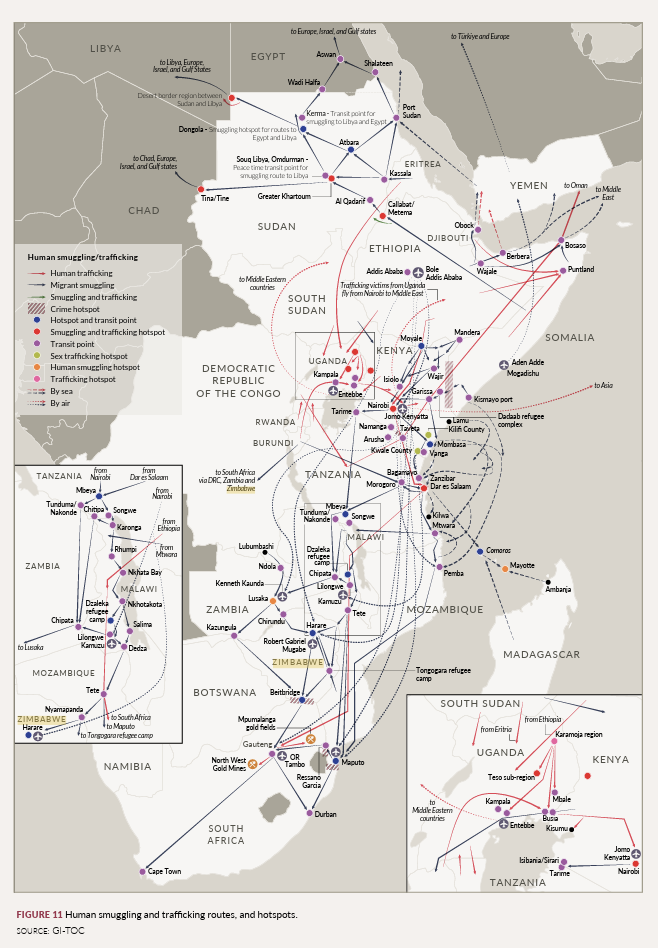
At Chirundu (on the Zambia border), Forbes (near Mozambique) and Plumtree (near Botswana), porous borders and limited oversight from authorities create a gap filled in by illicit activities characterized by intimidation and violence.
On these trafficking routes, migrants overlap and share space with cocaine, heroin, ivory, and pangolins--an endangered mammal that is among the most trafficked in the world.
For many migrants, Zimbabwe is a high-risk transit zone to South Africa but also other potentially onward routes, stretching as far as Europe.
The heroin trade
Kenya too, say researchers at GICT, is not only a stopping point on this southern route, but also has its own direct links to countries in Europe (Ireland) and the United Kingdom. The transport of one illicit good, like heroin, is also facilitating money and interest for the conveyance of other goods too, including people.
Much of the global heroin trade comes into ports in Kenya and Tanzania from Afghanistan and other places in Asia. Once there, it is divided up for two separate markets. The local African one, and an even more lucrative one in Ireland and the UK. Previously, the heroin bound for the UK and Europe would have made its way via the sea towards European shipping lanes, but because of unrest in the Middle East, much of it is now going first along the southern route think researchers, and then on towards the UK.
Other shipments might make their way across land to West African ports, and then be loaded up there towards Europe and Britain, before sometimes being loaded on to private vessels or picked up at sea by fishing vessels. According to informants, corruption and poverty help gangs move their goods across some of these borders, where some officials might be bribeable to look away. One informant working in South Africa told researchers: "It was easy to pay them to look away, and we could bring anything across – guns, cocaine, anything!"
Cocaine and migrants via West Africa to Spain and Italy
Heroin and other drugs are just one illicit trade that is worth billions worldwide and is lining the pockets of huge networks of criminals on a global scale. Once crime gangs have found a successful way of transporting one type of goods across borders, they will often expand to include others too.
A report by the Italian news weekly L'Espresso in October 2025 found, that cocaine is increasingly being transported from Latin America across the Atlantic to West Africa, and then on via Spain's Canary Islands towards Italy and the rest of Europe. Much of this trade has been "restructured" in recent years, reported L'Espresso, after numerous Italian investigations broke up some of the hold the Italian organized crime gangs working out of Calabria under the name of 'Ndrangheta had previously had on the cocaine trade.
Now, continued the L'Espresso report, much of the trade is being operated by "narcotraffickers" and "narco Jidhadists." They have turned West Africa into a new logistic hub, and are often transporting migrants on top of the cocaine shipments hidden in containers and lorries, claimed the Italian news weekly.
Since the grip of the Calabrian gangs was loosened, writes L'Espresso, gangs from Montenegro are thought to have moved in on activities as well. Although these gangs also use large containers via the Canary Islands when they can, they are believed to have turned to more road routes too, often sharing space with migrants on lorries traveling northwards through the Sahel, writes L'Espresso journalist Michele Bollino. This traffic, of people and illicit goods, which necessitates huge bribes at borders and while passing through groups controlled by various militias, contributes to a "vicious circle of instability," state experts at the UN. The instability favors the expansion of narco traffickers, which provides Jihadist groups with the funds to continue their control of these areas, which then expands the conflict and instability, allowing the goods to move more freely along the routes.
Once past the Sahel, the drugs and migrants are transferred via Libya, Morocco and Algeria on smaller boats towards Europe, where the clans working for the 'Ndrangheta remain in control of much of Italy and the onward passage northwards through Europe.
Read AlsoIncrease in migrant deaths highlights rising dangers of Mediterranean route
The 'Southern Route'
A landlocked area in Southern Africa, Zimbabwe, sits at the center of "regional mobility networks" that form part of the broader of what the GICT report dubbed the "southern route," a migration pathway that begins in the Horn of Africa and extends thousands of kilometers southwards.
People on the move, usually from Ethiopia and Somalia, travel through Kenya, Tanzania, Malawi, Zambia, and Mozambique before reaching Zimbabwe and ultimately South Africa. People from the Democratic Republic of Congo, Rwanda, Burundi, and Sudan also often reportedly travel this route.
While South Africa was identified as the main endpoint, many people stop along the way, with Kenya serving as both a major destination and transit hub for a large proportion of East African migrants. Others continue south, drawn by South Africa’s longstanding demand for migrant labor, particularly in informal sectors and agriculture. The route is considered less deadly than the Sahara or Mediterranean crossings.

However, it is far from safe. Detention, exploitation, and abuse are widely reported, and the overwhelming majority of migrants rely on smuggling networks to move across borders and linguistic regions.
In some coastal stretches, particularly between Tanzania and Mozambique, sea crossings using dhows link human smuggling with drug trafficking routes. Despite its dangers, the southern route remains a vital artery for mobility in Africa, shaped by a combination of economic pressures, conflict, climate shocks, and the enduring pull of opportunity further south and, for some, beyond the continent.
The convergence of illicit trade, criminality and migration are a toxic mix which are destabilizing large regions across Africa, say the GICT report authors. And this instability is in turn feeding off and fueling even more migration and even more criminality.
Read AlsoThe Netherlands: Eritrean trafficker sentenced to 20 years in prison in unprecedented case
Route switching
The GICT report tracks how journeys toward Europe from this region rarely follow a single, direct path. Instead, they are characterized by route switching, meaning migrants adjust their trajectories to adapt to cost, laxity of security measures, and available opportunities.
Tracing the path of people movement on the African continent, GICT cited how many migrants from the Horn of Africa, particularly from Ethiopia and Somalia, initially travel east or southwards passing through countries such as Tanzania, Mozambique, and Zimbabwe before reaching South Africa.
After arriving in southern Africa, migrants may later re-route toward Europe-bound pathways, including traveling north once again toward Libya and attempting the Mediterranean crossing, or using irregular and semi-regular air routes to move further afield.
In this context, Zimbabwe’s geographical role is best understood as fluid and non-linear within a longer migration chain that can, in some cases, extend as far as Europe.
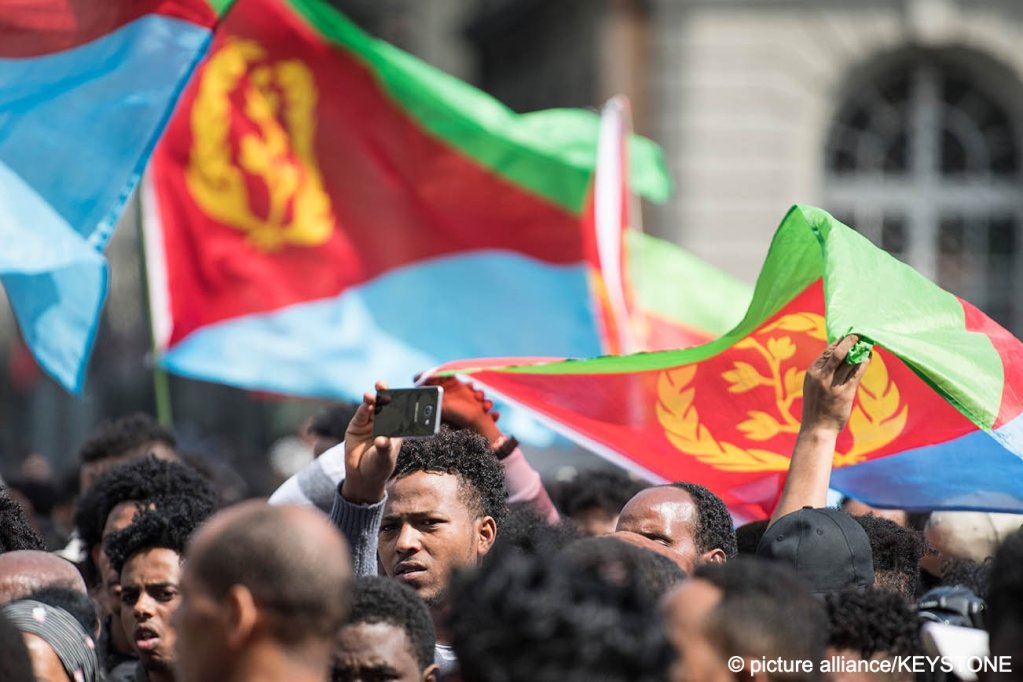
This tracking is represented in the rising numbers of Eritrean, Ethiopian, and Sudanese migrants arriving in EU countries. This points to the same populations who used to be more often found using southern routes are now also often on the Europe-bound pathways.
Official data show that in 2025, Eritrean nationals ranked as the second highest number of people coming to the UK, following Pakistan.
In parallel, overall asylum applications in the EU showed that there were 2,345 asylum applications from unaccompanied minors recorded as Eritrean nationals in 2025. Again, the African country came in second, this time behind Afghanistan for the greatest number of unaccompanied minors applying for asylum in Europe.
Between January and November 2025, 12,684 migrants and refugees from Sudan arrived in Europe by sea and by land, indicating a three-fold increase compared to the same period in the previous year.
At the core of this movement are transnational smuggling networks, which operate across regions and provide logistical support that enable migrants to shift between routes.
Read AlsoMigrants from Africa brave deadly Canary Islands crossing
Mostly young men
The International Organization for Migration’s Zimbabwe Country Strategy 2026–2027 provides details of people moving through the Southern Route, which includes Zimbabwe.
Here, Zimbabwe is simultaneously a country of transit, destination, and origin. The country also receives migrants from neighboring countries such as Mozambique, Zambia, and Malawi.
In 2024, there were a recorded 429,000 migrants in Zimbabwe, 54 percent of whom were male and 47 percent female. Among the men, the demographic breakdown shows that 24 percent were between 18-29 years old, 29 percent were between 30-39, and 30 percent were between 40-49 years old. Men reportedly tend to travel through these informal corridors more frequently, while women tend to move through safer or more discreet pathways.
Youth unemployment was cited as a key driver of movement, whether within the region or beyond. An estimated 3.29 million people are in informal employment, which often translates to livelihoods that offer little to no stability and social protections.
The IOM report underscored the complexity of Zimbabwe’s role as a country of origin, transit, and destination within a wider but interconnected regional system.