
The Sinag Himig Chorale London recently performed in Rome, bringing their voices to an international stage. Research from Leeds Beckett University has shown that community choirs can create a shared space of trust and understanding between migrants and local populations. Something that these singers say has helped them.
When Mickey Javelona left the Philippines 11 years ago, he left behind the only family he had ever known. His mother, Editha, was widowed when he was just six years old and had never remarried.
"It was always just the two of us," Javelona told InfoMigrants.
By then, Editha was 60, and her health was becoming fragile. Javelona knew that staying in the Philippines could not offer the security he needed to take care of his mother.
"I was only earning about 7,000 Philippine Peso (equivalent then to around 100 euros) a month as a nurse in the southern Philippines," he said.

About six months after he moved to the United Kingdom, Editha was diagnosed with stage 4 uterine cancer.
Javelona sent home everything he could earn to cover the litany of treatments that ran from chemotherapy to radiation. No amount would be too big if it meant making his mother better.
From thousands of miles away, Javelona worked long shifts in an elderly ward, caring for patients in their most vulnerable moments, performing the most intimate tasks of bathing them and feeding them.
It was exhausting work, and for Javelona, thinking of his mother in the Philippines, very emotional.
It was singing that eased the quiet irony of caring for others while being unable to care for his own mother. It was through song that he found a way to bridge the distance.
Healing melodies
Javelona’s patients would often ask him to sing songs reminiscent of their youth, such as "Only You" by The Platters or songs by Bill Withers. But it was when they requested music by The Carpenters that brought him closest to home.
"My mom can’t sing, but she knows all The Carpenters songs by heart!" quipped Javelona.
Mickey Javelona, a Filipino migrant nurse in the UK, is also a solo tenor for the Sinag Himig Chorale London | Courtesy of Sinag Himig Chorale London
Javelona inherited his voice from his father, and melody became a connection to a parent he had lost early on. As a young professional finding his way in a foreign country, music became the thread that held them all together, allowing him to hold on to both of his parents at once.
For many migrants like Javelona, singing is both a salve and a way to release emotions that words alone cannot carry.
Music is also what eventually led him to be the tenor soloist of the Sinag Himig Chorale London.
Migrant voices
Founded in 2021, the Sinag Himig Chorale London brings together Filipino migrants in London through music blanketed in faith and heritage. More than a performance group, it has become a space where members reconnect with their identity while building new lives abroad.
Recently, the chorale performed in the Basilica di Santa Pudenziana in Rome, bringing their voices to an international stage. At their concert, "Woven: A Tapestry of Faith and Music," the choir sang sacred hymns in English and in Filipino.
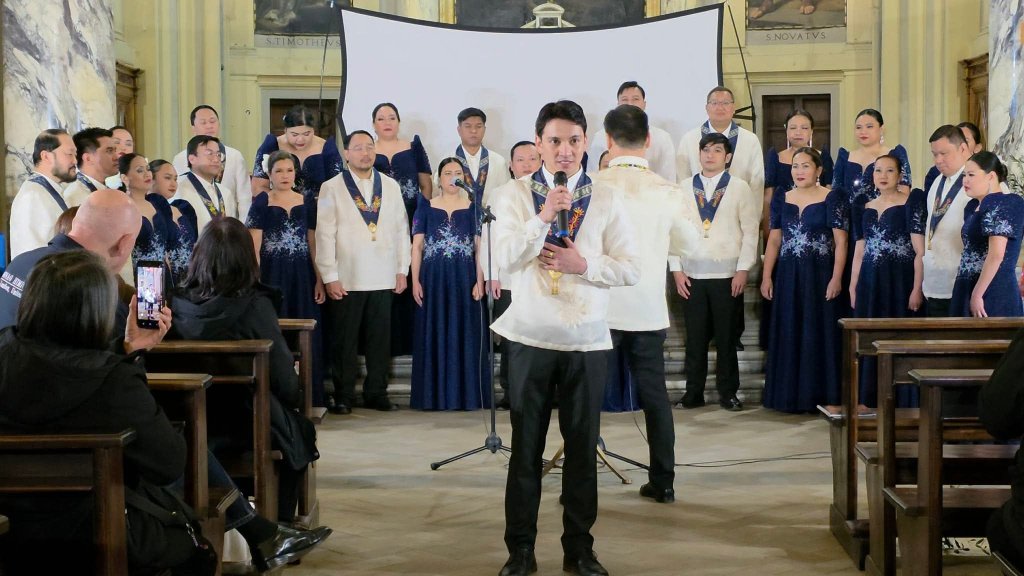
The concert also included a mass book composed by Nikko Oliver Villanueva dedicated to Saint Lorenzo Ruiz, who is said to be recognized as among the first Filipino migrant workers because of his evangelical work that brought him all over the world.
For many members, the performance was more than an artistic milestone. It was a moment of recognition and proof that their journeys, often marked by sacrifice and separation, could also create something beautiful and shared.
"All of our choir members are migrants, but from different professions. Some are nurses, some are nannies, some are accountants," Chi De Dios, choir manager of Sinag Himig Choraale London, told InfoMigrants.
But they are all committed to singing as a way to connect with others and bridge their lives at home and the one they are making in their adopted country. Some come in from different parts of the UK, traveling from as far as Kent, Birmingham or even Wales to attend the weekly practices in London to prepare for concerts and performances.
Giving back
Like Javelona, De Dios also arrived in the UK alone. "All I had was 20 kilos of luggage," she recalled.
An operating room nurse by profession, De Dios began singing in the Church choir back home in the Philippines. When she passed her nursing board exam, she made her own vow as an act of gratitude.
"I told God, 'I promise that I would never stop singing for your glory,'" shared De Dios.
When the COVID-19 pandemic hit, the church that had been her refuge for years struggled. With no congregation attending services, donations dwindled.
"It was my shelter all my life, and now it needed help." De Dios, together with Jarom Pinlac, founded Sinag Himig Chorale London.
What began as a response to a crisis grew into a community. The group performs concerts to raise funds for the church, sometimes collecting as much as 5,000 British pounds for their parish in Hammersmith. They have also extended their efforts back home, organizing benefit performances for disaster relief in the Philippines.
Collective music making
Across Europe, similar groups are emerging as spaces where migrants and refugees rebuild their sense of belonging.
Citizens of the World, comprising refugees and local residents has performed at famed UK venues and events that include Glastonbury, the Barbican, and Buckingham Palace. The Sheffield One World Choir promotes cultural awareness by sharing songs from members' countries and traditions. Meanwhile, another Filipino choir, Haraya, has won many awards and competitions.

Organizations like Musicians Without Borders have highlighted how collective music-making creates connection and strengthens empathy. In divided communities, music, whether played or sung in the community, can bring people together.
Together with the Leeds Beckett University, Musicians Without Borders has held training opportunities for people working across music and performing arts, to equip them to collaborate with people who have migrated, been forcibly displaced or hold refugee status. The research has also shown that community choirs can foster trust and understanding between migrants and local populations, creating shared spaces where differences are softened through collaboration.
For migrants navigating unfamiliar cultures and distances from home, these choirs offer a simple yet profoundly comforting connection. A metaphorical umbilical cord that keeps loved ones close until they meet again.
For Javelona, that is every year in June when he goes to the Philippines to visit his mother Editha, who has since recovered from cancer. "I have never missed her birthday since I moved abroad -- just once during COVID."
"Distance deepens the love from where you came from. Communities like the Sinag Himig Chorale London are our extensions of our families back home," concluded De Dios.