
For the first time in years, Italy, which was at the forefront of Europe's general demographic decline, has reported that its population has remained largely stable over the last year. But, as more and more European countries struggle with declining birth rates, ageing populations and shrinking workforces, researchers are asking themselves whether babies or migration could best help re-balance Europe's demographic equation?
For the first time in 12 years, Italy’s population decline has stabilized. Italy was once at the forefront of Europe's general demographic decline, but migration to the country in recent years appears to be offering it a path out of that decline.
Official data from the Italian Statistics Bureau (ISTAT) indicate that the country's resident population remained at 58.94 million on January 1 this year, virtually unchanged from a year earlier.
But despite the stable results, "Italy remains a country where only very positive net migration can offset a largely negative natural change and where the population continues to age," commented ISTAT.
The equation is more complicated than that though think some researchers. Andrea Bassanini, a senior researcher at the Organization for Economic Cooperation and Development (OECD), recently wrote an article for the Center for European Policy Research (CEPR) in which he said that the argument was not simply a question of pitting migrants against more babies being born.

Speaking to InfoMigrants, Bassanini said to understand the underlying economic and social implications, other demographic factors such as birth and death rates, as well as the working-age population, need to be taken into consideration.
"Net migration stabilizes the overall population. Yet, the working-age population is shrinking, and it has been shrinking for a few years. At the same time, fertility is still decreasing, making population ageing problematic both in the short and in the long-run," Bassanini explained.
"More decisive actions on several levels would be required to improve the situation," thinks Bassanini.
Balancing Europe’s demographic equation
Italy's demographics highlight how many European countries are struggling to manage the effects of a "demographic winter" characterized by low fertility and aging populations, both contributing to a shrinking workforce.
With migration being a contentious topic, policymakers are debating whether the solution lies instead in boosting fertility or managing migration.

To this end, many EU countries have begun to offer financial incentives to encourage people to have more children. Hungary, Poland, and France have implemented financial incentives that include income tax exemptions, universal child benefits, and family allowances. Greece introduced a Childbirth Benefit in 2020, giving 2,000 euros for every child born and allocating an estimated annual budget of 170 million euros to fund this social welfare benefit.
Italy's births dropped to 355,000 in 2025, down 3.9 percent from the previous year. The number represents a new record low since the country's unification in 1861. Like its European neighbors, the country has turned to economic incentives to cushion the financial burden of raising a family.
The Italian way
Italy has the Assegno Unico e Universale (Universal Child Allowance), which gives a monthly allowance for children under the age of 21 and without age limits for dependent disabled children. Parallel to this, as one of the countries that geographically stands guard at Europe's external borders, Italy has seen a disproportionate number of irregular arrivals. Taking a hard-line stance has been the centerpiece of the government's policies on migration and asylum.
However, achieving a demographic balance is more than just offering financial incentives or restricting migration. According to Bassanini, interventions that lie in balancing both birth rates and migration are key.
"Without reversing the decline of fertility rates, the country risks paying a price in the long run. Reversing the hard-lined migration policy, at least as regards labor migration, would be an alternative consistent with pro-fertility policies," said Bassanini.

It is a strategy that the government in part seems to have taken on board. Since coming to power at the end of 2022, Italy's government under Giorgia Meloni has continuously expressed hardline policies towards migration but has also sought to open up more legal routes into the country.
Italy has signed memorandums of understanding with countries like Bangladesh, to increase the numbers of legal routes into the country and has increased the quotas of seasonal work permits offered under its tri-annual "decreto flussi" (flows decree), which is meant to regulate how many seasonal workers can access jobs each year.
Organizations like the Italian Business Association (Confindustria) have also spoken out frequently about the need to train and fill jobs to keep the Italian economy on track. Some associations, like that in Milan have even started up their own programs to try and prepare more migrants for specific jobs needed in the Italian workforce.
Read AlsoItaly: 'New migration rules will not affect unaccompanied minors'
Managing the 'demographic debt'
Bassanini also explained that increasing fertility comes with a hidden cost he calls the "demographic debt."
A demographic debt occurs when the number of people linked to an increase in birth rate grows faster than the number of workers. "New babies today won’t enter the labor market for 20 years. In the meantime, there are more consumers relying on fewer workers, which can dampen GDP per capita (defined as) the level of resources available to each consumer," Bassanini explained.
Also noteworthy is that the negative effects on GDP per capita last longer than 20 years.

Citing an example to illustrate this point, Bassanini said, "Suppose that I can put in place a policy yielding 1,000 more babies every year. After 20 years, there will be 20,000 more consumers between the ages of 0-19 than without my policy and no additional workers. After 21 years, there will be 1,000 more workers (aged 20) but 21,000 more consumers (aged 0-20)."
This translates to an imbalance of having more consumers than workers that would compound for many years. By simple calculation, Bassanini's example suggests that it would take almost 50 years to get the first dividends of a policy that puts its emphasis on encouraging an increase in fertility rates.
"The problem is to avoid that greater fertility results in lower employment," said Bassanini.
However, he stressed that the OECD research does not negate or oppose government interventions meant to increase the birth rate.
"Fertility policies do not have to reduce female workforce participation. Adequate childcare and early education can allow parents to remain in the labor market. Yet, governments must carefully design policies to avoid reducing employment while supporting families. a balance that may also require selective labor migration to cover short-term workforce gaps," said Bassanini.
The cost of increased fertility policies could be offset by labor migration.
Read AlsoMigration in 2025 – the year in pictures
Attracting labor migrants and convincing them to stay
Bassanini’s OECD study shows that raising net migration to 0.61 percent of the population by 2030 could nearly offset the short-term impact of higher fertility on labor markets.
However, implementing such a policy means more than encouraging high-skilled workers to arrive. Countries must also retain migrants, integrate refugees and asylum seekers into the workforce, and recognize foreign qualifications.
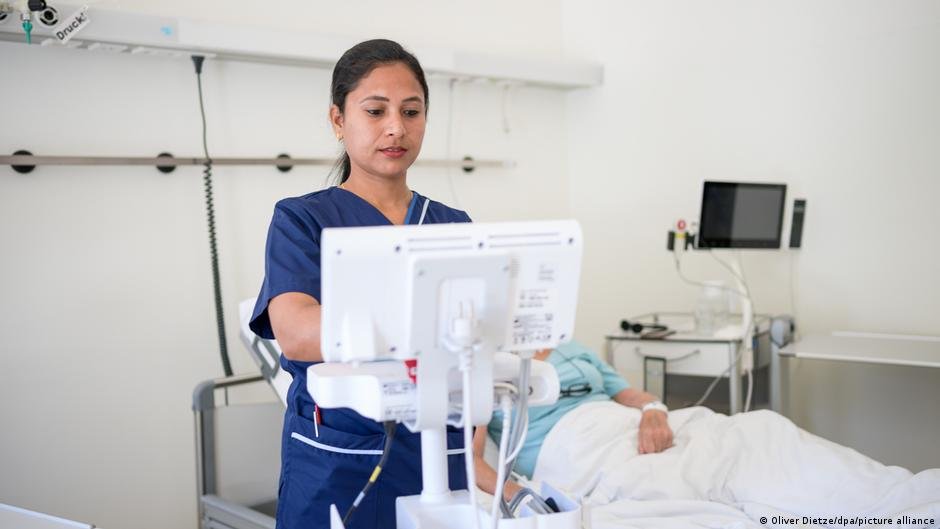
Germany, for example, is aggressively recruiting foreign workers to plug gaps in its workforce. However, a survey of 50,000 migrants ages 18 - 65, who moved to Germany, found that one in four was considering leaving. Attracting people to move but not convincing them to stay negates the economic benefit of immigration.
"Measures such as facilitating access to nationality, streamlining recognition of foreign qualifications, and easing labor market entry can make migration more effective," said Bassanini, referencing Spain as demonstrating the best immigration practices in action.
Read AlsoIntegration to emigration: Why do migrants leave Germany?
Spain: outlier among EU migration policies
In 2024, The Economist put the spotlight on Spain as the best-performing economy in the EU, attributing its growth to being "driven by a robust labor market and high levels of immigration, which mechanically boost economic production."
Foreign-born nationals account for 18.1 percent of Spain's total population. In the EU, Spain has emerged as an outlier, championing immigration not only from a humanitarian perspective but as an economic growth strategy.

Most recent developments in the country's migration policy include announcing an intention to regularize the status of 500,000 undocumented migrants already living in the country.
"Spain's policies to attract non-EU workers, regularize undocumented migrants, and simplify nationality access have reduced labor shortages in manufacturing to less than half the EU average and fueled rapid economic growth," said Bassanini.
Read AlsoSpain's new migrant regularization explained
Crushing demographic debt
In the long term, improving fertility rates translates to ensuring the sustainability of current living standards and effectively managing labor migration.
"Migrants are not an infinite pool. And many migrants remain only temporarily in the host country. But in the short and medium-term, when the problem of population ageing is worsening because of the massive retirement of baby boomers and Generation Xers, labor migration could be a useful solution," said Bassanini.
Crushing demographic debt requires short-term and long-term solutions. Interventions that encourage birth rates with accompanying support for childcare present gains in the long term. However, managing migration levels to complement fertility solutions should be studied and evaluated as a short-term intervention -- but only if countries can attract, integrate, and retain labor migrants effectively.
Read AlsoFrom north to south, Europe tightening migration policies