
Italian authorities have impounded the private search-and-rescue vessel Sea-Watch 5 after a daylong standoff off the Sicilian coast earlier in March. The private rescue group has condemned the decision and is expected to launch an appeal. NGO rescue missions are increasingly succeeding in taking Italian authorities to court over such cases.
The latest incident between Sea-Watch and Italian authorities comes after the Sea-Watch 5 rescued more than 90 people from distress in international waters two weeks ago.
According to a statement by Sea-Watch, released on March 30, the vessel was initially directed by Italian officials to sail to the distant port Marina di Carrara, located more than 1,100 kilometers away, in order to disembark the 93 migrants onboard — including 23 minors and a pregnant woman.
Highlighting the fact that there were multiple medical emergencies on board, the Sea-Watch 5 gradually headed towards a nearby port on the island of Sicily instead.
Following a three-day stand-off, Italian authorities agreed to accept to take in the nine medical emergencies among the 93 rescuees, as by that time they needed to be tended to as a matter of urgency; this included the case of a two-year-old child in life-threatening condition.
Sea-Watch also highlighted that upon nearing Sicily, the Sicilian juvenile court in Palermo ordered the immediate disembarkation of the 23 minors on board along with their families.
Sea-Watch believes that this court order further justified the captain's conviction after completing the rescue that heading towards Sicily had been the right course of action at the time.
Read AlsoSea-Watch 5 disembarks migrants in Sicily after Italian standoff
March 18: Sea-Watch 5 declares 'state of necessity'
However, once the minors and their families — as well as those with medical emergencies — were taken off the ship, Italian officials denied entry to the remaining survivors on board.
Instead, authorities once again instructed the Sea-Watch to set sail once more, reassigning the distant port of Marina di Carrara in northern Italy as its intended port of disembarkation.
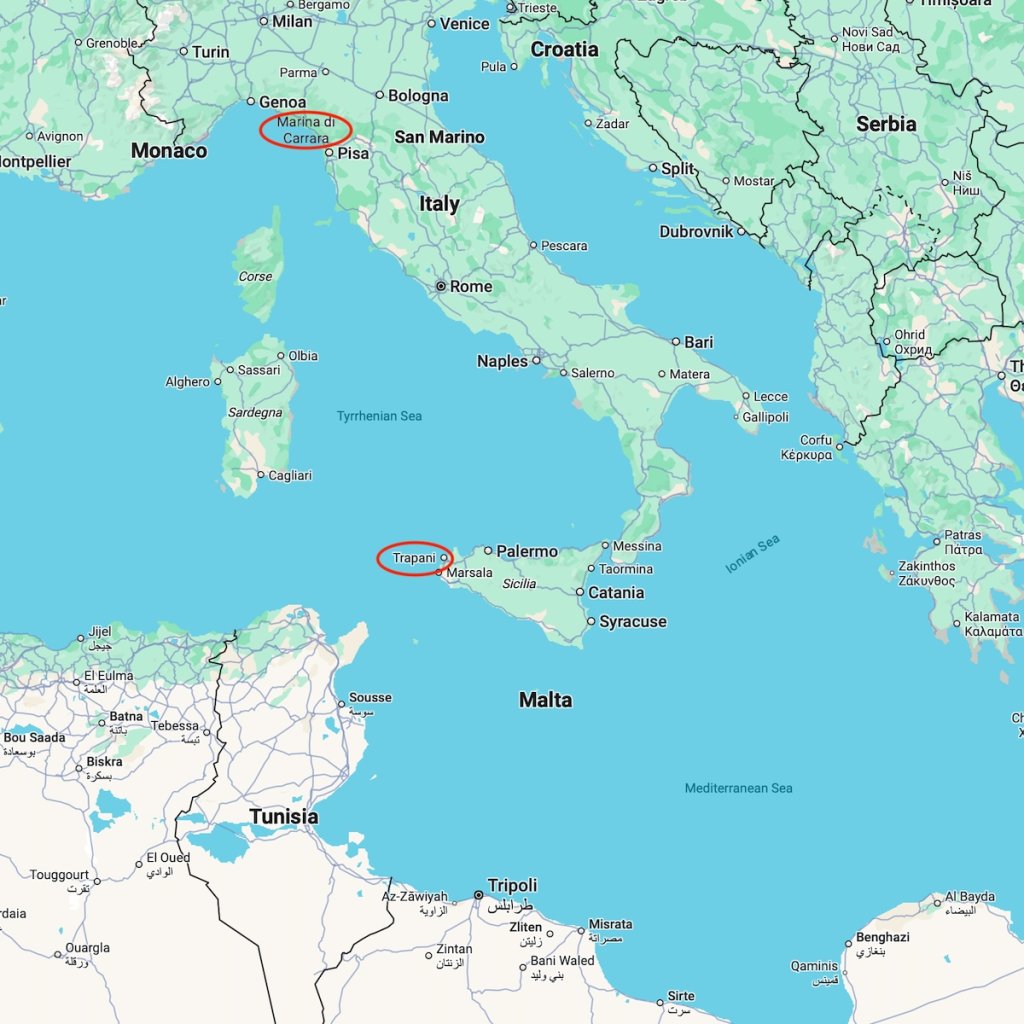
Amid adverse weather conditions, that 1,100-kilometer journey would have taken several days, Sea-Watch said, adding that after several days outside the Sicilian port of Trapani, the survivors on board had already been "suffering from seasickness, exhaustion, and fuel burns, which needed to be treated under proper clinical conditions."
The crew thus decided to defy orders, which Sea-Watch in a statement issued at the time referred to as "absurd," with the captain of the vessel declaring a "state of necessity" on March 18 in order to navigate the boat directly into the port of Trapani instead.
The charity stated that this is fully in line with European law, in order to safeguard the fundamental right to life.
Under international law, a state of necessity allows for such a breach to prevent greater harm.
Read AlsoInternational law and the criminalization of sea rescue
Sea-Watch: 'Administrative obstruction killing people at sea'
In response to this defiance of the original orders issued by Italian authorities, officials impounded the vessel and imposed a 20-day detention as well as issuing a penalty of 10,000 euros on Sea-Watch.
Sea-Watch has condemned the detention, saying it is a "predictable measure designed to sabotage civilian sea rescue operations," highlighting that this is not the first time that the NGO's rescue vessel has been impounded.
Most recently, the Sea-Watch 5 was impounded for similar reasons in January, but succeeded in having the court order annulled during appeals.
Read AlsoGovernment will challenge Sea-Watch rulings, Italian minister says
Sea-Watch Spokesperson Bana Mahmood said that such administrative measures are "not about enforcing rules but about deliberately creating new mechanisms with the aim to detain and immobilise sea rescue ships."
"Administrative obstruction is killing people at sea," she added.
Sea-Watch further denounced the original directive to sail to Marina di Carrara as a form of "state torture" and a "cynical and inhumane political calculation."
Read AlsoItaly: Courts issue back-to-back rulings in favor of Sea Watch migrant rescue organization
Three years in, Piantedosi decree remains divisive
The original order to sail to a distant port was based on the so-called Piantedosi Decree introduced three years ago, named after Italian Interior Minister Matteo Piantedosi.
Under the legal measure, Italian authorities are able to assign a port for disembarkation. Italian authorities claim this is to avoid overloading one particular place with continual arrivals. The south of Italy, which is located much nearer the rescue spot, is also generally economically much poorer and lacks infrastructure, compared to richer regions in the north.
However, sea rescue organizations claim this measure is designed solely to obstruct their work and slow down the numbers of people they can rescue. By forcing these ships to travel for days, sometimes even weeks, they hope to ensure that their operational scope is curtailed, limiting the amount of the time they get to spend in the central Mediterranean.
Furthermore, the decree limits each mission to one rescue, prohibiting such NGO vessels from picking up other migrants along the way.

Read AlsoCentral Mediterranean: Number of rescued migrants halved by Piantedosi legislation – MSF
Interior Minister Piantedosi has repeatedly defended his controversial twin measures of decree against critics who say that the law is costing lives at sea by claiming that charity operators like Sea-Watch have effectively become migrant taxis — incentivising smugglers in North Africa to take people to the central Mediterranean and dumping them there in the hope of being rescued.
In Piantedosi's view, limiting the operational capabilities of groups like Sea-Watch helps to break the business model of smuggling rings and thus helps save lives.
Sea-Watch, however, disagrees with that assessment: "Crews are confronted with instructions that are incompatible with international law and humanitarian obligations. Compliance would endanger both rescued individuals and crew members; refusal, in turn, leads to sanctions," the NGO said in a statement.
Read AlsoFrom courtroom to coast guard: Europe's legal debate over regulating humanitarian aid at its borders
Sea rescue organizations join hands
Various civilian rescue groups like Sea-Watch joined forces as an alliance known as the "Justice Fleet" in November 2025.
The Justice Fleet alliance includes similar organizations like Mediterranea Saving Humans, Mission Lifeline, Sea-Eye. SOS Humanity, MSF as well as several others, who have all agreed to refuse to comply with orders by authorities that they say would place them in conflict with international conventions and human rights obligations.
Together, they pursue legal action against detention orders of vessels — with a moderate rate of success.
Read AlsoNGO ship 'disobeys' authorities, takes rescued migrants to Sicily
On March 30, an Italian court retroactively annulled an August 2024 detention order of another civilian rescue vessel, the Geo Barents, which is operated by the medical humanitarian organization Doctors Without Borders (MSF).
The Salerno court found the original detention order under the Piantedosi decree to have been unlawful, affirming that the MSF crew's conduct had been legitimate and in accordance with international and national law.
"This is another ruling that reaffirms the duty to save lives at sea and highlights the Italian authorities' systematic obstruction of humanitarian search and rescue operations in the central Mediterranean," said MSF head of mission Juan Matias Gil.
Read AlsoItaly: SOS Humanity ship detained again amid growing tensions over Mediterranean rescues
Death rate in Mediterranean escalating
The Mediterranean Sea remains one of the deadliest migration routes globally.
According to the International Organization for Migration (IOM), nearly 700 people have died or gone missing on the central Mediterranean route to Italy since the start of 2026 alone.
This is more than double the figure recorded during the same period last year, which comes however amid an overall drop in crossing attempts.
This means that each crossing attempt has become far more dangerous compared to just one year ago.
One of the main reasons for this development are much tighter border controls in North Africa, after the European Union and some of its member states signed multiple agreements with the governments of Libya, Egypt and Tunisia to curb departures.
This has pushed smugglers to shift migrants on longer and more dangerous routes.
Meanwhile, the true number of migrant deaths in the Mediterranean Sea is believed to be notably higher than official figures shared by organizations like the IOM, as many cases remain unreported.
Read AlsoIncrease in migrant deaths highlights rising dangers of Mediterranean route