
Sweden's restrictive migration policies are exacerbating the healthcare sector's critical labor shortage, which heavily depends on foreign-born professionals to meet staffing needs. This has put pressure on the government to ease restrictions on skilled workers.
Sweden appears to have U-turned on some of its harsh migration measures, after media reports that the country's health care system is facing significant shortages due to the deportation of foreign health care workers.
Sweden's Deputy Prime Minister Ebba Busch acknowledged the "disproportionate consequences" on the health care sector, leading the Migration Agency to pause new deportation orders pending the new rules, though existing orders remain enforceable.
Sweden heavily relies on foreign workers especially in the healthcare sector. More than 27 percent of active doctors in Sweden were trained abroad, a figure likely to rise due to limited domestic medical school places, as the country produces fewer physicians than demand requires. Immigrants now account for over half of healthcare assistants (53 percent) and 37 percent of assistant nurses.

2026 | Photo: Virginia Mayo/AP Photo/picture alliance
The Swedish government also announced some administrative changes to control the resulting outflow of skilled workers. The salary threshold for a work permit is being reduced for specific in-demand healthcare and nursing roles, while also eliminating the need for asylum-seekers-turned-labor migrants to return home for permit extensions via the "track change" (sporbyte in Swedish) pathway.
The sporbyte allows rejected asylum-seekers to switch to work permits if they find qualifying jobs, without having to travel to their home countries to seek extensions for their permits. Previously until April 2025, they could do this from Sweden but this process was abolished under the new regulations, sparking deportations of vital foreign workers.
Read AlsoSweden to raise hurdles to gaining citizenship
Pause on deportation of skilled labor
While the Migration Agency has temporarily put fresh deportation decisions on hold, the agency's head of press Jesper Tengroth told Brussels based publication Euractiv, that those with existing orders must still depart.
However, Johan Kaarme, a paediatrician and head of health and social care at the Swedish Association of Local Authorities and Regions (SKR) speaking to Euractiv, warned of lingering uncertainties in the reform package, putting pressure on healthcare workers stating "there are still many unknown factors in the new package of changes."
Sweden has grappled with shortages of specialist doctors and nurses for years, increasingly turning abroad for support. "Over the last ten years, Sweden has benefited from a valuable influx of close to 4,000 foreign doctors, 2,000 nurses, and 33,000 assistant nurses," Kaarme told Euractiv.
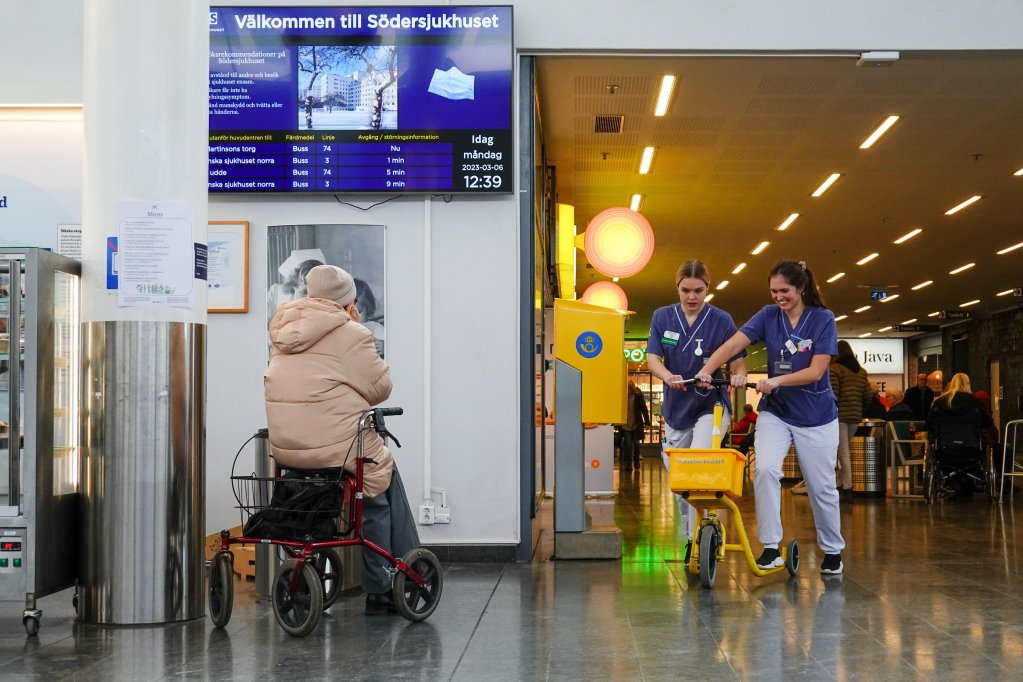
Hospitals have adapted with English-speaking environments, integration support, language courses, and competitive pay -- up to SEK 900,000 (80,400 euros) annually at Karolinska University Hospital -- targeting needs in elderly care, ICUs (Intensive Care Units), psychiatry, and more across its main urban areas.
The country's unions have repeatedly warned of dependence on overseas healthcare staff, advocating for stronger domestic workforce strategies rather than solely relying on international recruitment.
Sweden is not alone in its dependency on foreign labor, EU neighbors like Ireland are also relying heavily on overseas recruitment (43 percent foreign doctors and over 50 percent nurses), these include mainly non-EU nationals from India, Pakistan, The Philippines and Sudan. By contrast, the Netherlands has taken a different approach, where foreign doctors only make up around three percent, with the country relying heavily on training and retaining its healthcare staff.
Read AlsoDenmark, Sweden: Stricter immigration policies lead to historic low migration
Critical labor shortage
Europe faces a projected 950,000 healthcare worker shortage by 2030, accordingto WHO data -- with Sweden acutely exposed. The country's gaps stem from too few domestic medical school places, fragmented regional planning, increasing elderly care needs from an aging society. EU free movement allowed for quick hires from both EU (e.g. Poland) and non EU states and this has proved to be a cheaper stopgap than implementing major education reforms.
Currently the salary requirement for obtaining a work permit in Sweden is 2,770 euros per month, but as of June 1, it will rise to 2,850 euros per month. Healthcare and nursing professions are expected to be exempt from this increase, along with other in-demand jobs in Sweden.
Kaarme supports the exemption, but he fears that the measures will nonetheless deter more healthcare workers from coming to Sweden.
Although Mario González Estrada, President of the International Doctors Association (IFL) of Sweden, also welcomed the pause, he noted that there will be long term consequences to Sweden’s stricter migration policy, making the country less attractive to skilled workers. "Unfortunately, for many international doctors, the migration process is perceived as an obstacle rather than a gateway into the Swedish health care system."
According to a new report by Sweden's National Board of Health and Welfare (Socialstyrelsen), a further 50,000 employees are needed to work inside Sweden's elderly care sector by 2030, in order to meet the growing challenge of the country's aging population.
This poses a challenge for the care sector where roles are poorly paid and it is increasingly difficult to recruit staff, half of whom are foreign born. "The supply of skilled staff is one of the biggest issues facing elderly care," Björn Eriksson, Director General of Socialstyrelsen told Swedish Radio News in an interview.
Read AlsoSweden: New measures to encourage integration of migrants
Deportation figures unknown
So far, there are no exact figures for how many doctors, nurses, midwives, and assistant nurses were expelled last year.
After April 1, 2025, when "track changers" were required to apply for work permit renewals from their home countries, Swedish authorities issued about 650 deportation orders -- many targeting healthcare workers -- with two-thirds ultimately denied new permits.
Davood Javid, a senior consultant and specialist in internal medicine and cardiology at NU Healthcare in Trollhättan, 75 kilometers north of Gothenburg, has warned of a "slow drain on expertise."
"I now know of many international doctors who have been deported from Sweden after a track change," González Estrada whose organization represents a network of more than 2,000 international doctors, told Euractiv.
Even the ILF’s vice President was affected. "He was doing specialist training in family medicine and had been in Sweden for three years when he was expelled to Iran, and has not been allowed to come back."

Healthcare workers have also been impacted by the so-called "teen deportations" where children are deported once they turn 18, while their right to remain in Sweden is reassessed under Swedish family law. Javid's two grandchildren who were studying to become nurses, were deported to Iran last October.
In an opinion piece for the Swedish publication Dagens Nyheter, Javid wrote: "There is a perception that specialists will come here anyway, as Sweden offers a high standard of medical care and a good working environment. But in reality, competition is much stronger. Countries such as Germany, the Netherlands, and Canada are often seen as clear and predictable for families settling there long-term."
He added: "When uncertainty in Sweden is perceived as greater, we find ourselves at a disadvantage, even though many other factors work in our favor."
Read AlsoSweden halts deportations of teen migrants whose families remain
Overstretched and underpaid
President of the Swedish Association of Health Professionals, Sineva Ribeiro, said the deportations of health care staff have far reaching effects across the healthcare system, placing a heavier burden on other health workers.
"I am glad that the government finally responds to our requests, but I find it hard to comment on what the outcome of these promised changes will actually be," she told Euractiv.
If the current ruling parties win the general election, scheduled for September 2026, Sweden could still implement tougher migration rules with detrimental effects on the healthcare system.
A government inquiry proposes converting certain approved permanent residence permits into temporary ones to push migrants toward seeking Swedish citizenship, though most consulted bodies have rejected it and further review is underway. The Swedish Migration Agency estimates this would impact around 185,000 migrants.
Read AlsoSpain: Care sector looking to employ 160,000 newly regularized migrants