
The German Parliament has voted in favor of implementing the new Common European Asylum System and has agreed on toughening up its approach to irregular migration still further. The measures aim to speed up asylum procedures and the deportation of rejected applicants.
To implement the Common European Asylum System (CEAS) effectively, which will begin from June 12 this year, the EU is trying to make sure that the implementation across its member states is united and that all relevant laws needed for the implementation are also embedded in national law.
EU member states agreed on CEAS in May 2024. Each member state can implement the asylum system reforms in the way they best see fit, and that is why Germany’s governing coalition set aside today (February 27) to debate how to implement the new rules within Germany. By midday, they had passed two new laws to allow for a further toughening of migration policy.
One of the laws will be passed directly, and the second one will need a second vote in Germany’s other house, the Bundesrat, to pass fully.
The EU hopes that it can begin processing asylum applicants at the external borders. To do that, it would also need return centers situated outside the EU, where applicable, or within countries where no external borders are present, like in the case of Germany.
Here’s a breakdown of the main points of debate and how they might be implemented in Germany:
Restriction on movement
This is essentially aimed at reducing secondary migration within the EU. Anyone found to have moved from another EU country to Germany without permission could potentially be taken to one of the so-called Dublin centers in Germany, where they would, in theory, be sent back to the first EU country.

In these centers, asylum seekers might only be able to leave their accommodation during the day. Anyone who has already had their asylum application refused would possibly not be allowed out at all.
Under the new CEAS rules, asylum seekers could be subject to detention for the duration of their process. That is if there are questions over their identity or if there is a fear they may try and ‘disappear’ from the system to avoid any future deportation.
Read AlsoGermany: Court rules on secondary asylum applications
Border and airport asylum processes
Under CEAS, the EU is hoping to be able to process asylum applicants with limited possibility of staying in the EU more quickly. That is for instance speedier processes for people who come from a country with less than a 20 percent success rate in asylum applications. This will mostly affect people who come from a country on the Safe Country list.
Asylum processes for these people would be limited to 12 weeks.
In parallel with this speeded-up process, EU countries like Germany would also be looking to be able to send people directly back at the borders once they have been processed. Since Germany has no external EU borders, centers located close to airports would be set up so that people undergoing a speedy control would be able to be sent straight home if their application fails.
Read AlsoGermany: Top court rules deportation possible even for those holding protection in Greece
Dublin centers
In order to counter secondary migration, Germany and other EU states would be able to set up Dublin centers, so that anyone found to have already entered another EU state or lodged an application for asylum there could be sent back to the first country of application.
Germany already has several of these centers, although only very few people are sent there. The majority of Germany’s applications to return people via the Dublin process, to states such as Greece or Italy do not succeed, even though legally they have the right to do so.
Last year, according to Reuters, out of around 36,000 ‘Dublin cases’ only 5,300 people were actually sent back to the other EU country.
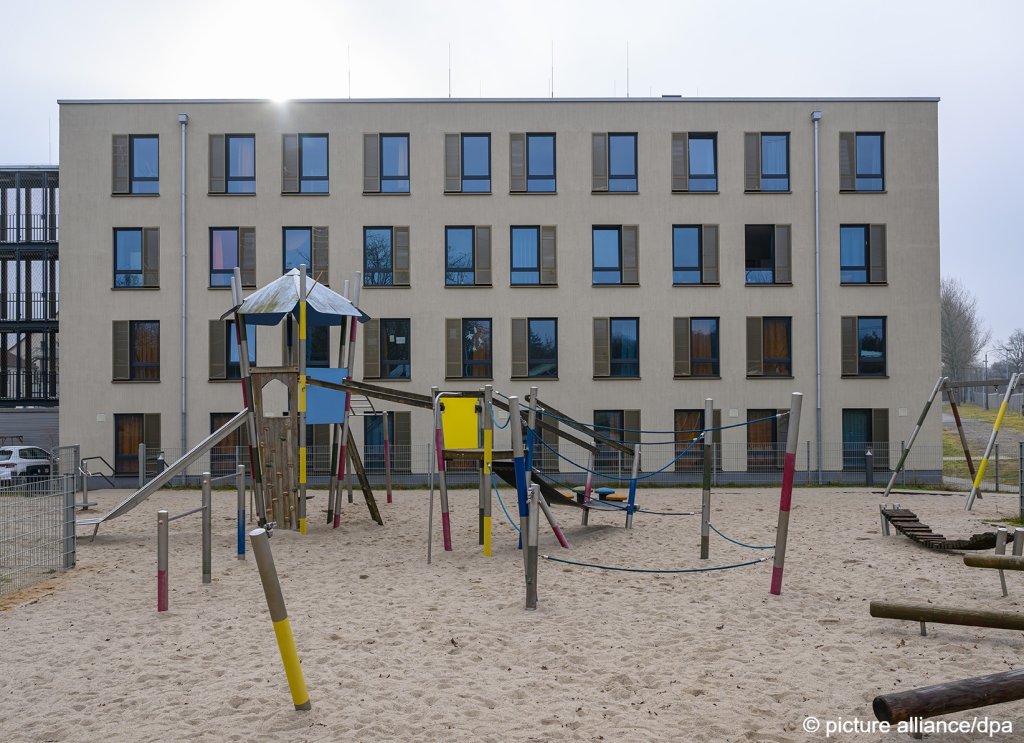
The government, which is made up of a coalition of conservatives and social democrats, with differing views on migration, debated to what extent the freedom of anyone in a Dublin center could legitimately be curtailed. They decided single adults could be detained for up to 24 months. Even their freedom in and around the center can be limited until it amounts to essentially detention.
For families with small children, mandatory stay at the centers cannot last longer than 12 months. This is split between six months to obtain a decision as to whether they will be sent back to their own country and a further six months for that order to be carried out.
Anyone who leaves the Dublin centers without permission would risk having their welfare support reduced to the absolute minimum needed for existence.
Under the new ‘solidarity mechanism’, the EU is hoping that a migration database will help with the registration and identification of asylum seekers across the bloc and would also speed up return processes to the EU state responsible for their application.
Read AlsoGermany to extend border checks by six months
Asylum seekers and work
In the future in Germany, asylum seekers should be able to begin work three months after filing their application. Until now, they had to wait at least six months before being allowed to work. The three months begin as soon as they have registered their desire to apply for asylum, not with the lodging of the application, which can take longer, as people have to gather certain documents needed for the process.
However, anyone who tries to falsify their identity will not be allowed to work.

Asylum seekers who have been refused but are still in Germany under a Duldung (suspension process) because it is logistically impossible to send them home will also be allowed to work.
However, those who come from one of the list of Safe Countries will not be allowed to work.
The German Employment Agency (Bundesagentur für Arbeit) has to approve any work application as before.
Read AlsoGermany: Plans for 'faster route to work' for asylum seekers
Medical support
From now on, migrant children and young people can expect a higher standard of medical care, at the level of Germany’s public health service. So, they won’t only be treated in the case of acute pain, as was previously the situation.
Any payment for medicine or equipment needed for their treatment will also be covered by the state.
Read AlsoGermany: Reduced benefits for Ukrainians who arrived after 31 March 2025
Criticism
Groups like Amnesty International and Pro Asyl have criticized the new reforms, saying they are against people’s basic human rights. In a joint statement, the two organizations said that the German government had taken the EU system and gone beyond what was needed from them.
"The German government appears to be taking what was an exceptional case and making it the rule, that is with regards to imprisoning those who are seeking protection from the very beginning," Amnesty and Pro Asyl said in the statement. The organizations added that the German state was removing people’s rights, isolating them and creating division against people who hadn’t committed any crime.

Clara Bünger from the left-wing Die Linke party in opposition, declared that she believed the new reform would bring "more chaos, sadness and a loss of rights" instead of more order to Germany, as German Interior Minister Alexander Dobrindt from the conservative CSU party has promised.
It has been reported in German newspapers that many members of the social democratic SPD party, part of the governing coalition, might have had problems voting through the reforms too, because their migration policies tended to be more left-wing than their conservative partners.
However, on Thursday, the CDU/CSU parties said they would be ready to vote through an SPD policy, known as the Tariftreugesetz, which stipulates that companies should only offer jobs, or buy products from tenders of companies that offer pay tariffs negotiated by the unions. In return for this concession, the CDU/CSU were able to get their migration reforms through, reported dpa.
With Reuters, AFP, dpa