
More than 70 civil society organizations are urging EU lawmakers to halt negotiations on the bloc’s proposed "Return Regulation", saying that the investigative measures will normalize and strengthen deportation raids. The European Commission told InfoMigrants that the proposal is in full respect of the Charter of Fundamental Rights and includes strong safeguards to protect rights in line with EU Treaty values and principles.
More than 70 civil society organizations are calling for a stop to the implementation of the European Union's “Return Regulation”, warning that vague provisions in the law give State authorities overarching powers to normalize immigration raids to escalate deportations across the continent.
The joint statement, initiated by the Platform for International Cooperation on Undocumented Migrants (PICUM) and Médecins du Monde, comes ahead of the European Parliament’s key vote on the Return Regulation in early March.
Speaking to InfoMigrants, Gianluca Cesaro, PICUM Senior Communications Manager, explained that ''investigative measures'' outlined in Article 23a, under a new disposition introduced by the EU Council in December 2025, 'encourages member states to carry out all necessary investigative measures, including searches in private homes and “other relevant premises”.
The exact provision states:
Without prejudice to investigative measures for other reasons not related to return in accordance with national law, the competent authorities of the Member States may, where necessary, proportionate and duly justified for the purpose of preparing or ensuring an effective return: a. search the third-country national and his or her place of residence or other relevant premises; b. search and seize personal belongings, electronic devices, and other items of relevance; c. impose other investigative measures, where provided for in national law. 2. Any investigative measures under paragraph 1, points (a)-(c), of this Article may be carried out without the consent of the third-country national concerned. 3. Any investigative measures imposed in accordance with paragraph 1, points (a)-(c), of this Article shall respect the fundamental rights and be subject to the safeguards and remedies provided for in Union and national law...
''The article is so vague and broad that it could encompass charity-run shelters and private homes of citizens 'suspected' of hosting an undocumented person,'' said Cesaro.
Read AlsoUK immigration raids hit record high as government targets illegal work
Endangering those without legal status
First proposed by the European Commission in March 2025, the EU Return Regulation aims to streamline deportations across the member states, including the possibility of transfers to centers outside the bloc. However, NGOs say amendments introduced by EU member states have strengthened punitive elements, including the controversial Article 23a, which they claim would allow home raids to locate undocumented migrants.
For Cesaro, the core issue is how the regulation could reshape daily life for people without legal status.
While the Commission’s text does not explicitly require immigration raids, Cesaro notes that it obliges member states to introduce broad and undefined "detection measures" to identify undocumented people.
"That could very well result in immigration raids," he said.
In several EU countries, Cesaro pointed out, such operations are already a reality. Enforcement actions have targeted transport hubs such as train stations and highways, as well as workplaces ranging from restaurants to car washes and nail salons.
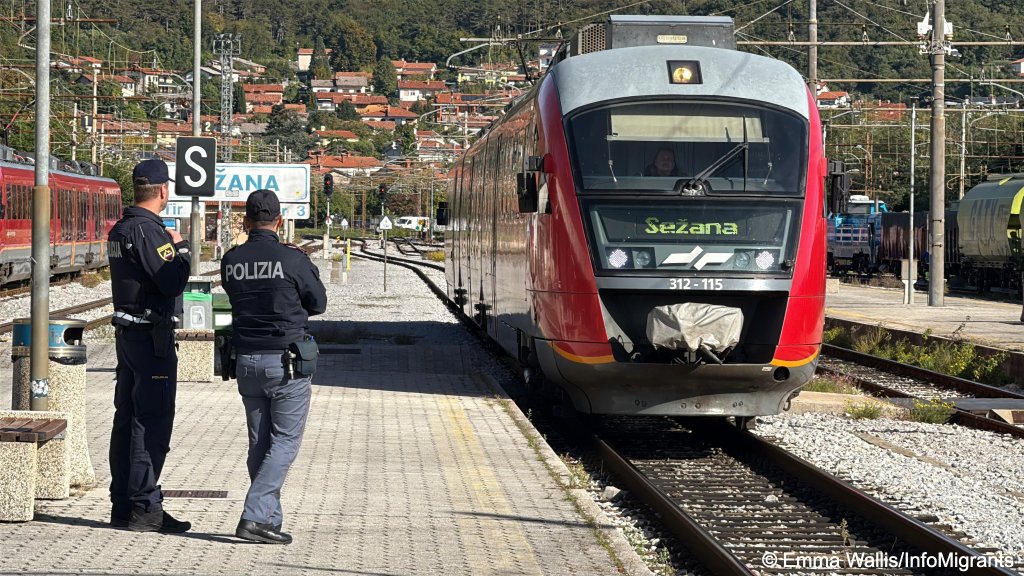
Recently in Ravenna, Italy, police raided a hospital amid a dispute over doctors’ refusal to medically validate immigration detention orders. In Belgium, the current right-wing government is considering plans to introduce home raids to search for undocumented people.
And in Belgium, the current right-wing government is considering plans to introduce home raids to search for undocumented people.
"We’re extremely concerned that the EU Return Regulation will normalize and strengthen these practices," Cesaro said, warning that raids could become commonplace "in more and more member states, and in more and more spaces."
EU response
Asked for comment by InfoMigrants, a spokesperson for the European Commission said that "The Commission proposal does not foresee an obligation for public services to report illegally-staying third country nationals. It does not foresee that national authorities should raid public and private spaces, conduct racial profiling, or strengthen invasive surveillance technologies."
"The fundamental rights of returnees must be protected through all steps of the return process, with clear procedural safeguards, including the prohibition of refoulement, and with due attention to vulnerable people and the best interests of the child," the spokesperson added.
At the same time, the spokesperson said, "For migration management to function effectively, it is important to limit abuse and absconding of returnees, which significantly affects the capacity to return irregular migrants. In this regard, the proposal foresees the possibility to request regular reporting to authorities, to reside at a specific address, or to stay in a certain geographical area. ... (I)n case of non-cooperation, authorities may impose certain measures such as a reduction or refusal of allowances or seizure of travel documents, which must always remain justified and proportionate."
Read AlsoEU races to speed up deportations in migration crackdown
ICE-like raids
Michele LeVoy, director of PICUM, referenced the measures outlined in Article 23a to draw parallels to controversial enforcement tactics elsewhere. "Immigration raids are not new in Europe. However, the EU 'Deportation' Regulation will expand and normalize racial profiling, policing of public services and ICE-like raids in public spaces, workplaces and even in private homes. We cannot be outraged by ICE in the United States while also supporting these practices in Europe," she said in a statement.
In response to InfoMigrants, the European Commission spokesperson emphasized that the regulation does not foresee an increase in unwarranted raids in public or private spaces, nor the disproportionate use of enforcement powers by authorities, racial profiling, or surveillance.
"As per the Commission proposal, all the principles and safeguards of the Charter and international law are to be followed and respected by Member States when applying EU rules on return."
"This includes in particular the principle of proportionality, the right to good administration, the right to an effective remedy and the prohibition of discrimination based on any ground such as race, colour, ethnic or social origin," according to the spokesperson.

Impact on public services
Another key concern for NGOs is the potential impact on public services. Advocates fear that detection measures could create pressure on service providers to share information with migration authorities, discouraging undocumented migrants from seeking healthcare, education or social support.
Andrea Soler Eslava, EU advocacy referent at Médecins du Monde’s international network, warned of serious public health consequences. "Recent events across the ocean show how laws that focus on detecting, detaining, and deporting people based on their immigration status have a real impact on people's health," she said in a statement.
“Pregnant women, children, and people with chronic illnesses simply avoid seeking essential health services, even in emergencies and when their lives are at risk. This is unacceptable,” Eslava said.
Read AlsoEU toughens up on illegal arrivals in new migration policy
Psychological toll
Beyond immediate access to services, NGOs say the psychological toll could be severe -- and personal.
Any policy that increases the risk of detention and deportation, Cesaro said, also increases vulnerability in personal relationships. “We already see how abusive partners and exploitative employers take advantage of this vulnerability to continue their abuses, knowing all too well that an undocumented person has few to no options to seek protection and justice.”
Concerns about the proposal have also been raised internationally. Sixteen UN human rights experts wrote to EU institutions in January, warning of human rights risks, including those potentially posed by Article 23a.
In its evaluation, the alliance of organizations asked the EU to explain safeguards in place to "ensure that detection measures do not amount to racial profiling and respect 'firewalls' between healthcare personnel, school authorities, and social services on the one hand, and authorities tasked with the enforcement of immigration rules on the other."
Additionally, the organizations asked for assurance that whistleblowers who report violations to the police would not have to fear detention.
On the subject of safeguards, the EC explained that the proposal "introduces a new right to information and counselling for the returnee, free legal assistance, clear rules on remedies and suspension of return, and safeguards for unaccompanied minors and families with children. A person cannot be forcibly returned without checking the risk of non-refoulement."
Community solidarity
Despite mounting pressure, undocumented migrants and their allies continue to organize. “Undocumented people have long been organizing and mobilizing to defend and advance their rights,” Cesaro said, pointing to multiple examples that include grassroots mobilization by undocumented migrants in Spain, which helped secure a mass regularization program. In Kampen, the Netherlands, a local church and community have supported an Uzbek family facing deportation for more than a year

“These are the kinds of collective efforts that strengthen our societies and democracies. They should be recognized, protected and enabled by public authorities, not discouraged or criminalized,” Cesaro concluded.
Read AlsoRefugees give back in Mauritania, working as firefighters to protect communities