
Since January 1, 2026, foreigners applying for a residence permit, resident card, or naturalization in France for the first time must pass a civic exam. InfoMigrants went to an exam center in the Paris suburbs to observe several of these tests.
"Good morning everyone. You're here to take the civic test to obtain a 10-year residency permit. Take your time, reread your answers, don't rush." It's 9.05 am on Saturday, February 14. The focused candidates smile gently in response to the encouraging message from Parisa Forootan, the examiner. A young man looks at a framed picture of the Arc de Triomphe hanging above his seat. "It's to get us in the 'France' mood," he says with a laugh.
Before leaving the exam room, Parisa Forootan says one last thing. "As I always say: I hope I never see you again and that you all pass. Good luck!"
Parisa smiles, closes the door, and comes to meet us. "I have to go back to supervise the exam, but I wanted to make it clear that cheating is impossible; each candidate takes a different test," she whispers. Parisa Forootan is the deputy director of ABC Formation in Saint-Ouen-l'Aumône, a suburb of Paris, one of the centers accredited by the Ministry of the Interior to administer these civic tests, now mandatory to obtain a first residence permit (multi-year card, resident card, or naturalization).
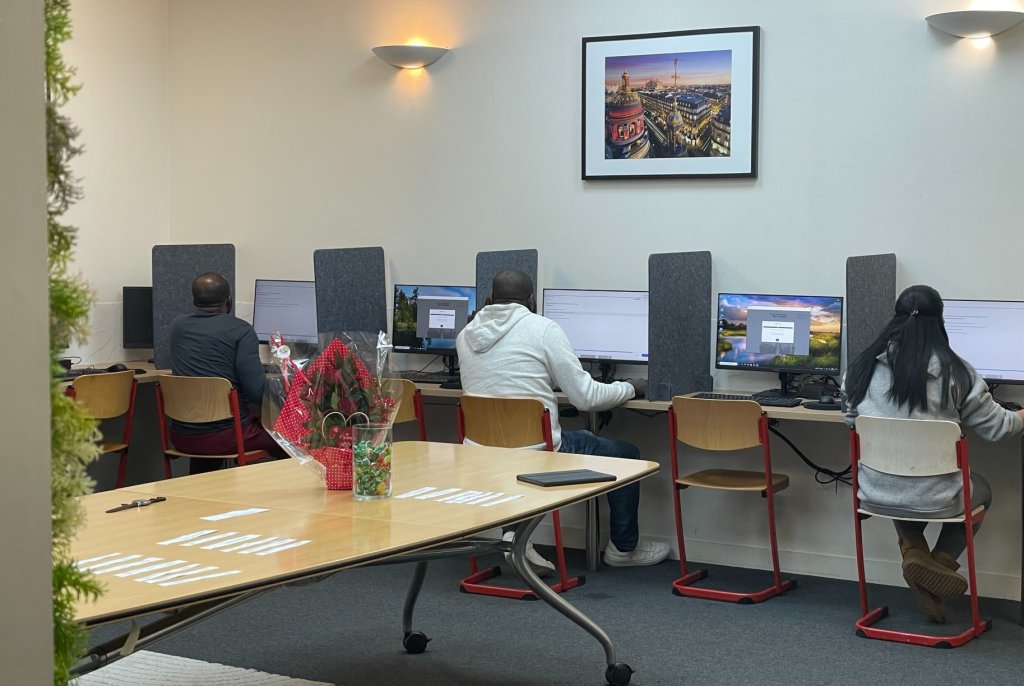
This Saturday morning, eight candidates are hard at work, hands on their keyboards. No more paper forms; the test is taken online. A thin felt partition separates the computers. For 45 minutes, applicants must answer 40 multiple-choice questions (MCQs) covering their knowledge of French history, republican values, French geography, and more. "Scenario-based" questions are also included. To pass the exam, a score of 80 percent is required (a minimum of 32/40). Results are available within 48 hours.
'For me, French history is a complete mystery'
Samuel, originally from Nigeria, is the first to leave. It's 9.35 am. "Oh-oh!" he says, laughing. "I found it quite difficult... For me, French history is a complete mystery..." Samuel is 40 years old and works as an order picker in Beauvais, Picardy. This is the first time he's taking the residency permit exam, and he hasn't had time to study, he explains. "I have a lot of work, irregular hours, it's not easy to find the time." For Samuel, the history and geography questions were quite difficult.

A few minutes later, Bienvenu, originally from Congo-Brazzaville, leaves the room. He says he's confident. "I'm aiming for a high score," says the 62-year-old, who has been in France since 2009. The questions were easy, he says. "What is the Hôtel Matignon? Who is the head of government? All that is easy." The only stumbling block was a history question. "In what year was Louis-Napoleon Bonaparte crowned emperor? I hesitated, but finally, I answered 1852." Correct answer.
Grace, originally from Congo-Kinshasa, dressed entirely in Adidas sportswear, leaves after the allotted 45 minutes. "It's okay," she says in a small, shy voice. "They asked me the dates of the First World War, which I knew, but at one point, I had to fill in the missing words of the Marseillaise. I didn't know all of that..." The contestant, who has been in France for 13 years, recalls other questions. "They also asked me something about a French writer, and I answered randomly."
This is the second time Grace has taken this exam for her residency permit. "The first time, I got 29/40." A failing score. "This time, I'd really like to get 32/40." "You know, it's not always easy. We don't study the same things as you do in Africa; you have to start from scratch."
A paid exam
In the reception area, at 9.50 am, Parisa Forootan and her colleagues wait for the exam to finish so they can reassure the candidates, gather their feedback, and offer them pastries or candy. "It's not much, but we want to encourage them," says one of the examiners. "If you fail, you can try again, but the exam has a cost. It's 70 euros each time, which is a significant amount for some."
The price varies depending on the exam center in France, from approximately 70 to 150 euros. "Many candidates travel across France to take the exam here in Saint-Ouen-l'Aumône. We have a good reputation, good reviews on Google," Parisa Forootan adds.
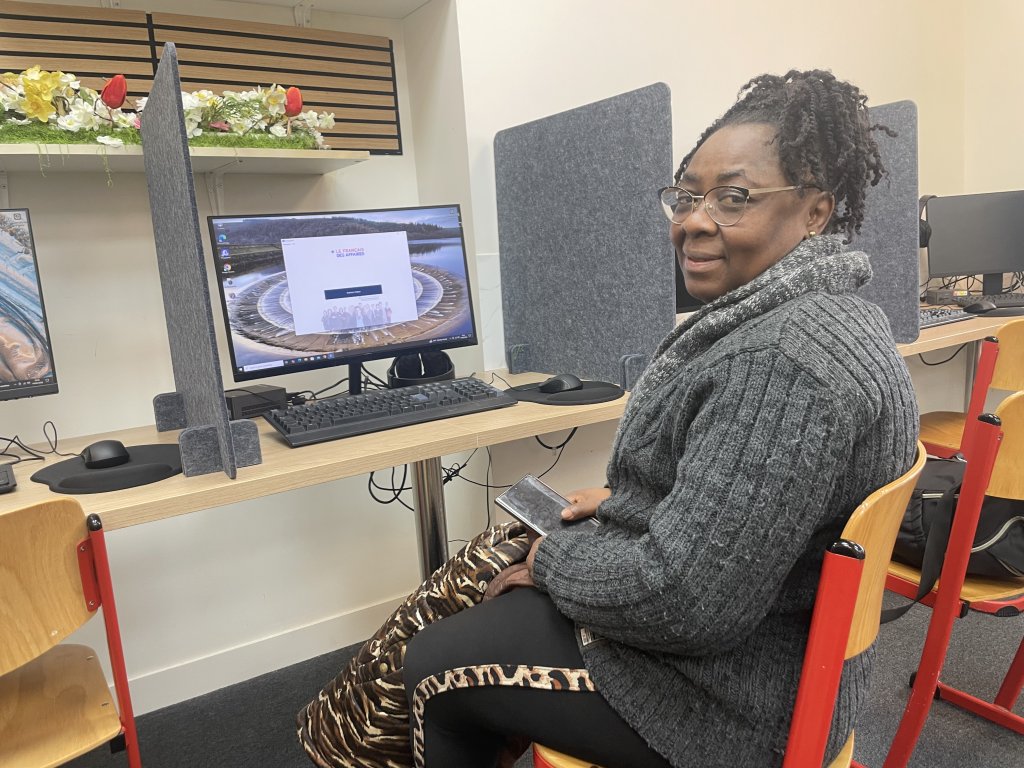
At 10 am, new candidates arrive. This time, they are taking the test for the multi-year permit (short-term residence permit). The exam is supposed to be easier than the one for long-term permits.
As she leaves, Charlie confirms the questions were "easy." This Cameroonian woman in her 50s is wearing a leopard-print coat. "They asked me the colors of the French flag... Honestly, out of five options, I had no doubt. For me, it was obvious," she laughs. Charlie explains that she didn't want to study with the past papers provided by the Ministry of the Interior. "I'll be honest, I went to university. That means I've reached a sufficient level of general knowledge and understanding. At least I hope so."
"There was only one question that gave me trouble," she confesses. "I didn't know a historical figure in the test. A certain Baker... I'd never heard that name."
'Someone who has lived in France for five years should be able to pass'
At 11 am, the last test of the day. "We're going to see people for the naturalization test," Parisa Forootan says. In the waiting room, Christina, a Lebanese woman who works in IT, seems stressed. "I have to succeed, I really want to be French," she says, adjusting her glasses on her nose. Beside her, Nagi, an Algerian, is more serene.

Twenty minutes later, they both emerge, smiling. "The questions were easy," Christina says. She has been in France for five years. "I was dreading the geography questions, but it was fine. They asked me the capital of Brittany… And, in no particular order, they also asked me the date of the French Revolution, the abolition of slavery… Honestly, someone who has lived in France for five years should be able to answer these questions even without practice," she asserts.
"I also found it easy," replied Nagi, who was also taking the exam for the first time. The young man, who has been in France since 2019, confessed that he didn't know who Claude Debussy was, "but apart from that, I had done some online practice questions. I didn't see any difficulties. So I left after 15 minutes."
On February 16, two days after the exam, the results are published. InfoMigrants received several messages. The first was sent by Charlie, from Cameroon. "I got 38/40! I said 37, I'm not far off my estimate." The second text arrived a few minutes later. It was from Nagi. "37/40. That's great. Have a good day." Samuel didn't pass. "I failed, but I'm going to re-register," he said.
Christina, for her part, aced the results. "I got 40/40," she wrote to us. "I'm so happy, this exam was the only one I needed to submit my [naturalization] application. And honestly, this exam is great, it's an opportunity to learn lots of things about France."
Christina, from Lebanon, and Nagi, from Algeria, were taking the exam for naturalization. Samuel, from Nigeria, and Bienvenu, from the Congo, were passing the residency card test.