
Germany has announced plans to resume returns of Syrian refugees and rejected asylum seekers, marking a significant shift in its migration policy. But Syrian authorities have asked for more time to rebuild not only the country's infrastructure but its fractured social ties too.
Germany has decided to resume deportations to Syria, but Damascus is pleading for a delay in the immediate returns to give the country the time it needs to rebuild not only its destroyed infrastructure but its fractured social systems too.
"We ask Germany to understand the situation of Syrian refugees and to give us more time for reconstruction," Mohammed Yaqub al-Omar, Director of Consular Affairs at the Syrian Foreign Ministry, said on Friday (February 13) to Germany's newspaper Die Welt.
Yaqub al-Omar warned that the country remains ill-prepared to absorb large numbers of returnees and premature deportations could worsen an already fragile humanitarian situation.
Nevertheless, the German government in Berlin has plans to resume returns of Syrian refugees and rejected asylum seekers, announcing that those who do not face individual persecution risks could lose protection status. The move reflects a shift in Germany's refugee policy for Syrians and the state's overall strategy to tighten asylum rules.
"The return of thousands of Syrians to Syria at this time could exacerbate the humanitarian crisis and mean that many people will have to live in refugee camps," al-Omar said.

Read AlsoGerman government pushes Syrians to return to their homeland
Resuming returns
In January, Germany deported another Syrian national with criminal convictions. The 29-year-old man from Baden-Württemberg, who was serving a multi-year prison sentence for drug-related offenses, was transferred directly from custody to the airport and flown to Damascus, marking the fourth deportation to Syria since Berlin resumed returns late last year after a suspension in place since 2011.
The decade-long civil war destroyed homes, schools, and the distribution of basic services such as water and electricity. Syrians fled, looking for safety within its borders, resulting in massive displacement among its civilian population. According to Yaqub al-Omar, an estimated 1.5 million people are currently living in tent camps in the north of the country alone.
The World Bank estimates Syria's reconstruction costs could run up to approximately 199 billion euros. Direct physical damage is estimated at about 99.5 billion euros, with infrastructure accounting for roughly 47.9 billion euros (48 percent), residential buildings 30.4 billion euros, and non-residential buildings 21.2 billion euros. Aleppo, Rif Dimashq, and Homs were the hardest-hit cities.
Read AlsoGermany: Fourth deportation to Syria and push to increase deportations overall
A country still in ruins
A report from the Bonn International Center for Conflict Studies (BICC) paints a stark picture of Syria as a country struggling to rebuild after more than a decade of war.
Returning from a visit in November, Osman Bahadir Dinçer, senior researcher at the BICC, described "heartbreaking" scenes of blocks of cities reduced to rubble. Families who had returned to former neighborhoods were living in tents beside the remains of what had been their home.
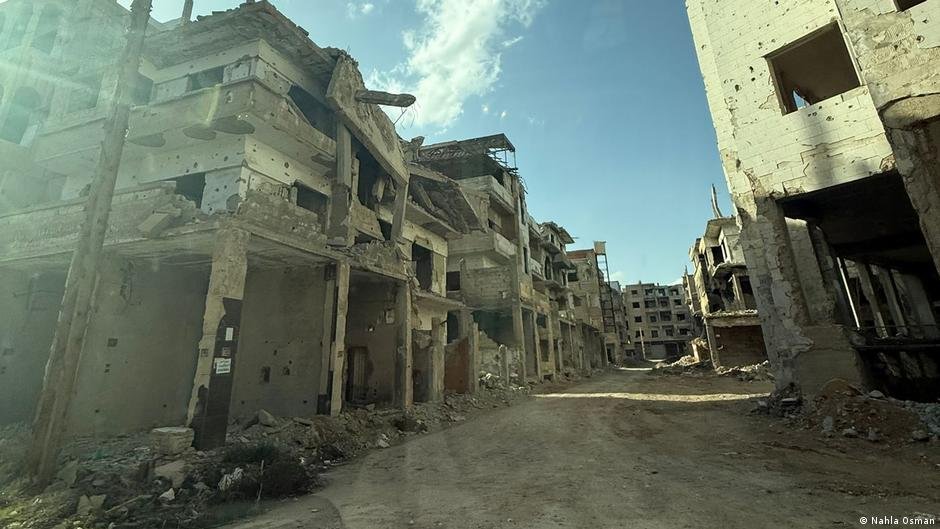
"The destruction is not only physical. Institutions, governance structures, and social relations have also been profoundly damaged," said Dinçer.
The Syrian Network for Human Rights estimates that approximately 2.9 million homes have been damaged. About 3,873 schools have been either completely or partially destroyed. Of this number, about 450 are completely destroyed and require rebuilding.
Electricity and water supplies are unreliable, healthcare facilities are understaffed or partially destroyed, and administrative systems function only in fragments. Dinçer observed that reconstruction is uneven and slow, hampered by limited funding, sanctions, and lingering insecurity.
Read AlsoGermany reviews Syrian asylum cases amid tougher migration policy
The internally displaced first
Before large-scale returns from Europe can be considered, Dinçer argued that Syria must first address the needs of its internally displaced persons (IDPs). Millions of Syrians who fled violence remain uprooted within their own country, often living in tents or overcrowded housing with limited access to livelihoods.
Prioritizing the safe and dignified return of internally displaced persons is essential. Without stabilizing conditions for those already inside Syria, absorbing additional returnees from abroad risks "drowning Syria".
"The deterioration of infrastructure, the collapse of the economy, and the sheer scale of destruction collectively eliminate Syria’s capacity to absorb returns on any meaningful scale. In other words, the country is not only "unsafe for return," but fundamentally "unprepared for return," said Dinçer.
Read AlsoSyrian refugees in Germany face pressure to return
Rebuilding: also a psychological process
Rebuilding from the devastation of war is not simply a matter of clearing debris and rebuilding roads. It also requires a psychological and social process to repair the way that political fragmentation has reshaped communities. "Rebuilding must address both physical infrastructure and the deep social divisions created by the war," Dinçer explained.

Trauma, mistrust, and unresolved grievances complicate efforts to restore normality. Schools and hospitals can be reconstructed with funding and technical expertise, but repairing relationships between communities requires long-term engagement, dialogue, and inclusive governance.
Despite these immense challenges, Dinçer also points to signs of cautious hope. Syrian civil society organizations, local initiatives, and diaspora networks are stepping in to fill in gaps. These grassroots efforts, while vibrant and resilient, are often underfunded. Still, civil society organizations remain indispensable, a fact that the state has openly acknowledged.
Citing government officials, the BICC report said: "The government cannot do everything — not possible."
Read Also