
Prime Minister Pedro Sanchez is facing some steep accusations from opposition voices who reject his initiative to regularize over 500,000 foreigners without papers in Spain. Some claim he's trying to hang onto power, while others say he's using immigration as a distraction from other issues. Sanchez underlined that unless countries in the West embrace migrants, they will not be able to keep their economies afloat.
Spanish Prime Minister Pedro Sanchez penned an editorial in the New York Times on February 4, defending his decision to regularize around half a million foreigners in the country.
"Last month, my government issued a decree that makes up to half a million undocumented migrants living in Spain eligible for temporary residence permits, with certain conditions, which they will be able to renew after a year," he wrote in the US-based daily, citing two main reasons for his decision.
"The first and most important is a moral one. Spain was once a nation of emigrants. … Now, the tables have turned. Our economy is flourishing. Foreigners are moving to Spain. It is our duty to become [a] welcoming and tolerant society.
"The second reason that made us commit to regularization is purely pragmatic. The West needs people. Currently, few of its countries have a rising population growth rate."
Read AlsoSpanish Prime Minister: 'Our model of regular migration works'
Sanchez says he wants to create a sustainable future for all
In the editorial, Sanchez went as far as integrating his decision into what he regards to be a pan-European need for migrants to fill major gaps in the workforce across the continent, saying that unless certain countries in the West "embrace migration, they will experience a sharp demographic decline that will prevent them from keeping their economies and public services afloat."
These approaches of answering broader economic questions by betting on immigration are indeed key policies in several EU nations, such as Germany and the UK, where skills-based legal immigration is part of the overall policy of successive governments. Even in Spain, there are precedents to this approach:
The last time such a broad regularization initiative took place in Spain was over 20 years ago, when the socialist government led by Jose Luis Rodriguez Zapatero issued papers for more than 570,000 undocumented migrants in 2005.
Zapatero's initiative was later found to be a success, resulting in a spike in Spain's tax revenues and social security contributions, remaining to this day as one of Zapatero's political legacies.
Read AlsoSpain should regularize 500,000 migrants immediately, deputy PM
Opponents call Sanchez a 'tyrant' and 'fascist' — including Elon Musk
Sanchez' decision in 2026, however, has quickly attracted a great deal of controversy and ire — not only from far-right groupings, who simply do not wish to see more foreigners arriving in Spain, but also from more moderate voices who feel that Sanchez' approach of ruling by decree to regularize hundreds of thousands of migrants is wrong and not reflective of the country's hard-fought democratic principles.
Many people question why, against a global backdrop of increasingly isolationist, anti-immigrant policies, Sanchez would appear to have chosen to go against the grain of the status quo.
Read AlsoSpain: Mass regularization of migrants set to start
Sanchez' staunchest critics including the world's richest man, tech billionaire Elon Musk, who took the social media platform X — which he owns — to describe the Spanish leader as a "true fascist totalitarian," adding that Sanchez' true motivation was "electoral engineering" — i.e. regularizing countless people who presumably might feel indebted to Sanchez and his party once they are naturalized as citizens further down the line.
Musk's dispute with the Spanish leader, however, is mostly linked to a recent plan to ban social media (including Musk's platform, X) for children in Spain, and is not likely to be primarily driven by Musk's views on Spain's immigration policies.
Sanchez meanwhile responded to his critics, including Musk, in a lengthy video published last week, in which he even acknowledged that "(s)ome say we've gone too far, that we're going against the current."
"But I would like to ask you, when did recognising rights become something radical? When did empathy become something exceptional?"
Read AlsoSpanish Prime Minister: 94 percent of migrants entered legally in past decade
Ruling by decree
Sanchez has been facing allegations of ruling by decree even before he took the decision to integrate half a million people into Spanish society, since he is effectively running a minority government after several of his coalition partners from 2023 stopped supporting his government in recent years.
This is not unusual in Spanish politics, but has repeatedly been used as an Achilles' heel by the opposition to any minority government to attack the leader and his decision.
This is why in the course of the past few months, Sanchez has repeatedly faced criticism from the right and even from centrist forces over a number of key policy issues which on account of running a minority government he has had to push through by decree — ranging from his government's stance on the war in Gaza to his opposition to give into calls by US President Donald Trump to increase its defence spending as a member of NATO.
The issue of migration is therefore only the latest topic where Sanchez' opponents feel that he is going a course that is not compatible with the will of Spain's majority.
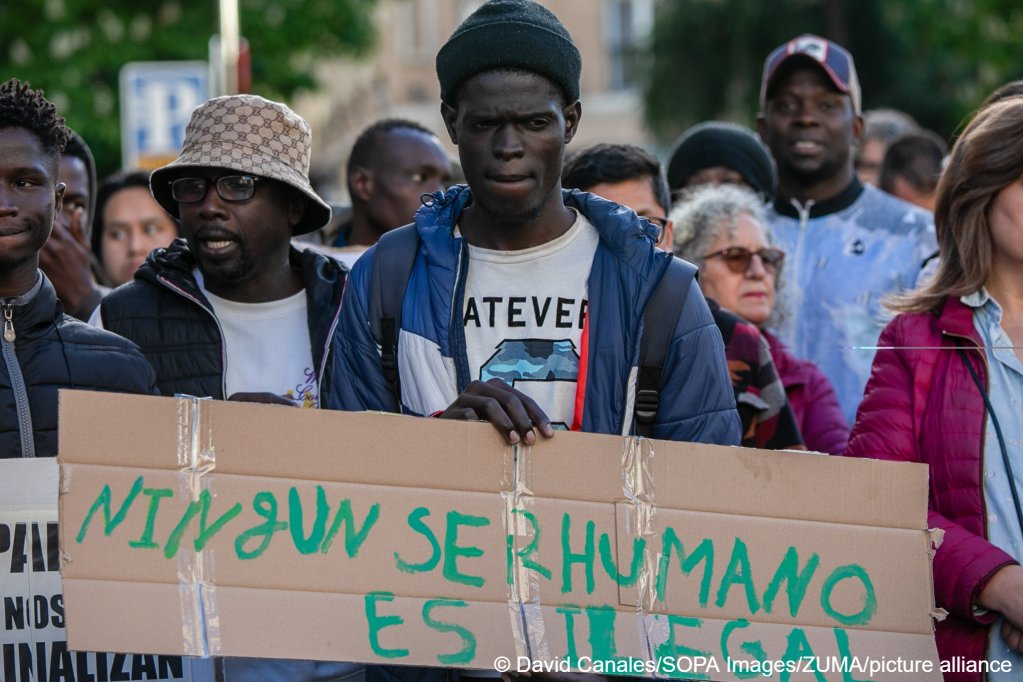
Read AlsoSpain registers record number of foreigners in employment in 2025
Migration policy as a distraction from corruption claims
Outside parliamentary politics, the current mood against Sanchez has also taken root among the electorate, and his public support has been declining steadily in recent months. In late 2025, protestors took to the streets of the capital Madrid, asking for his resignation over broader allegations of corruption.
This notion of corruption, however, is not directly linked to acts of misappropriating government funds or giving any kind of preferential treatment to any of his associates, as is often the case with such allegations; rather, it is all largely directed against his minority rule, over which the leader has little control, in actual fact.
However, it is also important to note that two of Sanchez' close associates, who used to serve as his party's secretaries, are currently in prison on accusations of corruption connected to public contracts; and his wife and his brother are also facing corruption allegations, which they deny.
Furthermore, the prime minister has also had to take flak for the deadly train crash in Adamuz on January 18, with many claiming that it was indicative of a broader crisis in Spain's railway sector, which has also been accused of accepting bribes.
Both the right-wing People's Party (PP) and the far-right Vox Party have been accusing Sanchez' government of using migration as a distraction away from such major corruption allegations. Vox party leader Santiago Abascal called Sanchez a "tyrant" for pushing through various laws, including the immigration decree.
Read AlsoSpain rejects EU push for offshore return hubs, instead promoting 'at-source' migration strategy

Read AlsoSpain: Parliament votes to consider regularizing undocumented migrants
A compromise to keep government functional
The immigration decree is meant to take effect across Spain in April -- two years after the motion was first tabled in parliament. Ironically, at that time, however, there was great support for the idea.
The decree was backed by the Catholic Church from the start as well as by roughly 900 charities and social organizations. It had also found popular support with 700,000 people signing a petition in its favor since 2021 — 200,000 more than needed for it to be considered in parliament; and even there, a parliamentary vote on whether the motion should move ahead was supported by all parties except, predictably, the far-right Vox Party.
That's when the left-wing Podemos Party stepped in suddenly and announced that it had revived the idea; representatives of Podemos said they had negotiated a deal with Sanchez' Spanish Socialist Workers' Party (PSOE) to push the plan through as a decree; in exchange, Sanchez was guaranteed sustained parliamentary support from Podemos until the next elections, which are slated to take place in the third quarter of 2027.
In the absence of a parliamentary majority, a marriage-of-convenience with Podemos over an issue which could almost have been waved through parliament two years ago, seems to have looked like a good deal to Sanchez — even though Podemos only hold four seats in parliament.
Professor Pablo Simon, a political scientist who works at the Carlos III University in Madrid, told The Guardian newspaper that the embattled prime minister had only agreed to pushing through the decree in response to such mounting domestic pressures, as Sanchez' government indeed continues to rely heavily on support by various parties — including Podemos:
"Right now, Sanchez is in a very difficult position internally, but he also knows the only way he can survive is by shifting to more leftwing positions that will allow him to absorb the electorate of the smaller parties," Simon explained in The Guardian.
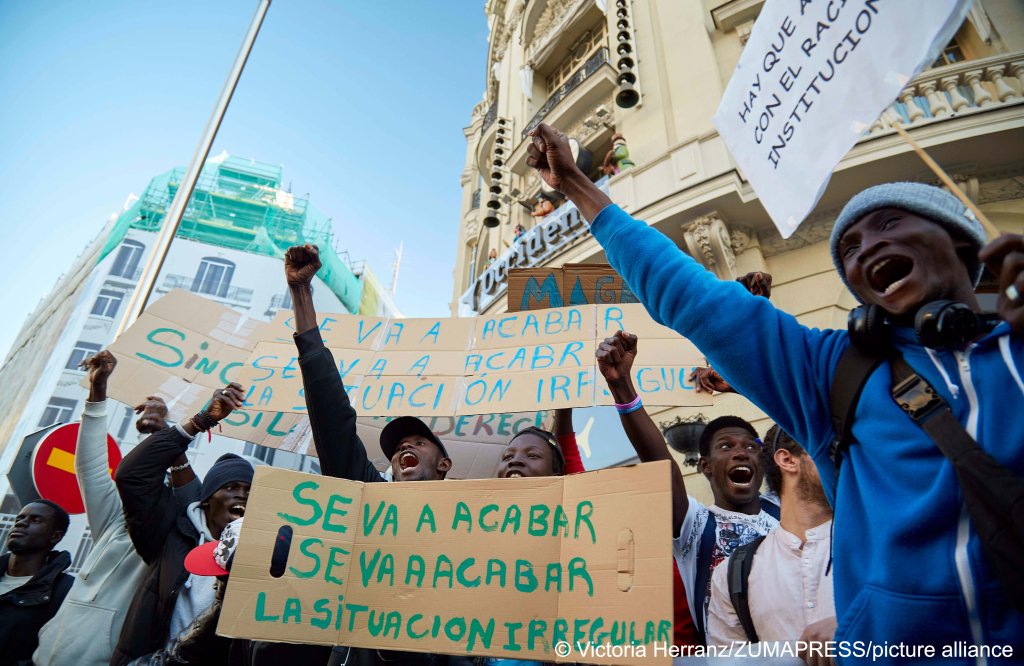
'Dignity, justice, and rights'
For Sanchez, meanwhile, the issue remains one that pertains chiefly to matters of "dignity, justice, and rights."
But there is no escaping the demographic realities of Spain's future, which after all does have one of the lowest birth and fertility rates in Europe.
Sanchez says he wants to proactively help create a sustainable future for his country, and both his arguments and the past success over 20 years ago of the Zapatero administration speak in favor of this vision.
In the next parliamentary elections, voters will get to have a say in the matter, though Sanchez has hinted before at the fact that he might not seek reelection then.