
Austrian authorities deported an Afghan criminal back to Kabul on Sunday (January 25). Austria’s Interior Minister Gerhard Karner promised that the government intends to step up the number of deportations. "Deportations to Syria and Afghanistan will step by step go from being isolated cases to a regular occurrence," said Karner.
An Afghan migrant, described as a "serious criminal", was deported by the Austrian authorities on Sunday (January 25) from Vienna via Istanbul to Afghanistan's capital, Kabul. The deportation was confirmed in a press release from the Austrian Interior Ministry.
According to the Austrian government, the 33-year-old Afghan traveled to Austria in July 2015. During the time he spent in the country, he was convicted six times of various crimes, including some serious and violent crimes, and had already spent five years in prison. Police say there are a total of nine criminal incidents on his record.
At the end of his latest sentence, on January 23, he was sent straight from prison to a deportation detention center.
Karner promises 'deportation offensive'
Austrian Interior Minister Gerhard Karner promised, "The deportation offensive will continue. Even towards Syria and Afghanistan, deportations will, step-by-step, go from being isolated cases to a regular occurrence."
"An asylum system can only function when it operates strictly, as only that way can it be fair. Concretely, that means no tolerance towards people who want to abuse it, and consequential deportations of all those convicted of crime, to protect the system from becoming overwhelmed," said Karner in a press release on Friday (January 23).
Read AlsoSweden calls for EU-wide action on returning failed Afghan asylum seekers

Criminal identified by Taliban
The Austrian Interior Ministry stated that the deported person was one of the criminals identified by a special delegation from the Taliban operating in Vienna. This group entered Austria last year to work on issuing special certificates to people that Austria seeks to deport. The delegation operates on a "technical-operational" level within Austria, stated the Interior Ministry.
The Taliban delegation reportedly met with Austria’s Interior Ministry in mid-September last year, according to news printed by the DID press agency. They were allowed to enter the country to "facilitate identification of Afghan nationals slated for deportation." At least 19 Afghan citizens held in Zimering Prison and the Hernals Police Detention Center were presented to the Taliban representatives for identification procedures at that point.
The Austrian ministry, reported DID, "described this cooperation as 'necessary' for carrying out the deportation of criminal offenders."
Read AlsoGerman government revokes Afghan admissions and tightens resettlement policy
'Technical-operational' cooperation to facilitate deportations
The meeting marked the first time since the Taliban takeover that cooperation was carried out officially. Earlier in 2025, an Austrian official traveled to Kabul to establish contact with the Taliban administration, reported DID.
The Austrian government clarified at the time that the Taliban delegation’s entry into Austria was "legal" despite the Taliban government still not being officially recognized by the Austrian government or most other Western states.

Germany and some other European countries also took a similar approach in 2025. Last week, the Swedish migration minister Johan Forssell called for an EU-wide action plan to return failed Afghan asylum seekers and convicted criminals to their own country.
Read AlsoUK: Two young Afghan asylum seekers sentenced for rape offense
Embassy no longer issues passports
Before the Taliban took over Afghanistan in August 2021, the country’s ambassador in Austria was Manizha Bakhtari. She was asked to leave her post soon following the takeover, but she has continued in her role in Austria, telling numerous newspapers that have interviewed her that she represents her people and is determined to continue fighting against "gender apartheid and for women’s rights," reported Die Korrespondentin in November last year.
Officially, Bakhtari is listed as the ambassador to the UN in Vienna, as well as UNIDO and IAEO on behalf of Afghanistan. Because she is no longer officially recognized in Kabul as an ambassador, she has had to shrink her team.
She told Die Korrespondentin she receives no money from the Taliban authorities in Kabul. The embassy also no longer has the right to issue passports, but they can still provide identification proof, she explained.
Read AlsoEU confirms 'contact' with Taliban in Afghanistan over migrant returns
Asylum applications drop by more than a third
In 2025, according to the Interior Ministry, 16,284 people applied for asylum Austria, the lowest number of applications since 2020 (a drop of 36 percent compared to applications in 2024).
First applications dropped even lower, stated the Interior Ministry. In 2025, just 6,849 of the applications came from first-time applicants. The rest of the applications were either for newborns or Afghan women who already had subsidiary protection, but following a European Court judgement, are now entitled to full refugee status.
One of the biggest factors for the drop in applications was the reduction in family reunification cases. Just 25 people arrived in Austria in 2025 via a family reunification process, compared to more than 3,400 people in just two months of 2023 (October to December).
Read AlsoGermany’s interior minister proposes sharing deportations among EU states
Austrian government 'not yet content'
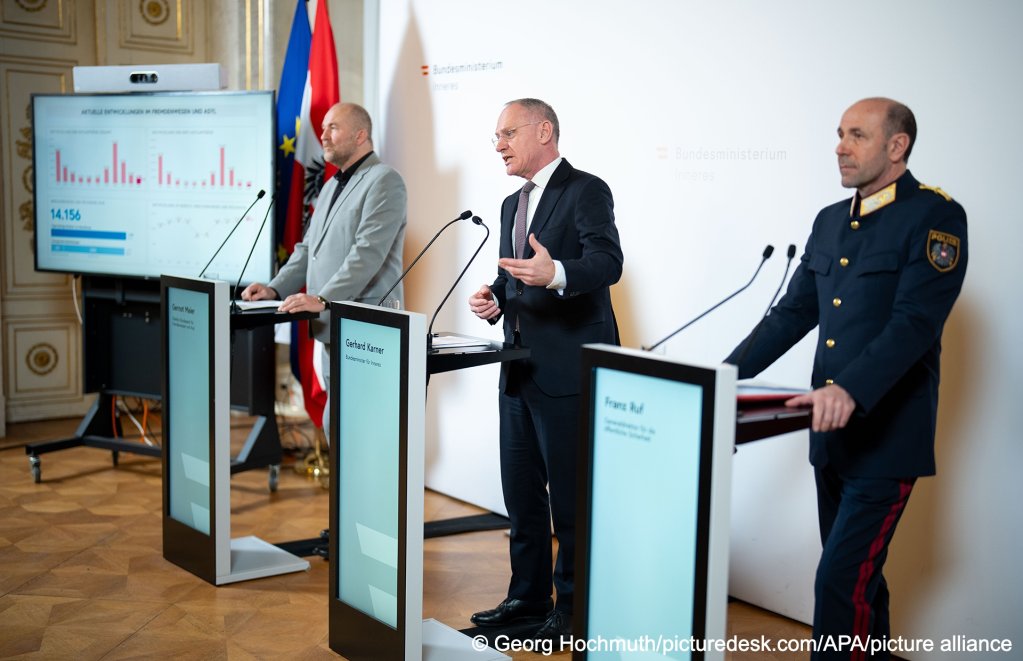
Deportation figures for 2025 show that 14,156 people left Austria last year. The interior ministry stated that 6,801 were forcibly deported, and about one in two of those had criminal convictions. Around 7,355 people left Austria voluntarily and under their own resources, confirmed the ministry. The number of deportations was "more than ever before," stated the press release. Around 4,000 of them were deported after having applied for asylum in Austria.
The ministry points out that if you take those 4,000 applicants, who were refused asylum, from the 6,850 first-time applications last year, only 2,850 of those applicants are still in the country.

Karner concluded that despite the record numbers of returns, his government is "not yet content. We must push forward consequently with our actions," Karner underlined.
Read AlsoAfghanistan: Germany 'close to reaching deportation deal' with Taliban