
Sweden’s migration minister has called on the European Union to establish a common system for issuing ID and travel documents to Afghan nationals whose asylum claims have been rejected or who have committed crimes. He said it is "more or less impossible" to deport these individuals without proper identification or travel papers.
The Swedish Migration Minister Johan Forssell has called on the European Union to establish a unified procedure for issuing identification and travel documents to Afghan nationals whose asylum applications have been rejected or who have committed crimes in their host countries.
Minister Forssell on Thursday (January 22) described the current situation as "more or less impossible" for deporting Afghan nationals who do not meet asylum criteria because they lack official ID or travel papers.
Forssell emphasized that, while the EU does not intend to make political arrangements with Afghanistan that could lend "legitimacy" to the Taliban, member states could still agree at a technical level to provide documentation that would facilitate deportations.
"It is a major concern for us that we are seeing quite a few cases of people that have committed crimes, Afghan people that committed crimes in Sweden and it is more or less impossible to expel them today," Forssell told the Associated Press news agency (AP) on the sidelines of an informal meeting of EU Justice and Home Affairs ministers in Nicosia, Cyprus.
"If you come to Europe and you commit crimes, you have chosen yourself not to be part of our society. And we need to do everything we can to make sure that you are expelled," he added.
Brussels confirms some engagement with Afghanistan
Forssell said the same challenges concern some Syrian asylum seekers, though the immediate priority remains Afghan nationals. He noted that obtaining ID or passports from Afghanistan is largely impossible because most Afghan embassies in Europe are not recognized by the Taliban government.
The minister described the EU Commission's recent contacts in Kabul as a "very positive first step" and said there is "broad consensus" among several EU countries facing similar issues to accelerate deportations of failed Afghan asylum seekers or individuals who have committed crimes.

Forssell also highlighted that more than half of Afghan asylum applicants are expected to be rejected and "they need to go back home," warning that failing to do so could reduce public support for admitting those who qualify for protection. He suggested that Afghan nationals scheduled for deportation across different EU countries could be grouped together and repatriated on chartered flights.
The European Commissioner for Internal Affairs and Migration, Magnus Brunner, confirmed that EU member states are engaging with Afghanistan’s "effective authorities" on a technical level to improve migrant return processes.
Sweden toughens stance on asylum as public anti-migrant sentiments grow
The Nordic country has seen public opinion shift amid concerns over challenges linked to migration. Forssell said these concerns were a driving factor behind the formation of the current government three years ago, which included support from the hard-right, anti-migrant Sweden Democrats.
According to Forssell, asylum applications in Sweden are now at their lowest level since 1985. "So I think we are doing very well and we are really delivering what the Swedish population wants to see from us," he said.
Sweden saw a significant decline in asylum applications in 2025, with a 30 percent drop compared with the previous year, according to Forssell. Immigration "is decreasing to Sweden and it is decreasing sharply," Forssell said.
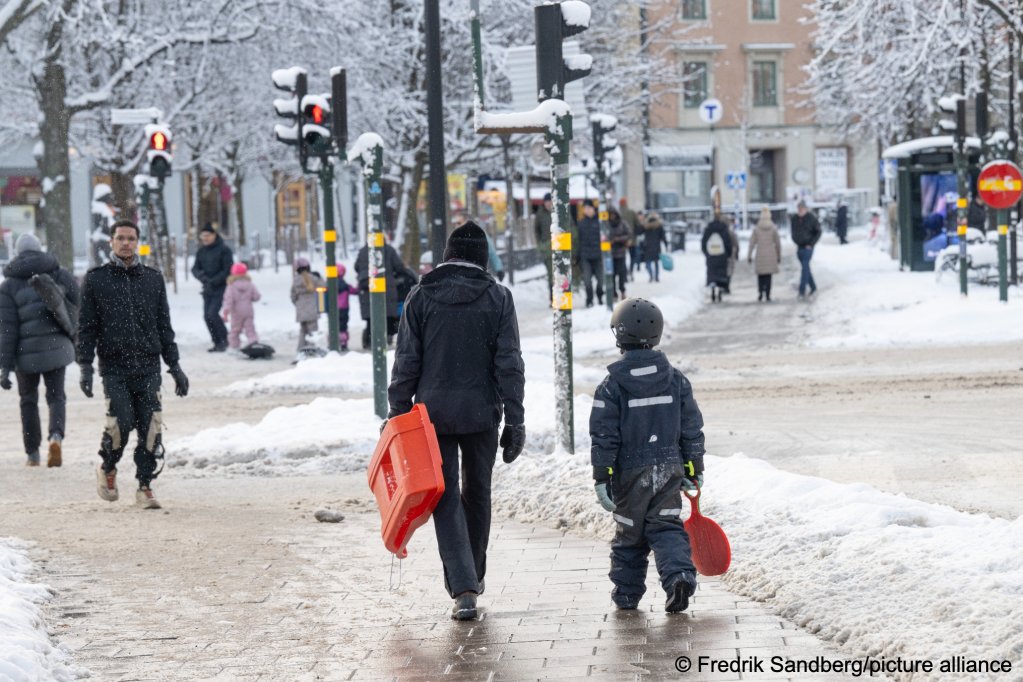
Since the current government came to power in 2022, asylum requests have fallen by 60 percent, while returns to countries of origin have increased by 60 percent, Forssell noted.
Sweden's center-right government, a minority coalition supported by Sweden Democrats, has pursued a tough stance on migration, introducing measures such as financial incentives for voluntary returns, stricter conditions for citizenship, and tightened family reunification rules.
From 2026, immigrants who voluntarily return to their country of origin are eligible to receive up to 350,000 kronor (30,800 euros). In 2025, Sweden granted 79,684 residence permits, six percent of which were asylum-related, compared with 18 percent in 2018, when 133,025 permits were issued. Around 8,312 people returned to their countries of origin in 2025.
More reforms are planned ahead of Sweden’s parliamentary elections scheduled for this year, on September 13, 2026. The government is also considering revoking Swedish citizenship from dual nationals under certain conditions, such as if they possess criminal convictions, and deporting migrants who do not abide with a criteria they have dubbed "honest living," a measure critics say remains vague and undefined.
With AP and AFP