
An anti-government protest movement which erupted across multiple cities in Iran on December 28 was met with violent repression by the Iranian regime. NGOs estimate that the crackdown has left thousands dead amid an ongoing internet blackout. Iranians at the Turkish border described the chaotic situation in their country.
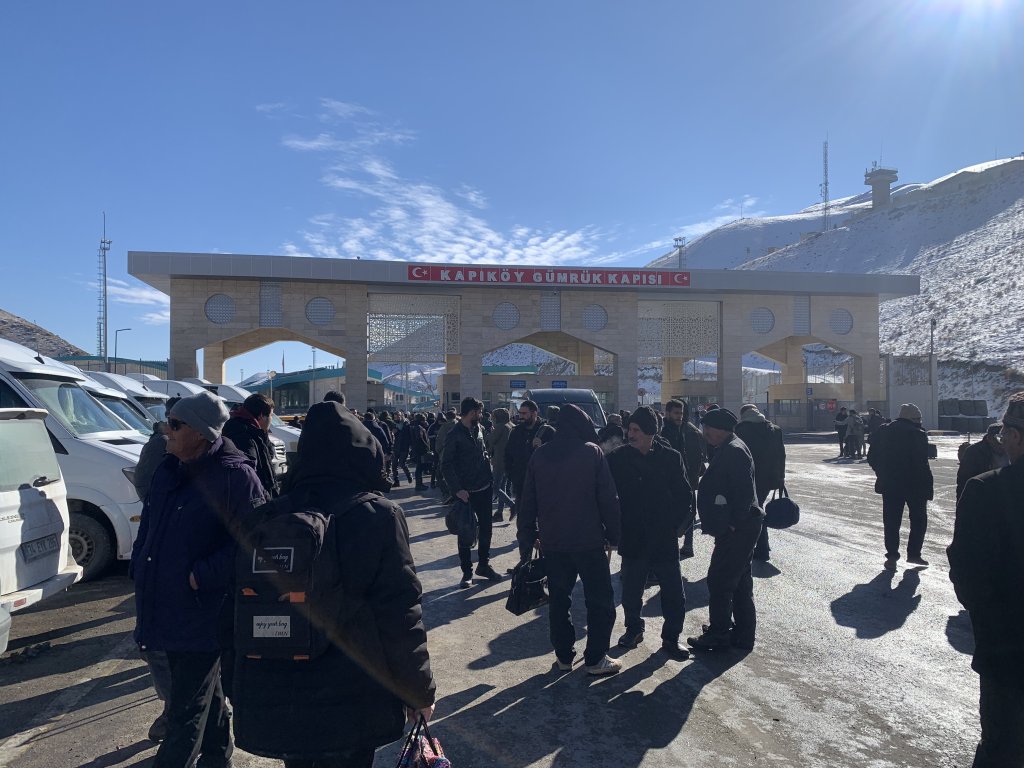
Rashad*, a young man wearing a red hat, reached Turkey on January 17 through the Kapiköy passage, which winds its way through the mountains. Stress and exhaustion were visible in his eyes. He was fleeing events in Iran, Rashad explained.
The Iranian authorities reacted with a violent crackdown to anti-government protests which began in multiple cities across Iran on December 28, leaving between 2,000 and 20,000 dead, according to non-governmental organization estimates. "I saw them shoot," said Rashad about the Iranian police, amid an ongoing internet blackout imposed by the government to prevent the circulation of information.
At that moment, several rays of sun brought warmth to the region used to negative temperatures, where in recent days Iranians fleeing the violence have joined the regular travelers along migration routes. Rashad mimed handcuffs with his hands to describe the complete blockade of Iran. He pointed to the road leading to Van, a Turkish city about a hundred kilometers away and the next stage of his escape.
Read AlsoIranian athlete granted refuge in Italy: 'We athletes will be the voice of the people'
'It's been like a war for the past two weeks'
Two conflicting emotions have emerged at the border. There is the almost vital need to report on the ongoing violent repression which contrasts against the fear of being arrested in the name of the same repression. Fear prevails in most cases. One man mimed holding a gun to his temple to explain his silence. Others, like Akboir, agreed to speak. "It's been like a war for two weeks," he said about the situation. He had just arrived from Tabriz, a city in north-western Iran. "It isn’t calming down, the police are still shooting," he said.
Protests erupted at the end of December because of soaring prices. "The economy is very bad, life is hard. That’s why people are protesting." Akboir periodically works in Istanbul for three months – the maximum amount authorized without a visa – and then returns back to Iran for 90 days, before going back to Turkey again. He appeared exhausted, just like his companion standing next to him. "The police have killed 15,000 people. Text messages don't work, only telephone calls get through," said the latter, anxious about keeping his anonymity for fear of being arrested by the Iranian authorities.
Suitcase in hand, Mehdi* witnessed the horror in the streets of Rasht, a city near the Caspian Sea. "People were killed by the police. Everyone was afraid and stayed home."
Beside him, Amir nods. He also saw shooting in the streets of Tehran, adding, "I only saw young people between the ages of 20 and 25 at the protest from my window."
He had videos of the repression and violence on his phone, but deleted them before crossing the border. He worried his phone would be searched and he would be arrested. Everyone with any footage deleted it while waiting for the bus that would take them to Van. Fear of the government was omnipresent. "In Tehran, they were arresting people who were filming the events," said Marjane*, a young woman who appeared to be in a shocked state.
Read AlsoLooming crisis in Afghanistan, as over 1.2 million Afghans deported from neighboring Iran
'I want people to know what's going on'
Imane*, in her twenties, was about to cross the border and enter Turkey with her parents. She was determined to send a message to the world. "I want people to know what's happening: they're killing a lot of young people." Her family came to Turkey for a few days to reconnect to the internet.
Many crossed the border for this reason, even those who defend the regime and deny the thousands of deaths. "Everything is fine in Iran," said Reza, accompanied by his wife. "But I need the internet to work. I'm coming to Van just for a day so I can connect."
As temperatures dropped, a couple hurried to get inside a car. The woman described Iran in one word: "catastrophic." She claimed to have seen police firing live ammunition at protesters. Another woman from the city of Urmia spoke of the climate of anxiety that reigned in Iran. "There are a lot of police everywhere. They are using machine guns in the streets," she said, miming a rifle with her arms.
Read AlsoTurkey to erect wall along part of border with Greece
No other choice but to return to Iran
Onür*, a 21-year-old Turk, had just arrived back in his country. The young man wearing headphones and a gray scarf around his neck was previously a student studying medicine in Iran. "It's too dangerous. When it started, my parents called me to tell me not to go outside. They're killing young people in Tehran, they're killing them all. I heard it from Iranians, because I can't get information without the internet." He planned to stay with his parents in Adana, southern Turkey, for two weeks before returning to Iran to continue his studies, despite the circumstances.
Some people were heading back to Iran, undisturbed by the widespread reports of violence. "Iran is very calm; it's the Americans and Israelis who are killing people in the streets. Iranians love their country," said a short, talkative woman who had entered Turkey as a tourist and was returning home.
Others explained that they had no choice but to return. "I don't have a visa, what can I do?" said a young woman carrying a suitcase. A couple who had come to Van for a few days were also left with no choice but to return to Iran. They tried to stay positive. "We saw on a website that the internet is gradually coming back online; it's better than before," said the husband, trying to put the situation into perspective. The couple entered the main border gate, heading back to a country whose future was more uncertain than ever.
*The names have been changed to protect the anonymity of the individuals.