
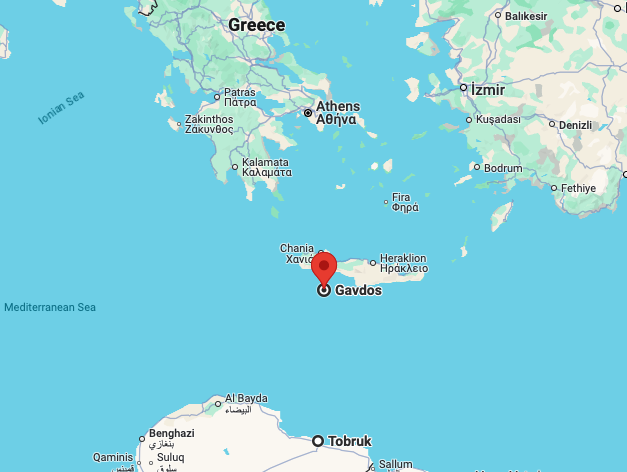
A small migrant boat with 79 people on board has reached the southern Greek island of Gavdos. Two of its passengers have been arrested on suspicion of facilitating the irregular crossing. There has been a recent increase in arrivals in Greece's southern islands after a relative lull for much of the second half of 2025.
The Greek coast guard said that the two people taken into custody were Somalian men, aged 19 and 23, who had allegedly been paid to steer the boat to Gavdos; it is unclear at this point, however, whether they are proactively part of an existing smuggling ring.
The migrant vessel had reportedly departed from the city of Tobruk in eastern Libya — one of the main departure spots for migrant boats in the North African country.
In the past year, irregular sea journeys to Gavdos and also to its much larger sister island Crete have risen in popularity, with about 20,000 people reaching the two islands in 2025 this way.
Read AlsoCrete and Gavdos among Greek Islands with highest migrant sea arrivals
Greece: Almost 50,000 irregular arrivals in 2025
In total, nearly 49,000 migrants managed to enter Greece using irregular journeys in 2025, according to data provided by the UN.
The vast majority — almost 42,000 people — arrived in Greece using various sea routes, with about half of all irregular sea arrivals in Greece originating from Libya.
While many migrants arriving in Greece are fleeing violent conflict, persecution and war, there are also large numbers of people who come to Europe seeking better economic opportunities.
In a bid to manage immigration more decisively, the European Union and its member states have all rolled out more restrictive laws in recent years, curbing in particular what qualifies for grounds for asylum.
As a result, the initial recognition rate of people arriving in Europe fell notably in 2025.
Read AlsoDetention and fines at core of Greece's new migration law
Uphill battle to curb arrival numbers
Greece remains one of the frontline states in terms of migrant arrivals, with the Greek government seeking increasingly restrictive methods to curb migration.
In July 2025, Greece suspended the processing of asylum applications for several months amid a temporary increase in arrival numbers — particularly of people departing from Libya and reaching the islands of Crete and Gavdos.
The measure, designed to discourage irregular journeys, appears to have paid off, as -- broadly speaking -- for many months arrival numbers on the twin islands fell significantly.
Read AlsoGreece approves a three-month suspension of asylum claims
However in December 2025, there was once again an uptick of migrant arrivals, requiring ongoing assessment of how Greece and the EU continue to react to such trends.
The Greek government has also tabled a law to make asylum-related crimes more severely punishable, including a bill to incarcerate smugglers for ten years, and also to make the refusal to cooperate and partake in deportation plans punishable by prison sentences.
Read AlsoCrete: Nearly 800 new migrant arrivals places Greek island under pressure once again