
The EU border agency Frontex recorded just under 178,000 irregular entries at the EU’s external borders last year -- the lowest annual total since 2021. However, certain migration routes were used more frequently in 2025, according to the Warsaw-based agency.
The number of irregular border crossings into the European Union fell by more than a quarter in 2025, the European Union's border and coast guard agency Frontex announced on Thursday (January 15).
The Warsaw-based agency recorded just under 178,000 irregular entries at the EU’s external borders last year. Citing enhanced cooperation with member states and third-country partners, Frontex said that this is the lowest number of irregular entries recorded since 2021.

In a statement accompanying the release of the data, Frontex Executive Director Hans Leijtens described the decline as "a significant development" while urging continued vigilance.
"The trend is moving in the right direction, but risks do not disappear," he said, emphasizing that migratory pressure remains unpredictable and that cooperation with authorities both inside and outside the EU continues to be key to managing flows.
"Staying prepared is about practical choices. It means officers on duty, assets ready, and close cooperation with national authorities and partners beyond the EU," added Leijtens.
Read AlsoExplainer: A closer look at Frontex and its role as Europe's border force
Sharp drops across routes
Frontex broke down the data and reported sharp declines in irregular crossings on several routes.
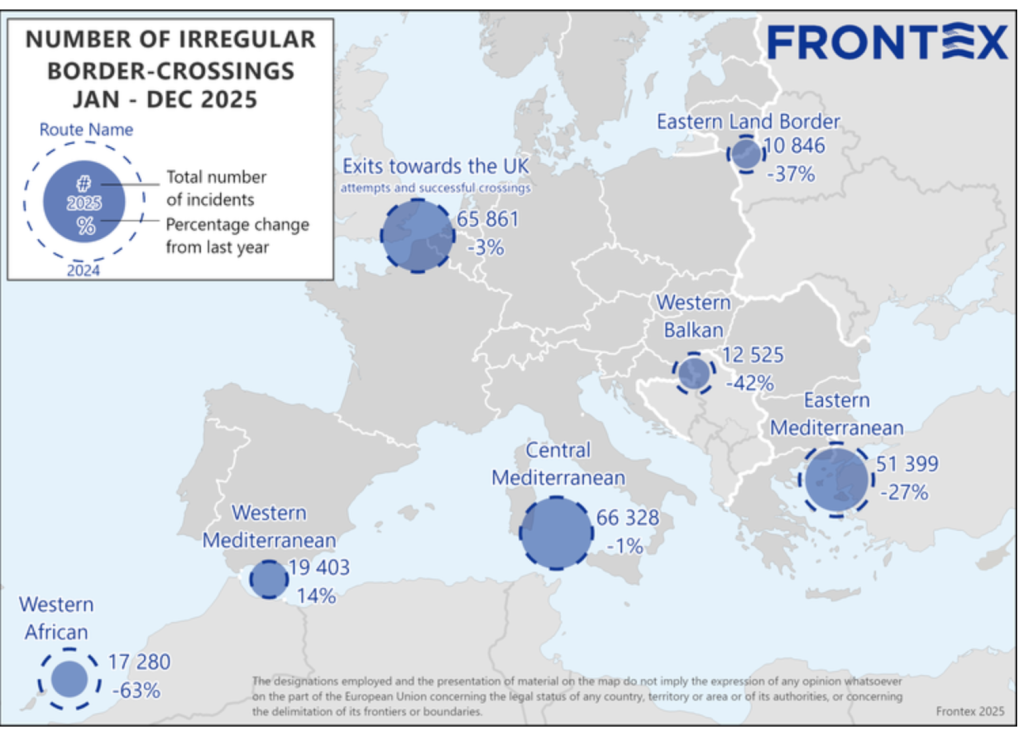
Within Europe, the Western Balkans corridors saw a decline of 42 percent, while irregular movements on the EU’s eastern land border with Belarus fell by 37 percent. Irregular arrivals via the West African route dropped by 63 percent--marked as the steepest decline, linked to drops in departures from Mauritania, Morocco, and Senegal.
According to Frontex, operations that included the launch of a new joint operation in Bosnia and Herzegovina in November 2025 and strengthening operational support on the ground contributed to the sharp drop in irregular arrivals in the Western Balkan route.
Read Also100 Frontex officers arrive in Bosnia to boost border patrols
Central Mediterranean Route, most active
Despite the overall drop, the Central Mediterranean route remained the most active, accounting for nearly one-third of all detections.
Crossings from eastern Libya to the Greek island of Crete more than tripled compared with 2024, and attempts from Algeria to Spain rose by 14 percent. Meanwhile, attempts to cross the English Channel to the United Kingdom fell slightly.
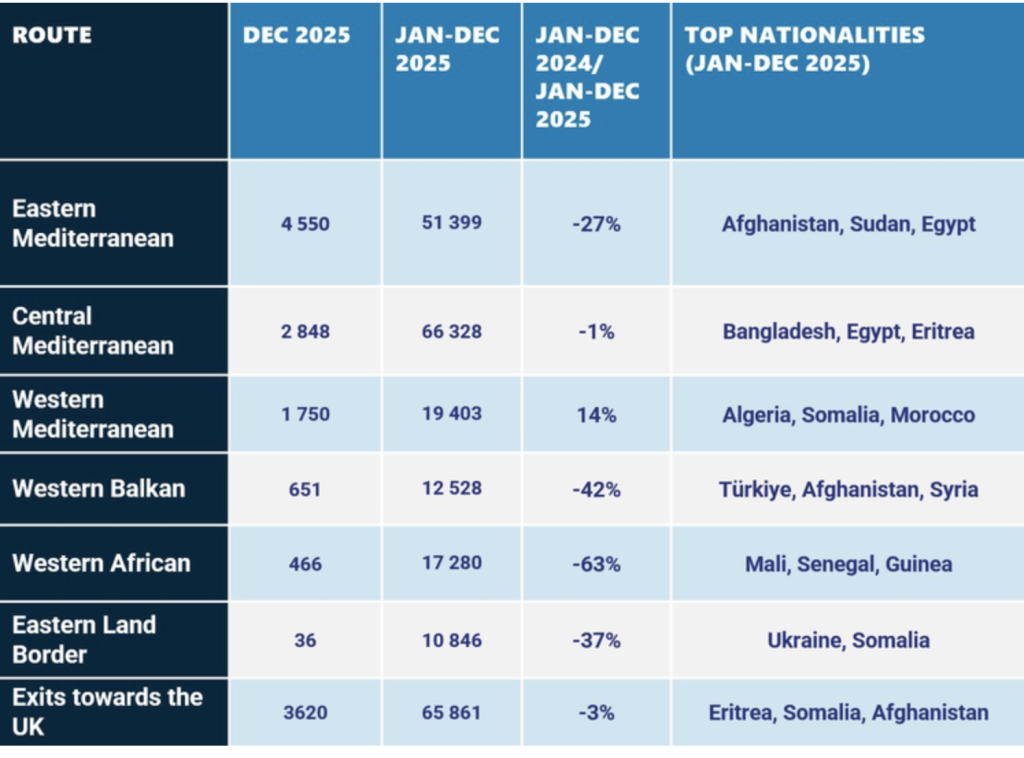
On the Eastern Mediterranean route, detections fell overall, continuing a downward trend. However, Frontex noted that within this route, crossings from eastern Libya to the island of Crete more than tripled.
Nationalities most frequently detected attempting irregular entry along the Central Mediterranean Route included Bangladeshis, Eritreans, and Egyptians. However, the nationalities also varied by route.
The agency points out that its data refers to the number of detections of irregular border crossings at the external borders of the European Union. The same person may be detected crossing the border several times in different locations at the external border.
Read AlsoCentral Mediterranean deaths at 370 this year, with 300 missing – IOM
Pivotal year ahead
This year will be a pivotal one for European border management. The EU Pact on Migration and Asylum will become fully applicable in June, marking the most far-reaching reform of Europe’s migration and asylum system in years. This will coincide with new digital border systems that include the full rollout of the Entry/Exit System (EES) and the planned launch of the European Travel Information and Authorization System (ETIAS) later in the year.
According to Frontex, if there is no major geopolitical escalation in the EU’s immediate neighborhood, irregular migration towards Europe across land and sea borders is likely to continue its downward trend, as seen since 2023.
Despite the positive trend, migration advocates warn that lower irregular crossings do not necessarily mean safer conditions for people on the move.
Human rights groups have repeatedly criticized Frontex for its role in border enforcement operations that coincide with reports of unlawful returns of migrants without allowing them to seek asylum, which are known as pushbacks, as well as other rights violations.
The Abolish Frontex campaign, which is comprised of several NGOs, said the rise of the far right and the shift of center and liberal parties toward the right have boosted support for Frontex.
Read AlsoEU court opens path to justice for alleged pushback victims in landmark case against Frontex