
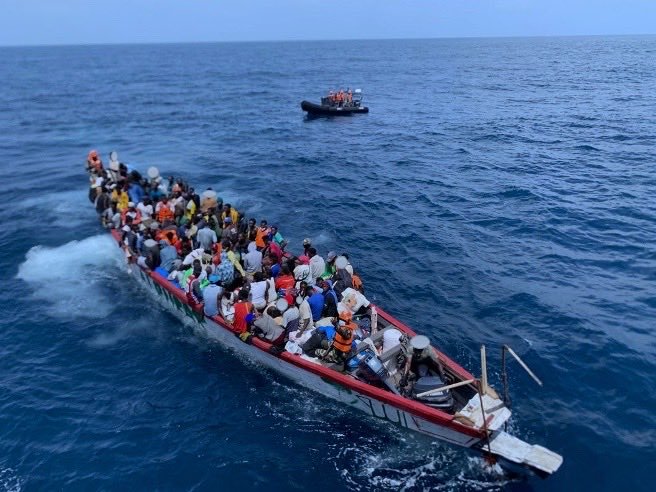
In 2025, more than 17,500 migrants arrived in the Canary Islands, compared with nearly 47,000 in 2024 -- a decrease of 62 percent in just one year, according to figures from the Spanish Interior Ministry. This drop in arrivals in the Spanish archipelago is explained by increased controls on the West African coast following agreements signed with Spain.
After two consecutive years of record arrivals in the Canary Islands, migration flows to the Spanish archipelago slowed considerably in 2025. According to figures from the Ministry of the Interior, just over 17,700 migrants arrived in the Canary Islands in 2025, compared to nearly 47,000 in 2024 and almost 40,000 in 2023. Thus, between 2024 and 2025, arrivals went down 62 percent.
This sharp drop is explained by the strengthening of agreements concluded between the European Union and Mauritania, Senegal, and Morocco, the three main countries of origin for migrants arriving by boat in recent years. In 2024, the EU increased its visits to Africa to sign new partnerships and try to stem the flow of migrants to the Spanish archipelago. A year later, these agreements have started to have some effect.
Read AlsoSpain asks Frontex to patrol African waters to curb migration
Agreements with Mauritania, major departure country
Since 2023, Mauritania has been the primary departure point for West African migrants arriving in the Spanish archipelago by boat.
For over 20 years, Nouakchott has received substantial sums from Spain and the EU for migrant management. For the period 2022-2027, the EU allocation amounted to 12.5 million euros. However, the recent spike in arrivals has prompted the EU to increase funding.
In March 2024, a new agreement signed between the EU and Mauritania sent 200 million euros to the Saharan country. The following summer, Spanish Prime Minister Pedro Sánchez visited Nouakchott to sign another migration agreement with Mauritania -- and the Gambia.
In exchange, Mauritanian authorities have pledged to tighten local legislation on irregular immigration.
Since the beginning of 2025, Mauritania has pursued a repressive policy towards sub-Saharan migrants in the country trying to cross the Atlantic to reach the Canary Islands. Numerous migrants have reported arbitrary arrests, even in the streets or at their workplaces. These individuals were then deported to the country's borders, notably the city of Rosso, Senegal, which saw thousands of migrants arrive in just a few weeks.
In May, government sources said that from January to April 2025, Mauritania intercepted more than 30,000 migrants. And during a meeting held in Madrid on October 17, Spain and Mauritania announced they had thwarted 3,500 attempts at irregular migration in 2025 on Mauritanian soil.
Read AlsoMauritania: Migrants face round-ups, arrests and deportations
Other agreements with Senegal and Morocco
Senegal, the second largest country of origin for migrants to the Canary Islands, also received 30 million euros in aid from the EU in October 2024 to combat irregular immigration.
The European Commission is already funding a 5.75 million euros project aimed at strengthening the capacity of Senegalese security forces to combat irregular immigration, human trafficking, and migrant smuggling.
This agreement, like the one with Mauritania, started to have an effect in 2025: in the first quarter, Senegalese forces intercepted more than 1,900 people attempting to cross the Atlantic, "the majority of whom were foreigners -- 1,000 people -- using Senegal as a point of departure," Modou Diagne, Permanent Secretary of the Interministerial Committee for the Fight Against Irregular Migration (CILMI), said in September.
Morocco, meanwhile, received 2.5 million euros in December 2024 to strengthen its border surveillance capabilities, improve control of entry points, combat human trafficking networks, and protect southern Europe from migration flows originating in this North African country.
In parallel, since 2013, the EU has spent more than 360 million euros -- including 234 million euros from the Union Emergency Trust Fund for Africa, according to an EU note dated February 2022 -- to assist Morocco in its fight against irregular migration.
Read AlsoEU-Africa migration policy shift: Cooperation or coersion?
Decrease in deaths on the routes to Spain
This 62 percent drop in migrant arrivals in the Canary Islands in 2025 comes with an overall 42.6 percent decrease in irregular arrivals across Spain (36,775 in 2025 compared to 64,019 in 2024).
However, another archipelago, the Balearic Islands, has seen an increase in arrivals. In 2025, nearly 7,400 people arrived in this Spanish territory, compared to 5,900 in 2024. This represents a 24.5 percent increase.
"Boats were arriving almost every day this summer. There were also corpses, missing persons. These are abnormal situations that we didn’t see last year," Carlos Martín Ciscar, spokesperson for the Acollim platform, a network of associations in the Balearic Islands, told InfoMigrants in October.
The route from Algeria to the Balearic Islands has thus become "the main transit route to Spain" by 2025, according to a report published at the end of December by the NGO Caminando Fronteras. This increase in departures to the archipelago causes a higher number of deaths. According to the NGO, 1,037 people who set off from Algeria towards the Balearic Islands lost their lives in 2025, compared to 517 in 2024.
Conversely, deaths on the Canary Islands route have fallen. Caminando Fronteras reported 1,906 deaths and disappearances on the Atlantic route. In 2024, the NGO had counted 9,757 deaths or disappearances in the same maritime area. This represents almost all of the deaths at sea towards Spain that year.
Read AlsoOver 3,000 people died while trying to reach Spain in 2025