
Recent events in Venezuela continue to inform much of the political discourse around the globe, with reverberations reaching Europe as well: Even before the ouster of leader Nicolas Maduro during a special mission conducted by US forces last week, instability, persecution of opposition supporters and economic woes had forced tens of thousands to flee the country and come to Europe. Many now wonder whether this pattern is likely to continue.
The eyes of the world remain on Venezuela after the ouster of its disputed president on January 3 by special US forces.
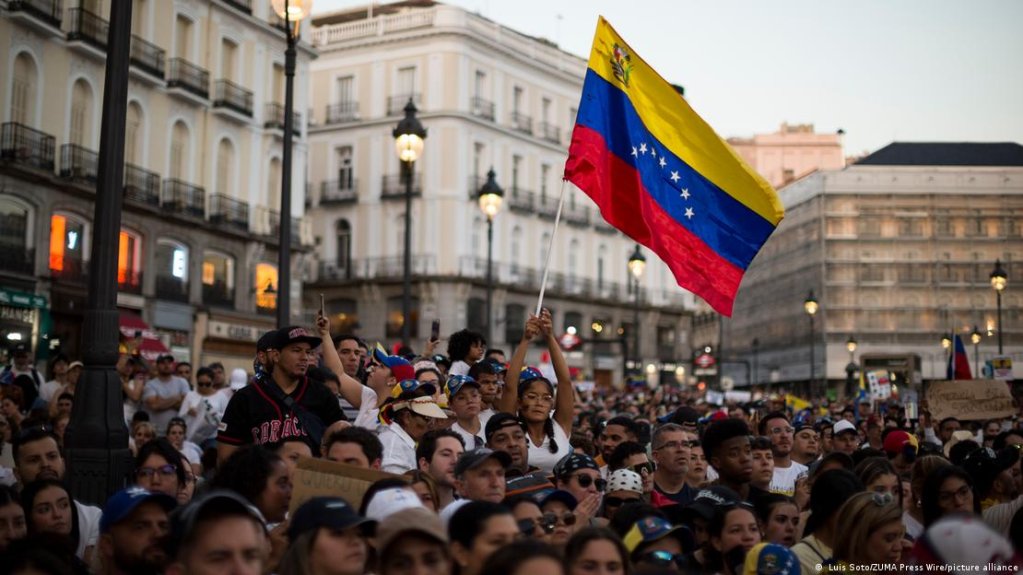
At the same time, Venezuelans around the globe are watching how the world reacts; after years of economic hardship, corruption, crime and widespread oppression, some are hopeful for a brighter future with a new leadership while others believe that not much will actually change.
Years of suffering have resulted in tens of thousands fleeing the South American country in recent years to Europe -- chiefly to Spain and to Germany.
Does the current crisis mean that more will follow?

A quarter of Venezuelans now abroad
The UNHCR says that the humanitarian crisis in Venezuela, which has been brewing for over a decade, has long become one of the largest international displacement crises in the world.
A quarter of all Venezuelans have chosen to move to another country over the past decade: In total, nearly 8 million Venezuelans are now displaced globally, with the majority of them, 7 million, residing in Latin America and the Caribbean.
However, the remaining 1 million Venezuelans have opted over the years to seek protection further afield; while many have chosen to go to neighboring countries like Colombia, Peru and Brazil, as well as further afield to the United States, large cohorts have come to Europe as well, especially in recent years.
In fact in 2025, Venezuela emerged as one of the main places with a marked uptick of its nationals seeking protection in OECD countries around the globe.
Read AlsoNew asylum applications to OECD countries 'historically high'
The same year, Venezuelans emerged as the leading nationality seeking protection in the EU.
At the same time, both protection and application rates from other nationalities have slowed down across the EU in 2025 amid stronger border fortifications, resulting in Venezuela becoming the leading country of origin for new asylum applications.
Read AlsoGermany: Asylum applications drop significantly, but problems continue with returns
US policies result in rise in EU asylum applications by Venezuelans
In 2024, around 73,000 Venezuelans applied for asylum in the EU, up from 66,000 the previous year.
In the first half of 2025 alone, almost 50,000 people from Venezuela arrived in various EU countries, chiefly Spain and Germany.
While final figures for 2025 are not available yet, estimates suggest that at this rate, the number of Venezuelan asylum applications in the EU for last year could exceed the mark of 100,000.
This estimation is not just an extrapolation of the data for the first six months of 2025 but also an assessment of the political developments in the region-at-large:
Since the return of US President Donald Trump to the White House one year ago, his belligerent rhetoric on Venezuela is likely to have pushed more and more people into seeking safety abroad; at the same time, his domestic crackdown on immigrants is also prone to have inspired many to not seek safety in the US but rather aim for other countries, including those in Europe.
In fact, Trump has revoked the protection status of some 250,000 Venezuelans as part of his course on migration, sending a signal to others that they need not seek asylum in the US and should opt for other destinations instead.

Read AlsoUnder the radar: The growing wave of Latin American asylum seekers fleeing to Europe
Tens of thousands of Venezuelans in Europe
The number of Venezuelans who have come to Spain over the past decade stands at roughly 400,000, according to the Regional Refugee and Migrant Response Plan (RMRP) — a multinational support organization focused on helping people fleeing the South American country.
Roughly 90 percent of all Venezuelan asylum applications in the EU take place in Spain, mainly due to the shared language between the two countries and a large existing diaspora.
Meanwhile, numbers for asylum applications by Venezuelans in Germany are also pointing at a continuing rise over recent years, making it the second-most popular country, albeit far behind Spain.
Read AlsoMigrants return to Spain hoping to obtain asylum
Recent data points to analyze trends of Venezuelans coming to Germany are however scarce: In 2018, there were only 6,000 Venezuelans living in Germany, which by 2020 had increased to over 10,000.
Unconfirmed numbers from various associations helping Venezuelan refugees around the globe say that this number had doubled to over 20,000 by 2021.
According to the weekly German news magazine Focus, most Venezuelans in Germany live in the eastern state of Saxony, with nearly 9,000 being registered there by the end of 2024 alone.
With Germany having another 15 federal states, it is likely that the combined number of Venezuelan nationals in Germany is by now far higher than the most recent official tally of 20,000 from 2021.
Read AlsoSignificant increase in the number of asylum seekers from the Americas to Germany
An uphill battle for recognition
The process for Venezuelans who wish to lodge asylum applications in Europe is fairly straight-forward — if they can afford the price of a ticket to come to the continent.
People from Venezuela can enter the Schengen area legally without having to apply for a visa in advance, which makes it easy for them to arrive at any European airport and present an asylum claim.
However, what follows is often an uphill battle that can take years.
Since there is no official state of conflict or civil war in Venezuela, the recognition rate of asylum applications in the EU is low, with only 3 percent of all applications being accepted in the first instance in 2024.
Appeals and similar legal routes result in some additional acceptances but are, by far, not the main guarantor of longterm settlement, with only around 20 percent of all asylum cases ultimately succeeding across the bloc, including the aforementioned 3 percent.
Those numbers are according to Martin Wagner, asylum expert at the International Centre for Migration Policy Development (ICMPD), which he shared with Euronews last year.
In Spain specifically, acceptance rates are slightly higher, since there is a special regimen in place to expedite the processing of Venezuelan asylum requests — but even then, most applications are rejected on the assessment of their individual merit.
Some Venezuelans, especially those in Spain, are fortunate that they can show historic ties to the country and therefore get on a pathway of being recognized through their ancestry; others have close family members living in Europe and try for family reunification — though in many instances those family ties are not as immediate as the law prescribes for this route.
Many end up being "tolerated" as foreign nationals, whether in Spain, Germany or elsewhere in the EU, since there are no fixed return agreements with Caracas, and since the country, upon individual assessment, is typically not found to be safe to return rejected asylum seekers to.
Read AlsoSpain's restrictive asylum system: Long waits, low acceptance rates
Little expected to improve for Venezuela
Future trends are likely to follow the current trajectory, unless there is an unexpected transition to a full-functioning democracy and rule of law in the country.
With the leader forcibly deposed, few expect a sea change to happen; in fact, President Trump himself said in recent days that the apprehension and arrests of Maduro and his wife were linked to the personal, transnational crimes they stand accused of having committed in the context of narcotrafficking, and do not amount to a precursor to a regime change.
Therefore, the exodus of Venezuelans is likely to continue.