
In 2025, 3,090 people have lost their lives trying to reach Spain, according to the NGO Caminando Fronteras. That number reflects significantly fewer victims than was the case in 2024, when more than 10,000 people were recorded to have died. This drop is largely due to Spain's partnerships with countries of origin such as Mauritania to stop departures. But what story do the numbers really tell?
In 2025, eight people lost their lives on average each day while trying to reach Spain from the African mainland. However, this figure actually represents some "progress" in the prevention of deaths at sea on the perilous routes from Africa to Spain.
The Spanish NGO Caminando Fronteras reported that 3,090 people in total had died from January 1st to December 15th, 2025. Among those victims were 437 children, 192 women and 2,461 men.
The months of January and February were particularly deadly as that period alone accounted for almost half of the year's total numbers of deaths (1,434).
Major improvement compared to 2024
Compared to 2025, the previous year was far more deadly for migrants on this route, with at least 10,457 people dying or disappearing while trying to reach Spanish territory in 2024, according to Caminando Fronteras.
This was the highest number recorded by the NGO since the start of their annual reports in 2007, and amounts to a daily average of 27 deaths.
This significant drop in numbers of victims between 2024 and 2025 is closely connected to the drop in the numbers of crossings actually succeeding on this route, according to official data published by the Spanish government.
The Spanish Ministry of the Interior has recorded a 40 percent drop in the number of migrants successfully entering its territory irregularly between January 1 and December 15 -- compared to the same period in the previous year.
In concrete terms, over 60,000 arrivals were recorded in all of Spain in 2024; that number fell down to just shy of 36,000 arrivals in 2025.
Read AlsoAt least 12 migrants die in boat capsize off Senegal coast
Methodological measurements of tragedies at sea
Caminando Fronteras' figures meanwhile go beyond official data and are based on cross-referenced testimonies from families and survivors -- in addition to taking officially recorded data into account as well.
Their numbers include both confirmed and presumed deaths, as well as disappearances linked to likely boat accidents.
No fewer than 70 boats have disappeared from radar detection system with all of their passengers in 2025; none of those dozens of people were ever heard from again by their loved ones.
Caminando Fronteras cannot account for how many boats may additionally have disappeared before even being picked up by radar systems -- especially smaller vessels, which are much harder to detect.
Therefore, the actual death count for any given year is likely higher than what Caminando Fronteras publishes.
The governments on the forefront of this migration route -- chiefly Spain but also African nations like Mauritania, Senegal, Morocco -- only publish numbers of confirmed deaths, where in most instances a dead body has been identified.
Read AlsoOver 140 feared dead after shipwreck off Mauritania coast
Canary Islands: Drop in arrivals and deaths en route
The overall decline of migration statistics to Spain in 2025 highlights the evolution of various dynamics on the migratory routes between Africa and Spain:
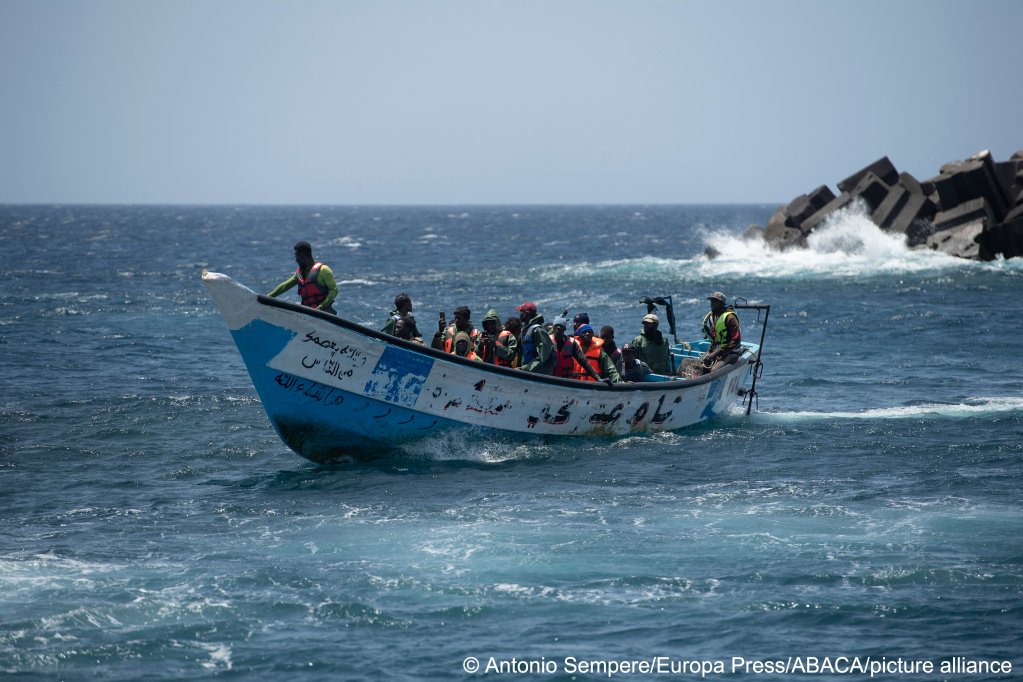
On the Atlantic route from West Africa towards the Canary Islands archipelago, Caminando Fronteras counted 1,906 deaths and disappearances in 2025 -- just under two thirds of all fatalities. The vast majority of them had left from Mauritania.
The previous year, Caminando Fronteras had tallied 9,757 deaths or disappearances on this route alone, amounting to the vast majority of the 10,457 deaths at sea that took place on migratory routes toward Spain in 2024.
This drop is also linked to the overall fall in arrivals to the Canaries in 2025, according to numbers provided by the Spanish Ministry of the Interior: Out of the roughly 36,000 arrivals in 2025, only about 17,500 affected the archipelago in 2025 -- just shy of half of the total number.
This compares to nearly 47,000 arrivals in the Canary Islands in 2024 out of a total arrival number of more than 60,000 people in all of Spain -- almost 80 percent of all arrivals that year.
Read AlsoSpain: Multiple arrests in connection with deaths in Atlantic waters last month
Cooperations that save lives
This fall in arrival numbers is attributed by Spanish authorities to the strengthening of border surveillance cooperations with its partners in Senegal and Mauritania, as well as closer migration partnerships between individual African nations and the European Union.
As a consequence of these agreements, Mauritanian authorities reported that they intercepted more than 30,000 migrants attempting to cross the Atlantic between January and April 2025 alone.
Since 70 percent of all departures in 2024 had launched from Mauritania, Spain's strategic partnership with the West African nation appears to have paid off in 2025, resulting not only in a drop in arrivals but also in much fewer fatalities at sea.
However, for Caminando Fronteras this is not necessarily a sign of progress: In its view, "the main cause of mortality [on migration routes to Spain] is the influence of migration control policies on the use of search and rescue operations," the NGO said in a statement.
"The arbitrary approach to rescue operations has repeatedly led to delays and inaction, allowing boats that were clearly in danger to sink, causing deaths that could have been avoided," Caminando Fronteras explained, noting that a large number of migrants trying to reach the Canaries tend to be unaccompanied minors, which implies that many of the casualties at sea will also likely involve young migrants.
Read AlsoSpain: Authorities transfer 679 unaccompanied migrant minors to mainland
Balearic route: twice as deadly in 2025
However, the drop in arrivals in the Canaries and the significant reduction of fatalities on that route might be overshadowed by another trend:
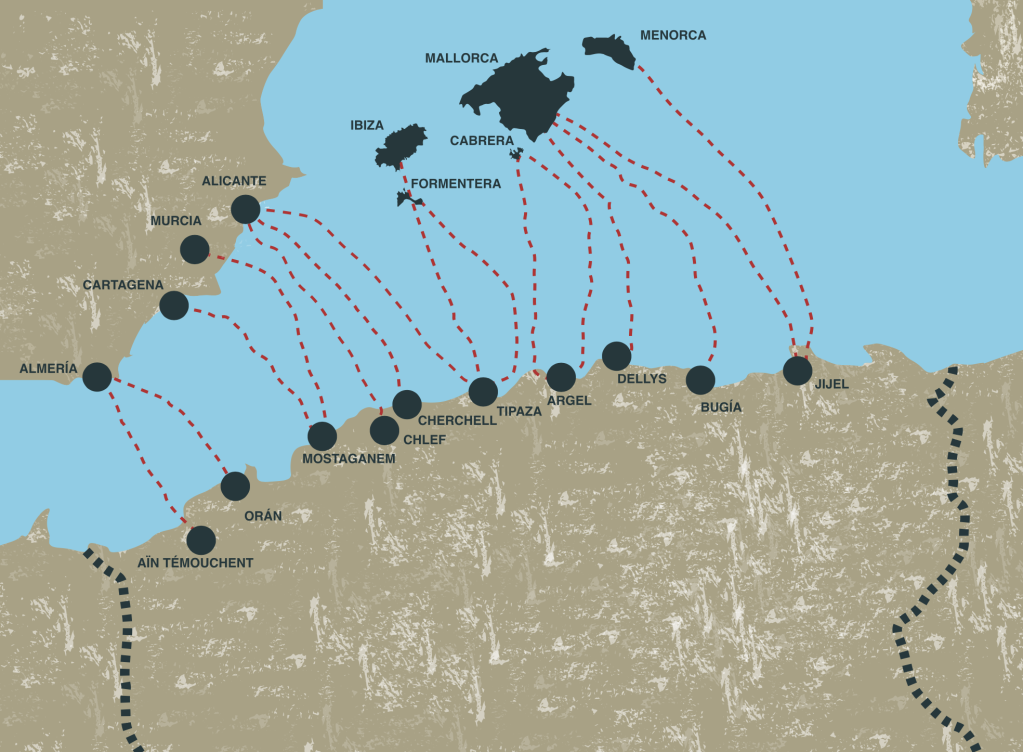
While the Atlantic route is becoming less attractive to prospective migrants and therefore also less lucrative for smugglers, there has also been an uptick on the migration route from North Africa's Mediterranean coast to Spain, with Algeria becoming the main point of departure in this context.
According to local authorities, more than 7,200 migrants reached Spain's Balearic Islands between January and December 2025, marking a 27% increase compared to 2024.
This rise in arrivals, however, also correlates with many more deaths: According to Caminando Fronteras, 1,037 people who had set off from Algeria for the Balearic Islands lost their lives on this route in 2025 -- twice as many as in the previous year, when the NGO's total death count on the Balearic route stood at 517.
Read AlsoHundreds of migrants rescued at sea while trying to reach Canary Islands, Mallorca
Correlation but not causation
Caminando Fronteras stresses, however, that the rise in numbers on the Balearic route does not reflect a shift of migrants opting to depart from North Africa instead of West Africa:
"(T)hey are two completely different migratory circuits, whose profiles, trajectories and dynamics are not interchangeable and cannot be interpreted as replacing one another," Caminando Fronteras explained in a statement.
The Algerian route "is primarily used by Algerian nationals, although Syrian and Palestinian migrants are also frequently present in smaller numbers. By 2025, Somali migrants had joined nationals from West African countries who had begun using this route several years earlier," the NGO stressed.
Read AlsoBalearic Islands: Migrant bodies found with bound hands and feet in waters off Mallorca
Caminando Fronteras highlights that major rescue challenges also prevail on this route: Among the "large number of bodies washed up on the shores of the Balearic Islands throughout 2025, many had drowned just shortly before being washed ashore," it said,
Since the Algerian route to the Balearic Islands had become "the main transit route to Spain" in 2025, more attention needed to be shifted to saving lives on this route, the group added.
The NGO meanwhile also confirmed that new migration routes were emerging, such as the one to the Canaries through Guinea, with "a growing number of departures from the port of Kamsar."
Read AlsoGuinea emerges as new irregular migrant departure point towards Europe