
A controversial law in Denmark which has been dubbed a "ghetto law" could violate EU anti-discrimination rules, the European Court of Justice has ruled. The judgement comes as residents challenge evictions and forced relocations linked to housing redevelopment plans governed by the legislation.
The European Court of Justice (ECJ) has ruled that Denmark’s controversial public housing law -- often referred to as the country’s "ghetto law" -- could amount to discrimination based on ethnic origin, dealing a blow to the Nordic country’s approach to housing-based integration.
In a judgment delivered on December 18, the court said it was up to Danish judges to decide whether the law violates EU rules on equal treatment. The case will now return to Denmark’s courts for further deliberation and interpretation.
Read AlsoUK and Danish leaders call for reinterpretation of ECHR
Law targets 'transformation areas'
Denmark’s 2018 Law on Public Housing requires authorities to draw up redevelopment plans for so-called "transformation areas." These are neighborhoods with social and economic challenges -- such as unemployment, crime and low income -- and where more than 50 percent of residents are classified as immigrants from "non-Western" countries and their descendants.
Under the law, public housing associations must reduce the proportion of public family housing units in these areas to 40 percent by January 1, 2030. To do so, landlords can demolish housing blocks, sell properties to private developers or convert family apartments into smaller units.
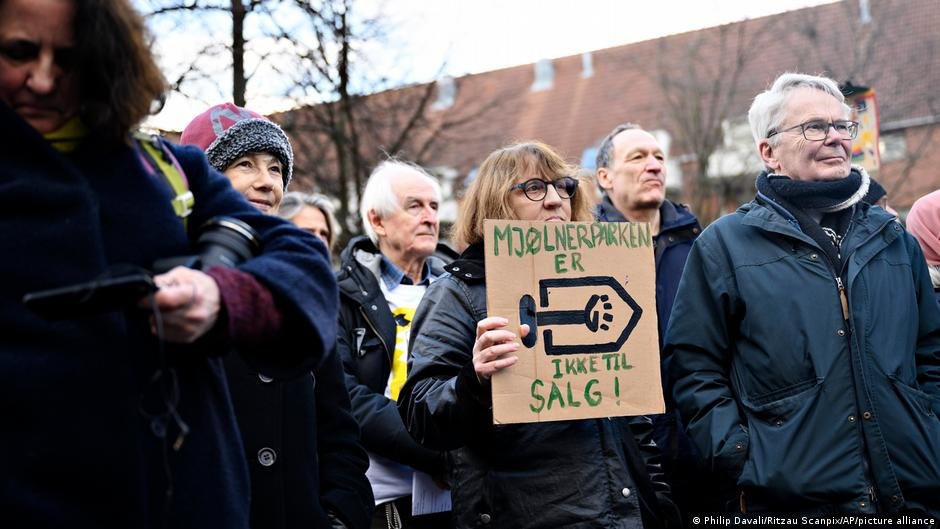
In practice, this has led to lease terminations and relocations, including on housing estates such as Mjølnerparken in Copenhagen and Ringparken in the municipality of Slagelse.
Danish authorities say the law is aimed at eradicating segregation and so-called "parallel societies" in disadvantaged neighborhoods that often struggle with crime.
The case reached the ECJ after Danish courts asked whether the law could amount to direct or indirect discrimination under EU law.
Read AlsoWhy Denmark is clamping down on 'non-Western' residents
Direct or indirect discrimination under EU law?
The EU's top court said ethnic origin is determined by a set of factors -- such as nationality, language, religion and cultural background -- and that no single factor, including nationality or country of birth, is sufficient on its own. It stressed that Danish judges must assess whether the criterion based on the proportion of "non-Western" residents establishes a difference in treatment based on ethnic origin.
In the ruling, the ECJ said this difference treatment may include "an increased risk, for the inhabitants of 'transformation areas', of having their leases terminated early and, therefore, of losing their home," a risk it said appears greater than in areas with similar socioeconomic conditions but lower proportions of immigrants.
Even if the law is not found to constitute direct discrimination, Danish courts must still examine whether it leads to indirect discrimination -- meaning that an apparently neutral rule places certain ethnic groups at a particular disadvantage in practice.

Reacting to the ruling, rights groups said they believed the ruling confirmed long-standing concerns. Dina Hashem, senior legal advisor at Amnesty International Denmark, called the decision "an important step in protecting human rights and respecting the equality of all people," adding that "the right to equal treatment regardless of ethnic origin is a fundamental principle that EU member states are obliged to respect in their national legislation."
She also criticized Danish politicians for ignoring warnings for years. "It is surprising that Danish politicians have ignored warnings about discrimination in the ghetto law for so long -- while residents in areas covered by the law have been forcibly relocated and apartment blocks demolished," she said.
Read AlsoDenmark's EU Presidency puts migration reform center stage
Residents say law is discriminatory
Residents affected by the law say it unfairly targets them based on their background.
In Mjølnerparken, some residents said they were confident the law would be overturned. "100 percent we will win," said Julia, a resident who declined to give her full name, adding that the law was solely about "discrimination and racism," she told the French news agency Agence France Presse (AFP).
Muhammad Aslam, head of the housing estate’s tenants' association, said residents were fighting for equal treatment. "Our fight is for each person to be treated equally, that you can’t throw people out of their homes and that the courts, the rule of law and democracy are respected," he said.
Aslam, who has lived in the estate since 1987, said he and his children were included in statistics used to label the neighborhood a ghetto. "I, who am self-employed, as well as my children are all included in the negative statistics used to label our neighborhood a 'ghetto,' a parallel society," he said.
Read AlsoDenmark: Unprecedented measures to signal to migrants they are not welcome
Lawyers and experts react
Eddie Khawaja, a lawyer representing residents facing eviction in Mjølnerparken, told Reuters he was "positively surprised" by the ruling.
"It is very difficult to see any elements that support our counterpart’s argument that this is a neutral criterion," he said.
Legal experts said the ruling strongly supports the residents' case. Professor Frederik Vaage of the University of Southern Denmark stated: "The interpretation is clear. The plaintiffs have won the case, securing a successful interpretation of EU law."
Earlier this year, the ECJ’s advocate general had also criticized the policy, saying that while efforts to diversify neighborhoods might be well intended, "such diversification cannot be achieved by placing an already disadvantaged ethnic group in a less favorable position."
Read AlsoUK intends to follow Denmark's lead in tough-on-immigration legislation
What happens next
Because this was a preliminary ruling, the ECJ did not decide the dispute itself. Danish courts will now apply the court’s interpretation of EU law to the cases before them.
Following the ruling, the Danish Ministry of Social Affairs and Housing said the case would return to the Eastern High Court, adding that it would study the ECJ’s verdict carefully.
Experts estimate that around 11,000 people across Denmark could be forced to leave their homes by 2030 if the law remains unchanged.
Read AlsoFrom north to south, Europe tightening migration policies
With AFP, dpa and Reuters