
Spanish police say they have arrested 11 people and identified more than 300 potential migrant victims of a gang accused of forcing the migrants to work in "slave-like" conditions on farms across central and eastern Spain.
Many of the migrant victims identified by Spanish police came originally from Nepal, said a statement issued by the police on Thursday (December 4).
According to a report by the news agency Reuters, the migrants entered the Schengen area on tourist visas, before being taken to rural areas of provinces in eastern Spain, around Alicante, Valencia and Zaragoza.
During the raids this week, Spanish police say they seized cash, forged documents and phones.
The migrants found were allegedly packed into poorly ventilated rooms, some of them sleeping on the floor, but still being charged "excessive fees" for rent, transport and food, police told journalists.
Read Also50 million people trapped in 'modern slavery' — report
'Forced labor'
Some of the migrants were working 12-hour days, and in many cases received no wages at all. Rights groups describe these types of conditions as "forced labor." Police added that the migrants had limited access to bathrooms and were in general kept in "living conditions that were completely undignified and inhumane," reported the news agency Associated Press (AP).
Although they were believed to be accommodated in lodgings in Albacete in south-eastern Spain, they were then driven on a daily basis to farms across several regions.

At least one Nepalese man is also believed to have died during one of several accidents involving vans used to transport the migrants around. The vans are believed to have lacked basic safety standards, police said.
A total of 322 migrants were found by police, 294 of them lacked proper documentation to live and work in Spain.
Read AlsoBritain recruits migrant workers from new countries to pick fruit harvest
Nepalese migrants
According to the World Bank, over 20 percent of Nepal’s 30 million people live in poverty. In 2017, the International Labour Organization issued a report on labor migration from Nepal. In it, they estimated that around 3.5 million migrant labor permits had been issued to Nepalis in the nine years prior to 2017 and that around 1,600 workers were leaving the country every day to take up foreign employment.
At the time of the report’s publication, around half of all Nepali families were thought to rely on financial support from relatives abroad.
In 2019, the UN Migration Agency (IOM) found that around 60 percent of the Nepalese working population was employed in agriculture. The agency also found that the overall number of people migrating for work worldwide had increased since 2017, although these figures were not specific to Nepal.
In 2018/19, the remittances generated from Nepalis working abroad amounted to a little more than a quarter of the country’s entire GDP (Gross Domestic Product).
Read AlsoUK: Nepali seasonal workers scammed by recruiters
Trafficking from Nepal
The number of trafficking cases registered by the Nepali police also increased between 2013-14 and 2017-18, said the IOM in 2019. According to Nepali police records, 78 percent of Nepali trafficking victims were female and 22 percent male. At least a quarter of the victims were children.
The IOM added that "undocumented migrants are particularly vulnerable to trafficking. They may then be forced to work in brothels, children are forced to work in circuses and coal mines, and men are being trafficked for their body parts."
IOM added that it had found "some evidence that many migrant workers use irregular channels to access foreign employment, not going through the process of obtaining a labor permit, increasing their risk to trafficking."
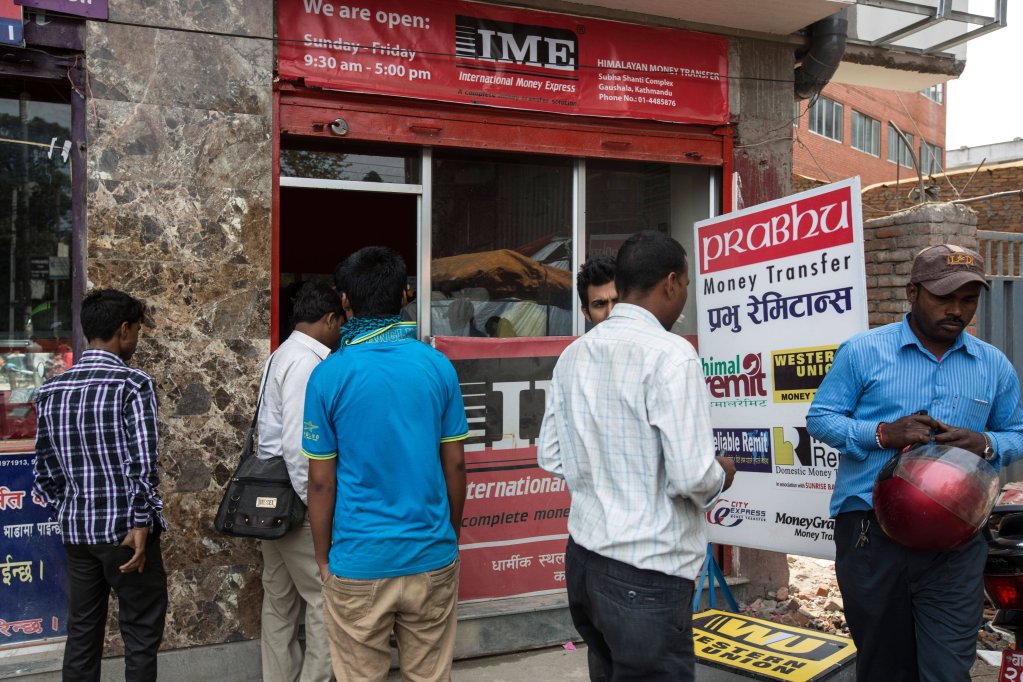
The difficulty for many Nepalis to obtain official labor permits means that many turn to smugglers in order to find employment, according to IOM. For instance, a ban on young Nepali women from being able to obtain labor permits to work in the Gulf countries prompts many women to turn to smugglers. This can result in them being exploited or deceived along the way, meaning that the smuggling turns into trafficking.
India is one of the main transit countries for neighboring Nepal, and from there, migrants tend to head towards Europe, the US or Gulf countries, sometimes using forged documents provided by the smugglers for their onward journeys.
According to the IOM, Portugal tends to be a gateway into the EU for Nepalis.
Read AlsoMigrant fruit pickers face exploitation in Portugal
Europol operation
At the beginning of November, Spanish police participated in a multi-country Europol operation, which uncovered 404 migrant victims of labor exploitation and 93 suspected perpetrators across 32 countries.
The conditions that migrants were found to be living in near Seville in Spain sound similar to those uncovered by the Spanish police's latest operation.
Europol issued the following statement about the case on November 6: "During a joint action on an agricultural property in Seville, a Nepalese victim of trafficking in human beings for labor exploitation was identified following an inspection at a kebab restaurant. The victim was found living in inhumane, unsanitary, and overcrowded conditions. An investigation has been launched, and the victim has been transferred to a police station for assistance and placed in a shelter. Additionally, labor authorities initiated three investigations involving five workers found working without labor contracts, two of whom were illegal immigrants in Spain."
With Reuters and AP