
Thousands of young Guineans are now setting sail from the country’s Atlantic coast toward Spain's Canary Islands, elongating the already perilous route to Europe. Political instability, economic hardship, and reinforced migration controls in neighboring countries in cooperation with European countries appear to be driving the route reconfiguration.
Guinea is emerging as a major departure point along the Atlantic migration route to Spain’s Canary Islands, with thousands of young Guineans attempting the journey in recent years. Authorities in the junta-led country have described the growing exodus as a "haemorrhage" while many young Guineans say they have lost faith in their country's leadership.
Departures from Guinea also seem to be on the rise due to an increase in border controls and bilateral agreements between Spain and countries further north, such as Mauritania and Senegal, which are pushing migrants to seek less monitored, albeit typically more dangerous, departure points.
"We can see how increased surveillance in Mauritania and Senegal pushes departures further south to Guinea, lengthening and worsening the journeys," Sylvia Ekra, Regional Director for West and Central Africa at the International Organization for Migration (IOM), said in a statement on November 25.
The longer Atlantic crossing from Guinea adds roughly 750 kilometers compared with routes from Senegal, increasing the dangers faced by travelers. Small, overcrowded pirogues (local wooden fishing boats) now depart from coastal towns like Kamsar, where fishing activity is increasingly diversifying into facilitating irregular migration.
The shift to Guinea shows a wider reconfiguration of West African migration routes. Before, smugglers targeted Senegal, Mauritania, and Morocco as departure points, but intensified European visa restrictions and bilateral agreements with Spain have redirected the departures ever further south.
The crossing from Guinea spans over 2,200 kilometers and can take up to ten days, substantially increasing the risk of shipwrecks, dehydration, and heatstroke. NGOs have warned of "ghost ships," vessels carrying migrants that vanish at sea, leaving passengers stranded and often unrecorded or unidentified. In 2024, the Spanish NGO Caminando Fronteras estimated that there could have been as many as 10,457 deaths along the Atlantic route in a single year.
What's driving migration from Guinea?
Growing economic hardship and political instability have fuelled a wave of disillusionment in Guinea, driving many to see irregular migration as their only remaining option.
"When you tell them that the route is dangerous, most reply: 'Where we are, we are actually already dead,'" French news agency AFP reported, citing Elhadj Mohamed Diallo, director of the Guinean Organization for the Fight Against Irregular Migration (OGLMI).
Despite stepped-up policing and anti-smuggling operations, departures continue. Diallo has documented multiple attempted embarkations involving local fishermen accustomed to the sea.
"These are people who are used to working at the ports. It may have started with a convoy of 15 people including children and women. They are fishermen who are used to the sea. Nobody was expecting these departures from Guinea, because the distance is enormous," he told RFI.
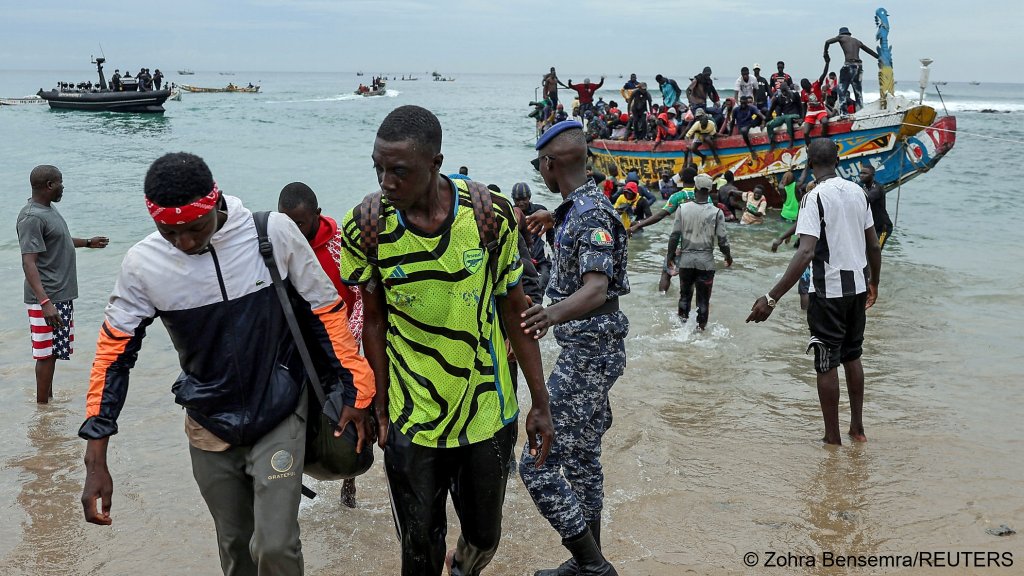
Controls in Senegal, Mauritania drive migrants to seek Guinea sea departure
Despite the high risks, departures from Guinea are increasing just as arrivals via northern routes decline. UNHCR data shows that departures from Mauritania fell by roughly 40 percent in the first half of 2025 compared to 2024, largely due to stricter policing and bilateral agreements with Spain, according to the UNHCR's latest report on the West Africa Atlantic Route (January-June 2025).
Senegalese departures also decreased amid intensified law enforcement.
From January to June 2025, 11,400 people arrived in Spain via the Atlantic route, with Guineans accounting for 1,229 arrivals. Malians led with 5,008 arrivals, followed by Senegalese (2,532), Morocco (910), Mauritania (438), Côte d’Ivoire (406), and the Gambia (262), the UNHCR reported.
Persistent instability across the Sahel continues to push people to seek safety in Europe. As neighboring countries reinforce their borders and partner up with European countries to put blocks on migration, Guinea’s coastline has become a comparatively unmonitored alternative. So, for now, analysts expect this southward shift in departure points to continue.
With AFP and RFI