
Between 100 and 130 migrant girls, awaiting recognition of their minority status, are taking part in a program offered by the Doctors Without Borders day center in Pantin. The aim is to ensure comprehensive support for these vulnerable teenagers, often homeless and at the mercy of exploitation networks, so that they do not go off the radar.
Between 100 and 130 foreign girls, awaiting recognition of their minority status, are taking part in a program offered by the Doctors Without Borders day center in Pantin, in the northeastern suburbs of Paris. The aim is to ensure comprehensive support for these vulnerable teenagers, often homeless and at the mercy of exploitation networks, so that they do not go off the radar.
When she was told that she was not a minor under French law, Zahra*, 16, "17 in a month," thought the problem lay with her. "I think it might be because of my body," she says. She spreads her arms to her sides to explain what she means: she feels too fat. As if a large body were a sign of maturity. Yet she has a youthful face and punctuates all her sentences with a nervous, teenage laugh. "It’s not your fault," a member of Doctors Without Borders (MSF) tells her, sitting opposite her in a day center in Pantin.
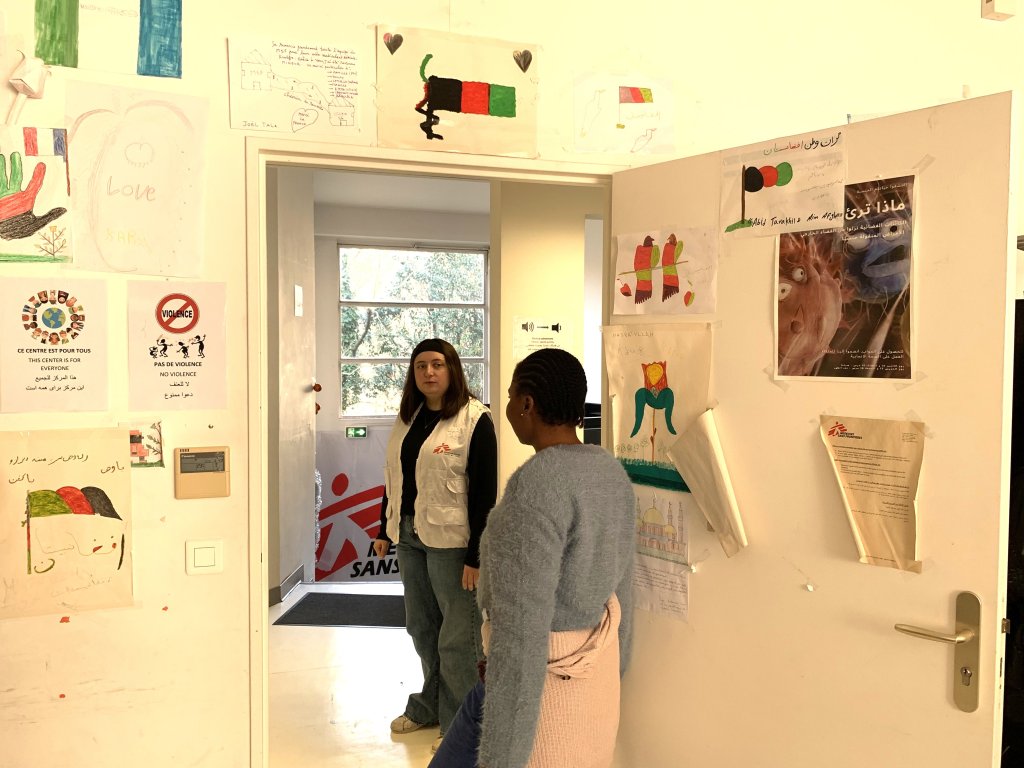
Like Zahra, the young foreign girls welcomed at this center suffer from a lack of confidence and self-esteem, after lives marked by abuse and, often, exploitation. The French state’s failure to recognize their minority status is the latest blow. While their appeals are being processed, they can come to this shelter during the day, between 9 am and 6 pm, to eat, wash, sleep, do physical or manual activities, or simply lie down on a mat near the radiators, as two of them did on Thursday, November 27. Since July 2024, this place has been dedicated to young women.
"I feel good here, loved. We don't get bored, there's always someone to talk to. We don't feel the absence of our parents. Everyone is kind," Zahra says, enthusiastic and warm. She is staying in a social hotel that is closed during the day. "I come every day. I'm a regular."
"Here, nobody wants to hurt them." The place is unique. "We don’t know of any other day center dedicated to girls," Diane Lafforgue, the project coordinator, explains, adding that this center has existed since 2017 but was previously open to a mixed public. "There were many more boys than girls. Being the minority made it difficult to support the girls. We lost track of them quite quickly," Véga Levaillant, the project’s socio-legal manager, adds.

For these girls, many of whom were victims of violence, including rape, the majority of boys was a deterrent. The MSF team then decided to change things. "A place reserved for boys had just opened in Paris, which helped us in our decision to open one for girls," Diane Lafforgue explains.
Now, their numbers are growing. There are 15 new participants in the program each month. Between 100 and 130 girls come to these premises, whose walls are covered with drawings and messages they've written in the style of feminist street art: "My body is not a punching bag" or, more simply, "Stop."
"They are constantly approached and solicited by men on the street because they are young, naive, and unfamiliar with social norms. Outside, they are vulnerable. But here, no one wants to harm them," Diane Lafforgue says.
'Advances'
The MSF reception center is not simply a heated rest area. The place offers individualized medical and socio-legal support. "When they enter the program, they have an initial appointment with a nurse who assesses whether there has been any violence or unprotected sex in the past five days," Véga Levaillant explains. "Then, the young women meet with a social worker, a lawyer, a psychologist, and an intercultural mediator. It’s a support system, providing support during their legal proceedings, which take an average of six to nine months."
When necessary, MSF teams, acting as chaperones, sometimes accompany these young women to the hospital for an abortion or to the police station to file a complaint. This is to support them "because they are in survival mode," Diane Lafforgue explains.

According to statistics, 70 percent of these young people will be recognized as minors at the end of the process and can then be placed in the care of French child welfare services (ASE). In the meantime, MSF’s priority is to prevent them from being left to fend for themselves, especially since several of them are sleeping on the streets or in a warehouse in Bagnolet (Seine-Saint-Denis).
Nadia*, also from Ivory Coast, 16 years old, slept in a music school the night before. She does not know where she will sleep tonight. Every night since her claim of minority was rejected, a week ago, she waits for hours in front of Paris City Hall for associations to direct her to temporary shelters. "We don't sleep well, we're cold," she says, her eyes wary, her lips trembling.
Her eyes well up when she explains why she crossed the Mediterranean. "I was working in Tunisia, I was a housekeeper for a family. But the husband was making advances towards me. So I left."
"Advances": these words often mask a more violent reality. The young women arrive here carrying their burden of modesty and shame. “They don’t talk about the violence they’ve suffered on the very first day,” Diane Lafforgue says. “It takes time to build trust. These are girls who are being dragged around. But, for our part, our role is to dare to ask the questions.”
Read AlsoParis police evict unaccompanied minors from Gaîté Lyrique amid clashes
Exploitation
Through persistent questioning, Diane Lafforgue and her colleagues realized that the majority of the people they were assisting, who came from the Democratic Republic of Congo (DRC), had arrived by plane with false documents (presenting themselves as adults to facilitate international travel) via a trafficking network. The violence often begins as soon as they leave the airport. The phenomenon is so widespread that it caught MSF teams off guard, and they are now trying to train themselves on issues related to exploitation.
Zahra seems to have fled a forced marriage. She remains discreet about it. Her departure from the country "just happened," she says. She laughs when mentioning the hardships, the interceptions in the Mediterranean, and the imprisonment in Tunisia. She prefers to share the big news of the day: her return to school. She has just come from her first day at a middle school in Bobigny, in a special education class. "We had a grammar lesson. I didn't understand very well, but I really enjoyed it. The teacher asked everyone to write in their notebooks: 'I met Zahra and she's very nice,'" she says before bursting into laughter again, honored by this gesture. As soon as classes ended, she rushed to the MSF office to share her joy.
"I have classes until noon, except on Tuesdays, which means I can continue coming here in the afternoons. I'm staying on as a member."
*The girls' names have been changed.