
In the camp near the Calais hospital, migrants are not deterred by the new UK immigration measures. Being just within reach of their final destination, migrants do not think of giving up.
A dozen seagulls fly around the grey Calais sky. The birds are looking for soiled food crumbs on the floor: a piece of bread, leftovers of a food distribution, fruit peels.
The somewhat aggressive ballet of seagulls doesn't disturb the inhabitants of this makeshift camp erected near the hospital in this northern French town. On this rainy November morning, the migrants are slowly waking up. Some are brushing their teeth and washing their faces near one of the two water tanks installed nearby, while others are returning from the showers provided by Vie Active, an association mandated by the state. Behind the bushes, figures can be seen emerging from their tents.
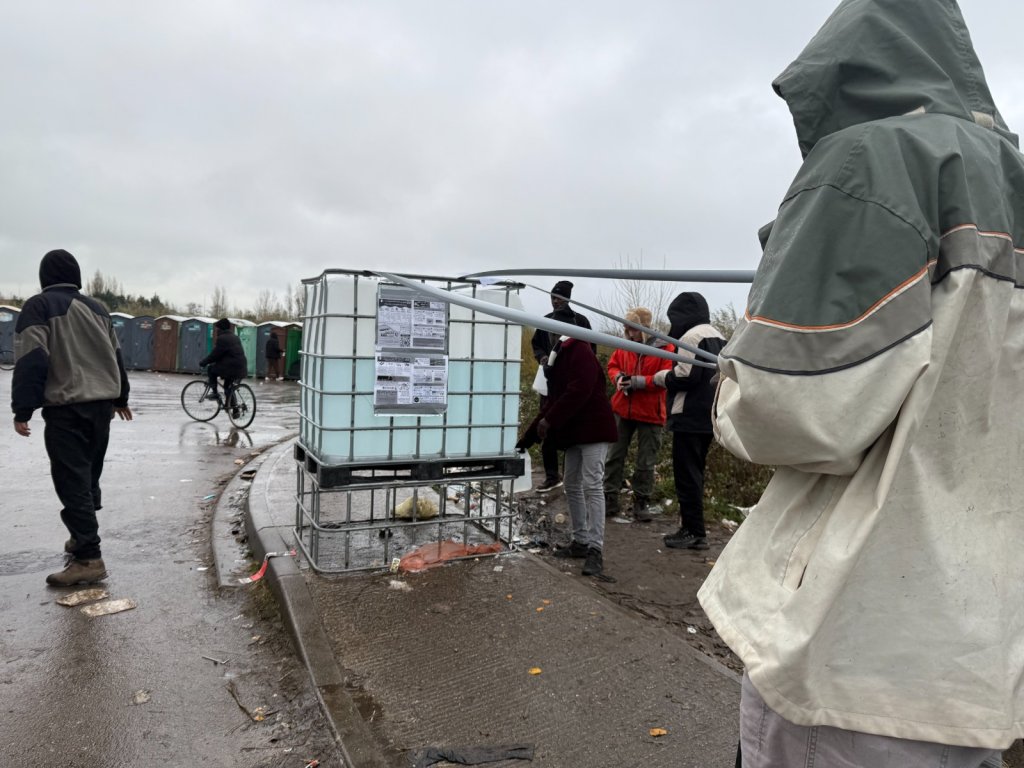
This is where approximately 1,000 migrants are hoping to soon reach the United Kingdom, the final stage of their long journey into exile. "It's cold, we live in the mud, it's dirty." Ayoub, a 24-year-old Sudanese man, sighs, a beanie pulled down over his head.
The majority of the migrants in this camp are from Sudan and cannot afford to pay a smuggler to cross the Channel. They try to hide in trucks bound for England – a method no less dangerous than boarding a small boat, but one that costs nothing.
'I have no other choice but to try my luck' in the UK
Despite the tightening of British immigration policy aimed at deterring migrants from reaching the UK, migrants in Calais have not changed their plans, something that is reflected by the number of crossings: since the beginning of November, more than 2,300 migrants have reached the UK via the Channel crossing. And since January 1, more than 39,000 people have reached British shores. That's more than for the whole of 2024.
Last week, the Labour government announced "the most important [reform] of modern times," according to the British Home Secretary: the introduction of a temporary status for refugees (the residence permit will be valid for only two and a half years instead of five), an increase in the required length of stay in the UK for obtaining permanent residency (20 years instead of five), and the elimination of automatic access to social benefits for asylum seekers.
"I saw on social media that life in England was becoming complicated for people like us. But I have nowhere else to go, so I have no other choice but to try my luck there," Ahmed*, a 26-year-old Sudanese man whose asylum application was rejected in France, told InfoMigrants.
While Ahmed seemed well-informed about the new British measures, the majority of migrants encountered that day in Calais were far from aware of them. Some were familiar with the plan signed with Paris this summer based on the "one in, one out" principle, which involves returning migrants who arrived illegally in the UK to France in exchange for the UK accepting migrants already in France.
Read AlsoUK: Irregular migrants and children may be subjected to mouth searches
Migrants with poor information
But the information they have is incomplete or even inaccurate. Mohamed, a 20-year-old Sudanese man who has been living in Calais for four days, has applied to legally enter the UK under this agreement. However, the young man does not meet the criteria established by the Home Office to benefit from this measure. "You just have to be an adult and have a passport," he believed, as does Ahmed.
Yet, according to the text, foreign nationals in France who can be accepted into the UK through this program must also have family ties in the country. Neither Mohamed nor Ahmed has these ties.
There are also those who have never heard of the agreement. Khalid*, another 18-year-old Sudanese man, returns from the showers run by Vie Active. He puts a foot down, stops his bicycle, and seems completely uninterested in the changes. He is "unaware of anything": neither the Franco-British agreement nor the new stricter measures. When given details, he dismisses the discussion with a wave of his hand. "It doesn't matter, I'm going to continue on my way. I came from Africa, I crossed the desert, the Mediterranean Sea … I've come too far to stop now and be afraid of an agreement."
Like Khalid, many of the migrants in Calais see England as their last chance. Despite the deterrence measures taken by the British government in recent months, they insist they will not give up on their goal, even though they are only a few kilometers from the English coast.
For years, they have been shuttled from one European country to another. Many have had their asylum applications rejected or have been "Dublinized" in another member state – the Dublin Regulation requires asylum seekers to apply for protection in the first country of entry into Europe; but since Brexit, the United Kingdom is no longer part of this protocol, and migrants can no longer be "Dublinized."
Read AlsoWhat happens to migrants removed to France under the 'one-in, one-out' deal?
British Eldorado
For them, the British Eldorado remains their last hope on their long, arduous journey into exile.
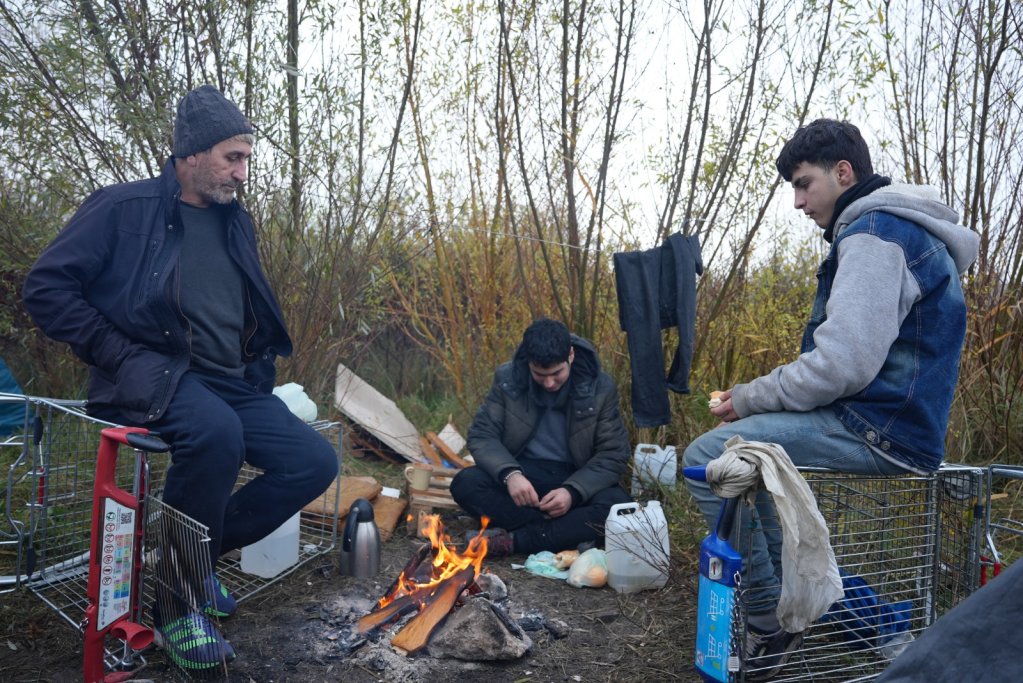
Reza is no stranger to this. This 55-year-old Iranian father was deported from the United Kingdom in 2018 (when the country was still a member of the European Union and subject to the Dublin Regulation) to Estonia, where he had his fingerprints taken. Once he had completed the Dublin procedure (which lasts 18 months), he finally applied for asylum in France, but his application was rejected. "I have no choice but to go to England, where else can I go?" he said, sitting on a shopping cart, warming his hands over a fire. Beside him, his two teenage sons spread some jam on a piece of bread.
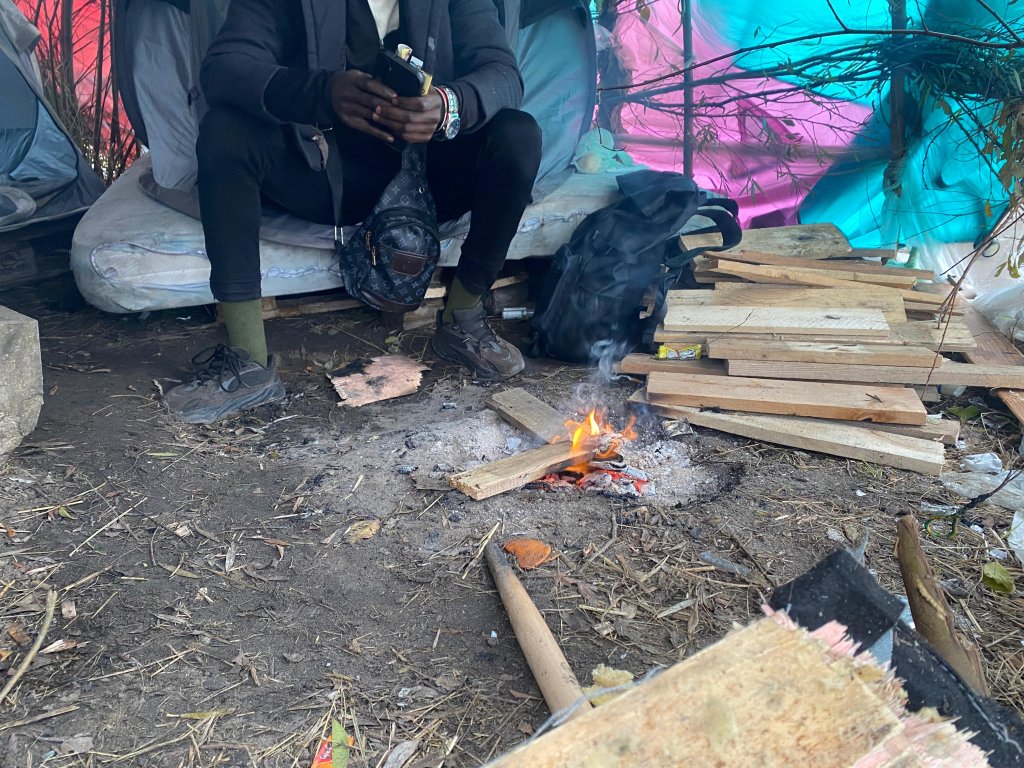
Ahmed also sees no other option. The Sudanese man had never considered going to the United Kingdom, but when his asylum application was rejected in France, he had to leave the reception center and found himself homeless. "I could have stayed here, but I don't have documentation. I don't particularly want to go to Great Britain, but I don't see what else I can do. Where else am I supposed to live?" the young man lamented, sitting in his tent, a small fire burning at his feet. "Over there, I think I would have a better life," he said with hope, like so many others, convinced that a future awaits them on the other side of the Channel.
Many say that France's refusal to grant them asylum has changed everything and forced them once again into exile. Ayoub summed up his situation: "France doesn't want me to stay here. The way we're treated is a way of telling us we're not welcome and that we have to leave. The living conditions in this country are pushing me to go to the UK, and the UK is pushing us back here. What are we supposed to do?"
*Names have been changed at the request of those involved.