
In December, Germany’s community sponsorship program for refugee resettlement -- NesT (Neustart im Team) -- will close after just seven years in operation. An innovative approach to integration, the scheme was suspended amid Germany’s toughened stance on migration and asylum.
It has been 10 months since Achol Lual, her mother and sisters moved to a small town in Germany’s Ruhr Valley, far from their home country South Sudan, and the hectic neighborhoods of Cairo where they lived before being resettled.
Twenty-one years old, Lual is working hard on her German so she can start nursing school next summer. "It is a big chance," she said about the opportunity to study. In Egypt, financial pressures meant pausing work to take up higher education was not an option. "If you have money you can go to learn, but if you don’t have money, you cannot do that."
Coming to Germany has changed her family’s life, Lual said, remarking that for her mother it has given her peace after years of exhaustion.
She remembers the cold January day she and her family arrived at the airport. Unlike most newcomers, they were welcomed by a group of local residents – a so-called "mentoring group" – organized under Germany’s unique community sponsorship program, Neustart Im Team (New Start in Team) or NesT.
One more resettlement flight to go ahead
The family didn’t know it at the time, but they were the last people to arrive through NesT before resettlement flights were halted in May by Chancellor Frierich Merz's coalition government.
Special federal admissions programmes have also been affected, including an embattled program for Afghans formerly working with the German government.
The abrupt suspension of these programs has led to a slew of legal challenges in German courts.
On October 29, the Higher Administrative Court of Berlin-Brandenburg ruled that Germany was obligated to facilitate entry to the country of a South Sudanese woman and her family who were scheduled to fly on a May 8 flight from Kenya. The flight, originally scheduled to carry some 180 refugees from Somalia, Sudan and the Democratic Republic of the Congo, had been abruptly cancelled just two days before departure. One family in the NesT program is scheduled to travel on the flight.
A spokesperson for the German Interior Ministry confirmed to InfoMigrants that the charter will go ahead.
According to another official at the ministry, who spoke at a Berlin conference last month, efforts are being made to arrange the flight before the end of the year.
Dismayed by the cancellation of NesT, and the broader resettlement program and admissions schemes, mentors from NesT started a petition last spring calling for the Kenya charter flight to go ahead, and for resettlement to continue.
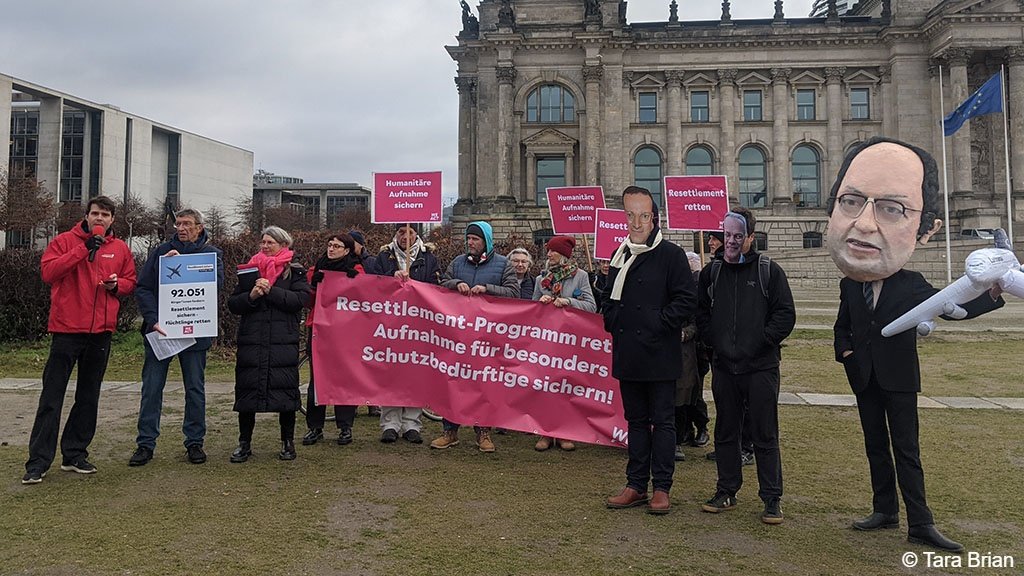
On November 18, they staged the submission of the petition in front of the Federal Parliament with some 93,000 signatures (now over 95,000).
How NesT works
Inspired by a long-standing program in Canada, NesT is one of more than 16 community sponsorship initiatives that sprang up in Europe and Australia in the last decade. Piloted in Germany in 2019, NesT became a regular admission stream in 2023, coordinated through Germany’s Interior Ministry, the Federal Office for Migration and Refugees (BAMF) and the Federal Government Commissioner for Migration, Refugees and Integration, in cooperation with civil society partners and the United Nations refugee agency, UNHCR.
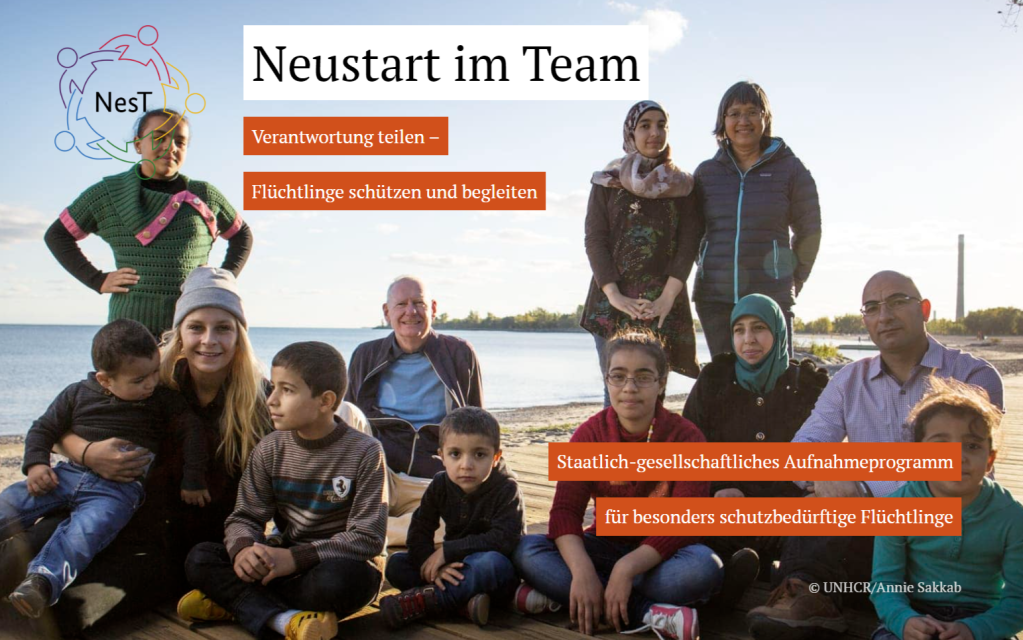
Under the NesT program, selected refugees being resettled to Germany are paired with mentoring groups in the local community. The mentors commit to finding and covering the costs of accommodation for one year and assist with administrative tasks like getting children in schools, enrolling the newcomers in German class, and supporting efforts to find employment.
Since its inception, 186 refugees have arrived through the program with the assistance of 43 mentoring groups.
NesT will continue to support existing groups until the end of the year – and the arrival of the last family this December – and then close shop at the end of the month.
Read AlsoGermany's new government suspends refugee resettlement
A pathway for the particularly vulnerable
Operating as part of Germany’s resettlement program, places offered under NesT are additional to regular resettlement quotas. Since 2012, more than 35,600 people have been resettled to Germany, including, since 2016, as part of the EU’s voluntary resettlement program. Germany had pledged 13,100 resettlement places over the course of 2024 and 2025, with some 5,720 arriving before admissions were halted.
Described by Germany’s Interior Ministry as a “legal and safe way” for particularly vulnerable people to access protection, resettlement involves the transfer of particularly vulnerable refugees from a country of first asylum to a third country that has agreed to admit them. Following nomination by UNHCR, refugees undergo health checks, security vetting and an in-person interview with German officials prior to being selected for admission.
While NesT is lauded for its positive integration outcomes, the program struggled to support the scale of refugees anticipated, with yearly arrivals falling short of government quotas.
A key challenge was finding enough mentoring groups. Both the COVID-19 pandemic, and the recent arrival of over 1 million Ukrainian refugees to Germany played a role in this, according to a review conducted by the program’s civil society coordination hub, ZKS. The program’s emphasis on finding housing before a family was even matched with a mentoring group was also highlighted as a limiting factor in a BAMF evaluation of the program.
Unlike Canada’s community sponsorship model, which allows an option for mentoring groups to identify refugees for sponsorship, mentors in NesT have no input regarding the family they will be paired with.
Read AlsoRefugees flown to Germany under UN resettlement program
A success story for those who took part
Despite NesT’s relatively small numbers, both mentors and refugees are keen to share positive experiences of the program.
Ruth Dirks, part of Achol Lual’s mentoring group and one of the leaders of the petition, described how the mentors enrolled the children in school and swimming lessons and arranged for medical procedures.
“We picked [the family] up on a Thursday from the airport and on Monday the youngest child was already in school,” she said. The two middle children were in secondary school a week later, and Lual and her mother started German classes in the spring.
“It is a great advantage when this start is accompanied,” said Dirks, who together with the rest of the mentoring group, also arranged an apartment for the family prior to their arrival.
Hanan, from Syria, arrived as a child
In Wuppertal, Hanan Tamer, 16, who is originally from Syria, arrived in Germany five years ago with her parents and older sister. Today she speaks fluent German and English, even getting a first in her English class this term.
About studying in German, she exclaimed: “It’s easy!”
“At first it was hard to learn German and get used to the life here,” she said, “but now I’m very used to it.” She is busy with school and friends, and enjoys basketball, cooking and drawing.
Her mother, Ftim Jansiz, 50, works as a tailor and passed her B1 German exam two years ago.
The family still lives in the home that the mentoring group found for them. “They [the mentoring group] helped us to find work, to find schools,” said Jansiz. Her husband has work as an electrician.

Sudden cancellation: 'We were disappointed and sad',
But the suspension of the program has left other refugees and mentoring groups in limbo.
Claudia, 43, and other mentors in the central German city of Fulda, were supposed to welcome a Somali mother and her daughter on the May 8 charter flight. After years in Kenya’s sprawling Kakuma refugee camp, the pair had already travelled to Nairobi in preparation for their journey when they learned it had been cancelled just two days before departure.
For the mentoring group in Fulda, the abrupt change of plans was also shocking.
“We were disappointed and sad,” Claudia related, “but we imagined for the family it must have been far deeper and shattering.”
The group had already prepared many details for the family’s arrival, including renting an apartment. Now that the refugees will finally be arriving, they are thankful they were able to sublet the accommodation and did not give up entirely. “Everything was completely uncertain, but we were still hoping,” said Claudia.
Other mentoring groups – and the refugees they expected to welcome – have not been so lucky.
Stefanie Westermann, 46, and Vite Joksaite, 47, part of a four-person mentoring group in Dortmund, had already completed much of the process to welcome a refugee woman to their city before resettlement was suspended.
Although Joksaite has much experience supporting refugees in Germany, including from Afghanistan and Ukraine, she believes the NesT program offers something unique. “[Through NesT] you get in very close contact with the people about whom you only read in the news or see walking in the streets [but] you don't know the realities. I think all of these polarizations or fears arise from this very big distance…so I think it’s a very good method.”
With the future of Germany’s resettlement program – and the community sponsorship model – unknown, Joksaite and Westermann reserve some hope for the future. “We will be waiting,” said Joksaite.
Read AlsoEurope's new migration deals promise 'safe and legal routes,' but who really has access?