
Europe says it wants to expand "safe and legal routes," yet most remain out of reach just as labor shortages deepen across the continent. The Mixed Migration Review 2025 warns that deterrence policies are hardening while the legal pathways migrants need remain limited, pushing people into irregularity despite Europe’s growing economic dependence on them.
As Europe signs new migration agreements from Tunis to Cairo, EU leaders insist that expanding "safe and legal pathways" is central to reducing irregular crossings. But the 2025 Mixed Migration Review (MMR) finds that many of these pathways remain limited in scope, difficult to access and far smaller than the bloc’s labor needs.
The report, published by the Mixed Migration Centre (MMC), suggests that while legal mobility schemes are growing, they have not kept pace with demographic pressures or the demand for workers across Europe. At the same time, countries continue to rely on deterrence measures and border externalization, creating what the MMR describes as a widening gap between policy ambitions and the realities of migration.

The publication argues that Europe is reshaping its migration governance in a way that normalizes harsh deterrence policies while neglecting workable alternatives. This shift is unfolding amid what the MMR calls a global moment of "geopolitical turmoil," marked by conflict, collapsing humanitarian funding and a weakening multilateral system.
As Roberto Forin, program coordinator at MMC Geneva, tells InfoMigrants, "what we are witnessing has been developing for years across Europe and globally. The return of Donald Trump has simply accelerated this trend."
The report warns that practices once viewed as unacceptable -- from pushbacks and prolonged detention to offshore asylum processing -- have increasingly become part of standard migration management.
Read AlsoEuropean nations join calls to alter ECHR to enable sweeping asylum restrictions -- but how?
A continent facing demographic pressure and labor needs
The MMR highlights a growing tension in Europe’s approach to migration. While governments across the continent continue to introduce tighter border controls and reduced access to asylum, many sectors still rely heavily on migrant labor to function. Europe’s aging population, shrinking workforce and well-documented labor shortages mean that migrants play a key role in health and social care, agriculture, transport, construction and domestic work.

According to the MMR, these demographic pressures are expected to increase in the coming years. At the same time, some of the policy responses being proposed or implemented may unintentionally make it more difficult for people to enter Europe through regular channels, pushing some toward irregular routes instead.
Forin says this disconnect has practical implications. "Our societies need migrants. This is essential not only for the economy but also for the sustainability of our welfare systems. If migrants work irregularly because legal pathways are closed, they pay no taxes and everyone loses."
Read AlsoGermany: Skilled workers welcomed, as integration rules tighten
Legal pathways exist, but remain limited
European officials frequently emphasize the need for "safe and legal routes" as an alternative to irregular arrivals. The MMR notes that such pathways do exist, but in most countries, they remain limited in scale or difficult to access.
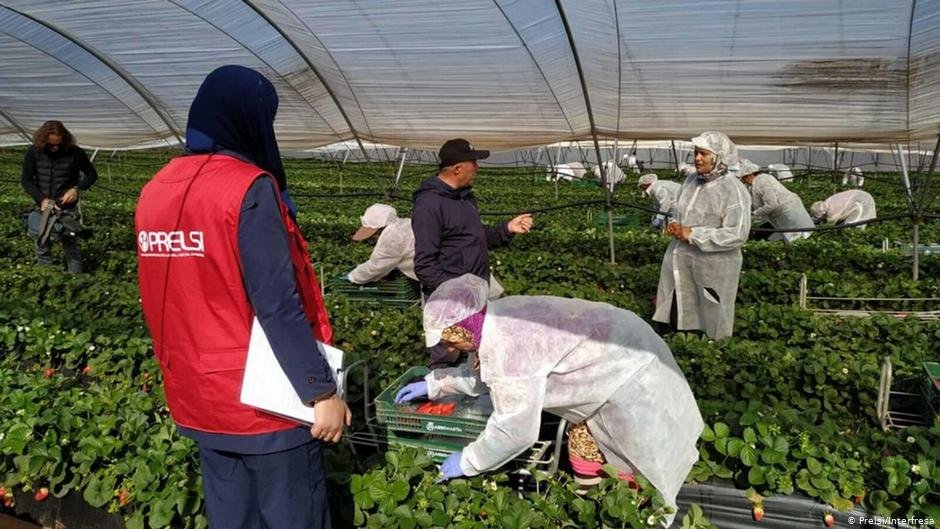
Spain is one of the more prominent examples of a country expanding regular labor mobility. Its seasonal worker program with Morocco has grown in recent years, and it has introduced mechanisms allowing people already in the country to regularize their status if they meet certain requirements. These measures have helped thousands to enter the workforce formally and may reduce incentives for irregular journeys.
Italy has increased its annual quotas for non-EU workers too, and introduced training programs with Tunisia and Morocco designed to match workers with Italian employers. However, the number of available places remains lower than the demand from employers, and administrative delays continue to be a challenge.
Germany has also reformed its migration rules in an effort to attract skilled workers. While the reforms have opened new possibilities, barriers such as qualification recognition and language requirements still make access uneven.
At the EU level, initiatives such as talent partnerships and pilot job-matching schemes with countries in North Africa are intended to link labor demand with mobility opportunities. According to the MMR, these programs are still small and at an early stage, reaching only a limited number of people.
For many, these constraints leave few alternatives. Forin explains, "Many people arriving in Europe know they will not qualify for asylum, but they apply for it because almost no other legal pathways exist. Without work visas, family reunification routes or meaningful mobility schemes, asylum becomes the only option."
Read AlsoOECD report: foreigners earn less but are becoming indispensable in labor market
The idea of control
This tension is reflected in the EU’s continued reliance on deterrence measures to attempt control over migration. However, the MMR points out that this approach may not always align with how mobility actually works in practice.
Forin argues that focusing solely on restrictions can have unintended effects. "Restricting access to asylum will not solve anything. It will simply push more people into irregularity and into the shadow economy, and this benefits no one."
According to the MMR, deterrence measures often gain political traction because they appear to offer straightforward answers to complex challenges. "These policies promise quick and simple solutions to structural challenges," Forin says. "People want to believe that migration can be addressed easily, even when the evidence shows that these measures do not work."
Read AlsoIrregular migration 'a trigger point for radical parties'
What an effective system could look like
The MMR concludes that focusing solely on deterrence is unlikely to address the underlying drivers of migration, which include conflict, economic inequality, climate stress and demographic imbalances. With these pressures expected to continue, the report argues that people will keep moving, and without regular options many will turn to irregular routes.

Forin says that workable solutions already exist within current legal frameworks. "The Refugee Convention is not the problem. The real problem is the failure of lawmakers to build the systems around it. Instead of undermining protection, governments should create legal pathways, allow faster access to work, and provide real alternatives to irregular routes."
He adds that fundamental rights should not be treated as an obstacle. "A world in which human rights are treated as an obstacle to governance is not a world we should want to live in."
According to the MMR, while European leaders continue to publicly support the expansion of safe and legal routes, these pathways will need to become more accessible if they are to provide meaningful alternatives to dangerous journeys.
In the end, the report argues, the question is not whether legal pathways exist, but who is actually able to use them.
Read AlsoWhen protection fails: Why trainees in Germany are still being deported despite legal safeguards