
A tunnel suspected of being used to smuggle migrants was uncovered at the Poland-Belarusian border. In the last few years, other tunnels have reportedly been discovered at borders in Lithuania and Hungary.
The Polish Border Police uncovered a tunnel that links Poland with the Belarusian side of the border, Euronews reported earlier this week (October 19).
Polish Interior Minister Marcin Kierwiński confirmed the discovery of the tunnel, which is the second tunnel discovered in the country this year. The government is reportedly still investigating who dug the tunnel and when.
Last month, the Polish Border Guard in the northeastern Podlaskie province reported over 120 attempts to cross the border over a 24-hour period. The authorities alleged that stones and branches were also thrown at security patrols.
The Polish government has repeatedly slammed Belarus and its ally Russia for what it claims is a "hybrid operation" to destabilize the EU by facilitating the arrival of migrants at the country's eastern border.
Both Belarus and Russia have repeatedly denied these allegations.
Read Also
Poland again registers increase in irregular migrant arrivals from Belarus
Systematic pushbacks on both sides
Human rights organizations have chronicled systematic abuse on both sides of the Belarusian and Polish borders. Migrants reportedly typically enter Belarus through Russia after taking a flight from Egypt, Iraq, Turkey, and other countries to Moscow or St Petersburg. From here, they travel by land to Belarus, where they attempt to enter Europe through Poland, or sometimes one of the Baltic states.
Migrants who are usually from Syria, Afghanistan, Somalia, Sudan, and Eritrea are routinely pushed back towards Belarus from Poland, claim organizations like Human Rights Watch (HRW) in what has been branded "ping-pong pushbacks." The rights group says that these pushbacks are unlawful, but have become normalized. The Polish government though has passed legislation allowing it to return migrants who do not claim asylum within the border zone.
In March, Poland temporarily suspended asylum applications at the country’s borders with Belarus. Amnesty International slammed the measure, claiming that it codifies "the carrying out of unlawful forced returns ("pushbacks") at the border, by empowering border guards to disregard asylum applications without consideration for people's individual circumstances."
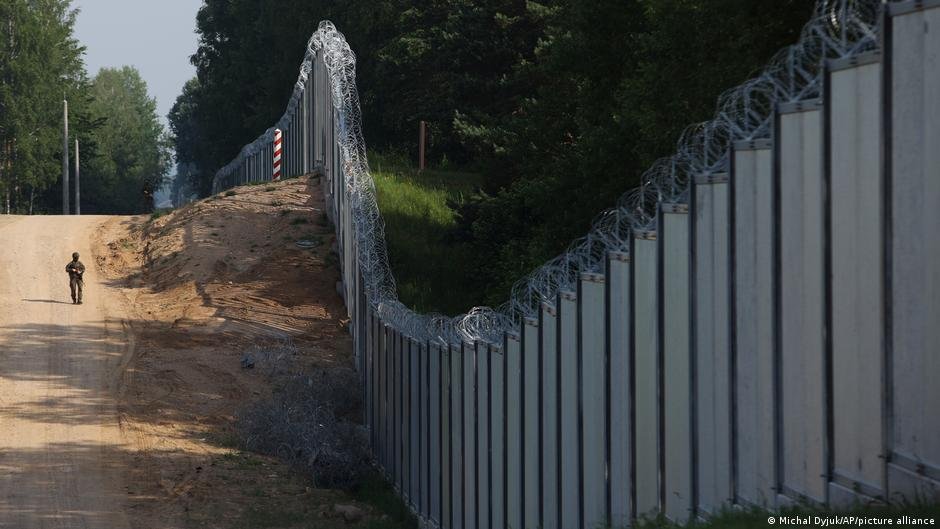
Earlier this year, Poland completed an electric border fence equipped with artificial intelligence along the entire border with Belarus, as part of its efforts to fortify its borders.
Read Also'Brutal barriers'? A closer look at the EU's eastern border
Other smuggling tunnels
The discovery of two smuggling tunnels that are allegedly being used for smuggling in Poland is not an isolated case.
Border guards from Lithuania’s State Border Guard Service (VSAT) discovered a 25-meter-long underground tunnel suspected to be used for smuggling on the border with Belarus, Lithuanian public broadcaster LRT reported at the start of the year.
The tunnel was uncovered near the village of Pašalcis, Giedrius Mišutis.
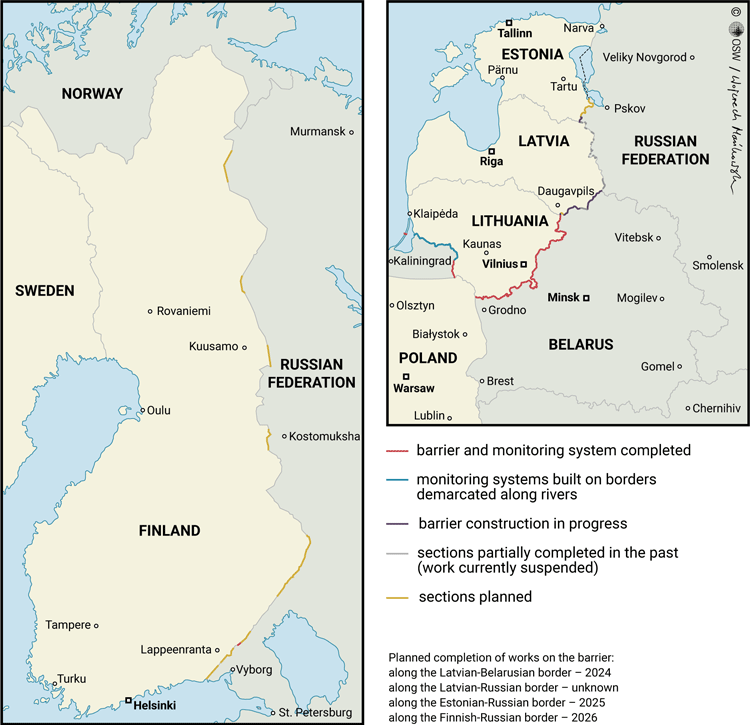
Pašalčis is part of an emergency zone declared on Lithuania’s border with Belarus in 2021, following a large number of irregular arrivals. The area is reportedly only accessible through the acquisition of a special permit.
The entire border with Belarus is covered by a surveillance system, including cameras at the site where the tunnel was discovered.
Hungary-Serbian border
In 2020, Hungarian police discovered a 24-meter-long tunnel at the border with Serbia, near the Hungarian town of Morahal. About 300 people are suspected of having traveled through this underground passage to travel onwards to Western Europe. Authorities said that it was the third tunnel discovered in this area within just one year, as reported by Radio Television Serbia (RTS).
The previous year, news agency Reuters reported the discovery of two tunnels used by migrants to enter the country from Serbia. The tunnel, running an estimated 34-meters long and about 6-meters deep, was discovered near the southern village of Asotthalom. Digging the tunnel was reportedly undetected because of thick underbrush in the area, while the dug-out soil was dumped into a nearby canal.