
The German government reportedly gives more than one and a half million euros to sea rescue organizations each year. This funding has drawn criticism from within and outside the coalition.
On Monday, (October 21), the German government again came under fire, this time in part from a party within its own ruling coalition, over its continued funding of German-based NGOs that operate sea rescues in the Mediterranean.
According to information provided by the Government’s deputy spokesperson Christiane Hoffmann, the government currently provides around one and a half million euros to various German-based sea rescue NGOs every year, to support their rescue operations in the Mediterranean.
The funding stems from a decision made by parliament in 2022, confirmed Hoffmann. However, in an interview with the German tabloid Bild Am Sonntag, FDP party leader Christian Dürr told the newspaper that he believed the parliament had made a "clear decision" that there was "no more tax money to fund these kinds of operations."
Read AlsoA peek into a Mediterranean Sea rescue by the Geo Barents
Around two million a year promised to fund sea rescue
According to research by the Protestant Press Service EPD, in 2022, the parliament pledged around two million euros per year to sea rescue organizations for a period from 2023 to 2026. The money was promised after the government and European missions that had been operating search and rescue missions in the Mediterranean were closed down.
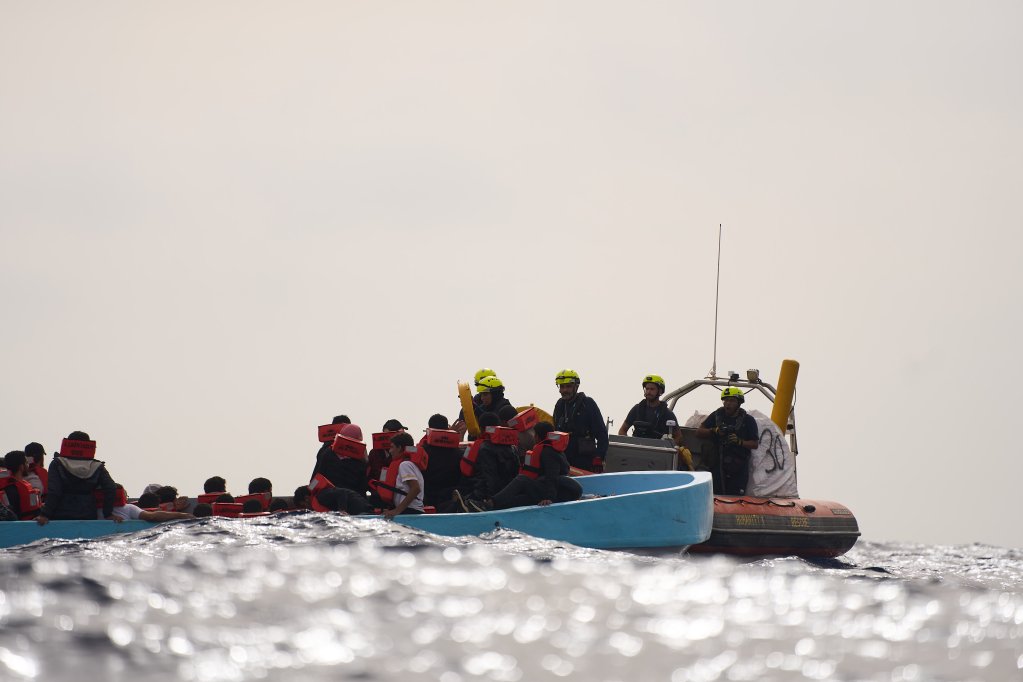
This year, three different German organizations received funding from Germany’s Foreign Ministry, according to EPD. SOS Humanity is reported to have received more than 500,000 euros, Sea Eye almost 394,000 and Resqship a little over 100,000 euros. In addition, the German branch of the French-based organization SOS Mediterranée also received 492,000 euros from Germany.
Finally, the Italian Catholic organization Sant’Egidio also received almost 500,000 euros from Germany, for its work supporting asylum seekers and refugees in Italy. Sant’Egidio is also one of the main operators of the humanitarian corridors in Italy that aims to bring asylum seekers directly out of conflict zones to Italy.
'At this point politics can't get much crazier!'
The opposition CDU/CSU parties have also criticized the financing of sea rescue organizations through German tax money. CDU politician Ingo Gädechens told the conservative broadsheet Die Welt: "The illegal migrants who are no longer allowed to cross Germany’s borders are being supported with German tax money to cross the Mediterranean! At this point, politics can’t get much crazier!"
Another FDP politician, Christoph Meyer, told Die Welt, "these so-called sea rescue organizations are nothing more than state-funded smugglers, that under the cover of humanitarian aid, are misusing German funds for their own ends, this just ends up discrediting real humanitarian aid."
Members of the FDP have said that last year, even Germany’s social-democrat SPD Chancellor Olaf Scholz appeared to distance himself from these payments as early as last year. The FDP accuses Annalena Baerbock, Germany’s foreign minister and a leading member of the Green Party, of doing her own thing without listening to the wishes of the rest of the coalition.
Meyer said that the Green party members were behaving as if they were "against the coalition" and carrying out blockades and broken promises that were undermining the work of government. However, Die Welt pointed out that until now, the FDP has not actually proposed a motion to try and prevent the funding of the sea rescue organizations.
Sea rescue NGOs think criticism is just 'electioneering'
A spokesperson from SOS Humanity, Lukas Kaldenhoff, told EPD that he felt the criticism and debate around the subject was just politics and electioneering. He noted that the liberal FDP party performed poorly in the September state elections in eastern Germany, losing its seats in the regional parliaments of Brandenburg, Saxony, and Thuringia.
Since those results, the FDP seems to be positioning itself by clarifying its policies and priorities ahead of the regional vote in Hamburg in March 2025 and the general election expected in September next year.
According to Kaldenhoff, finances paid to sea rescue organizations account for just 0.09 percent of the foreign ministry’s budget this year, which he said was a "negligibly small proportion."
Read AlsoItaly: Rescue ship impasse ends as migrants come ashore
Money is 'to save human lives' says Sea-Eye
Gorden Isler, the head of the rescue organization Sea-Eye underlined that the money they receive from the German government goes "to save human lives." Isler added the believed that the FDP had at the time voted for the motion to provide the funding, and it also wasn’t the party’s concern what the Foreign Ministry’s budget, which is under the control of Green minister Annalena Baerbock, spends its money on.
The Mediterranean route from North Africa towards Europe is one of the most dangerous sea crossings in the world. According to data from the UN Migration Agency IOM’s Missing Migrants project, at least 1,618 people have died or gone missing across all routes in the Mediterranean since the beginning of the year. The figures were last updated on October 16. Some NGOs estimate the figure to be far greater, since no one takes a register of every boat that sets off to sea, or how many people might be on board.
The Spanish NGO Caminando Fronteras (Walking Borders), for instance, estimates that in the first five months of 2024, more than 5,000 people died on routes towards Spain. This figure includes the Atlantic crossing from the coasts of West Africa towards the Spanish Canary Islands archipelago in the Atlantic as well as the western Mediterranean route.
Since 2014, the IOM has recorded more than 30,500 missing migrants across the Mediterranean.
Correction notice: This article was updated on August 26, 2025. An earlier version included an indirect quote by a Resqship spokesperson cited by EPD, who, according to the organization itself, is not affiliated with them. We have therefore removed it from the article, as well as a figure about Resqship's daily operational costs, cited by EPD, which also couldn't be verified by Resqship.