
A group of 16 migrants arrived in Albania from Lampedusa, Italy, this week. They are the first people who will be staying at a center in the non-EU country while Italy is processing their asylum applications. Refugee rights organizations have criticized the controversial Italy-Albania deal.
Ten men from Bangladesh and six men from Egypt arrived in the port of Shengjin on Wednesday morning. They are the first people who will be staying at centers that Italy has set up in Albania for asylum seekers after months of delay. (The centers were originally supposed to open in May.)
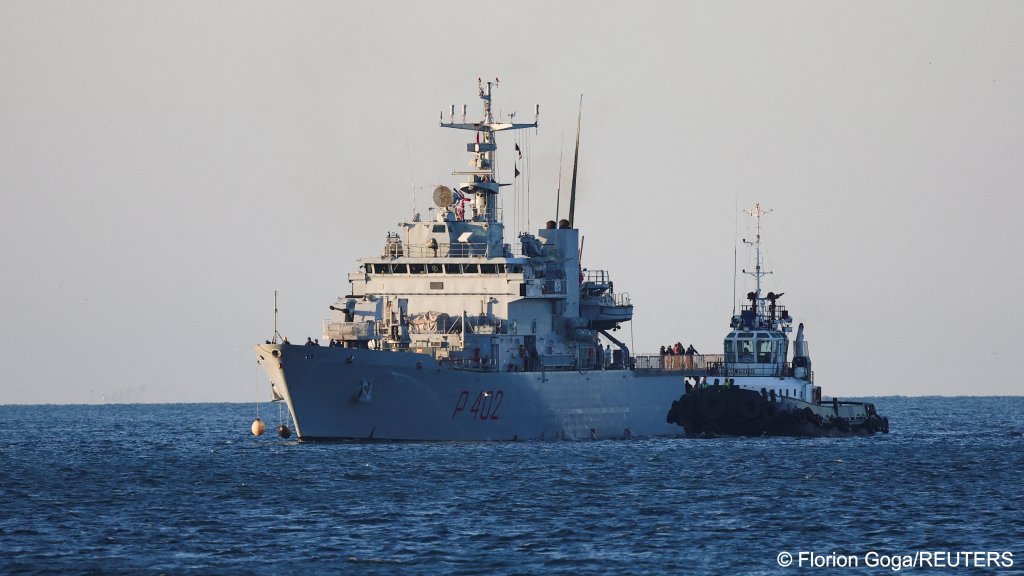
The 16 asylum seekers were picked up by Italian authorities in the central Mediterranean and were brought to Shengjin on an Italian naval ship from the port of Lampedusa.
Italy is running two centers for asylum seekers in Albania: At a facility in Shengjin, initial checks will be carried out. The main facility on a former military base in Gjader will house people while their asylum applications are being processed. Gjader is supposed to eventually house up to 3,000 people, though it will initially only have room for a few hundred people.
Who is brought to Albania?
Only people who are rescued by Italian authorities in non-EU waters in the Mediterranean will be sent to Albania.
Only male asylum seekers from countries deemed 'safe' by Italian authorities will be sent to Albania, no women or children. Families are also not supposed to be separated, meaning that mostly men traveling alone will be sent to Albania.
The countries that the Italian government has deemed safe, via a May 2024 decree, are the following: Algeria, Bangladesh, Bosnia and Herzegovina, Cameroon, Cape Verde, Colombia, Gambia, Georgia, Ghana, Egypt, Ivory Coast, Kosovo, Nigeria, North Macedonia, Montenegro, Morocco, Peru, Senegal, Serbia, Sri Lanka, and Tunisia, as well as Albania itself.
This selection has been criticized by the European Court of Justice, which found that many of the selected countries failed to meet the criteria for 'safe' countries, because for example some groups may facepersecution or torture there.
Read more: What is the Italy-Albania deal on migration? - InfoMigrants
Proponents and critics of the deal
Several politicians have expressed interest in the Italy-Albania model, indicating they might outsource their asylum procedures to non-EU partners.
EU Commission President Ursula von der Leyen praised the plan for its "out-of-the-box thinking" and said it could serve as an example to explore "possible ways to develop centers outside the EU." German Interior Minister Nancy Faeser has called the Albania-Italy plan "interesting," indicating that she was looking into whether a similar model may be an option for Germany. UK Prime Minister Sir Keir Starmer also recently expressed interest in the project.
Albanian Prime Minister Edi Rama has said that the deal with Italy is an exception and that he has declined other countries' requests to host asylum seekers.
The deal is controversial and has many critics. Human rights organizations are worried that the deal could circumvent asylum rights, and they have also described conditions in Gjader as "prison-like."
Amnesty International has called the centers a "cruel experiment (that) is a stain on the Italian government." And a migration researcher on the social media platform X pointed out how small the share of migrants brought to Shengjin is, compared to overall arrivals.
Others have criticized the high costs of the project and its limited scope. (The centers, which only have room for a small share of asylum seekers that arrive in Italy, are estimated to cost Italy around 670 million euros over five years.)
In a thread on X, data and migration researcher Matteo Villa criticized the project as inefficient, saying that the costs for Italy to host people in Albania would be nine times what they might pay to host them in Italy, while only two percent fewer migrants were actually to be expected in Italy through the deal.
He added that in his opinion, time would serve to demonstrate to the Italian authorities that "opening a center in Albania won't be part of a solution, but in fact will become part of the problem."
With AFP, AP, dpa, Reuters