
Spain has asked EU border agency Frontex to seek permission from West African nations to patrol their seas. It hopes this will stop migrants from reaching the Canary Islands.
Spain’s interior minister, Fernando Grande-Marlaska, has asked the European border agency Frontex to try to obtain permission to patrol some West African coastlines in order to help with those countries' own migration management efforts.
EU agreements with some West African countries, spearheaded by Spain, already provide for support with training and patroling the sea borders.
The Spanish authorities said they were making this request in a bid to "save lives," reported the news agency Reuters.
Grande-Marlaska pointed out that Frontex operated in African territory in 2006, when a large number of people were leaving the continent. He said Frontex should approach Mauritania, Senegal and Gambia – the major departure countries for people crossing to the Canary Islands – for new permissions.

In 2022, the NGO Statewatch claimed that Frontex was already planning operations in Mauritania and Senegal.
Read AlsoSpain: Prime Minister promotes positive migration messages in speech
'Improve capacity to act abroad'
The interior minister said he believed that Frontex could only truly protect Europe’s borders if it was able to operate outside of them as well, reported Reuters. "It is particularly important to improve its capacity to act abroad, both in terms of return and border management," Grande-Marlaska said during a meeting of EU interior ministers in Luxembourg on October 10.
At least 31,215 migrants have reached the Canary Islands this year. The figure is higher than last year, but still substantially under the number arriving in Italy (52,108), according to the UN refugee agency, UNHCR.
UN Migration's Missing Migrants project says at least 781 people have died on the Atlantic route towards the Canary Islands since the beginning of the year. The actual number could be much higher, since there is no official register of who sets off, and with such a vast route, no way of knowing how many boats, or people, have disappeared.
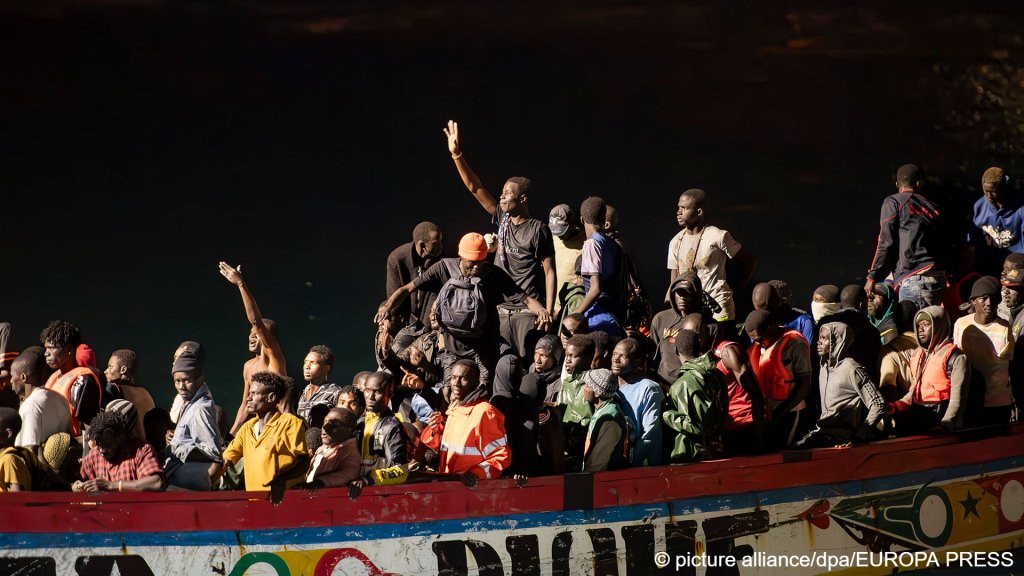
Dangerous Atlantic crossing
The Spanish human rights organization Caminando Fronteras (Walking Borders) estimates that in the first five months of 2024, at least 5,054 people died trying to reach Spain through various routes, the main one being the Atlantic route.
In September, a boat overturned off El Hierro in the Canary Islands as it was approached by rescuers. Nine people were found dead on arrival, and at least 48 others were unaccounted for. This was the deadliest such incident in 30 years of crossing this route, reports Reuters.
The request from Spain to Frontex comes just a day after the Spanish prime minister, Pedro Sanchez, spoke in positive terms about migrants and migration, underlining in a speech in parliament that Spain needed migrants to secure the future of its country and economic growth.
Sanchez told parliamentarians that they should look to the facts about migrants, emphasizing that the majority of migrants to Spain came via legal routes. However he also said that it was important to manage migration properly and that he planned to urge the EU to speed up the implementation of the new pact on migration and asylum.
Read AlsoMorocco reports stopping more than 45,000 crossings into Europe in 2024
Increasing returns
The new pact provides for an increase in funding and presence of Frontex officers, and also proposes the creation of faster assessment processes at borders.
An EU interior ministers' conference in Luxembourg this week discussed the possibility of creating return centers or deportation hubs at the EU’s external borders. The Belgian minister responsible for asylum and migration, Nicole de Moor, described Europe’s returns process as the "weakest link" in its migration management policy.
Last year, according to European data, more than 500,000 people in the EU were issued with notices to quit European territory. Only 20 percent of those issued with the notices actually did so.

Frontex assesses future strategic risks
In a strategic risk analysis report from Frontex published at the end of September, the agency writes that it expects "migratory pressures…to increase." It says this will require "substantial improvements in border management capabilities."
The report underlines that cooperation with third countries – in areas such as border control and surveillance, capacity building and training, as well as "return activities" – will be crucial to the EU to manage migration in the future.
The agency also worries that the influence of authoritarian regimes, already present in Burkina Faso, Mali and Niger, could spread. This could "stir sociopolitical tensions, unrest and civil war, triggering intra-Africa displacements and/or irregular migration flows outside the continent, mainly towards Europe on the Central and Western Mediterranean routes."
The report does not mention any specific states in which Frontex patrols are planned.
Read AlsoEU discusses deportation 'hubs' at interior minister conference
With Reuters, AFP