
Senegal has announced the introduction of additional measures to crack down on smugglers. President Bassirou Diomaye Faye said the new initiatives were in response to the deaths of at least 35 people who drowned off the West African coast earlier in the week.
Faye vowed to "relentlessly track down" migrant smugglers following reports of at least 35 people dying at sea when an overloaded boat sank soon after leaving the fishing port of Mbour, located about 100 kilometers southeast of the capital, Dakar. Many people are still missing from that accident, which took place on September 8.
On X, Faye reaffirmed his "commitment to dismantling the migration networks that exploit our children."
Faye, who was elected in March this year, said the government was working on policies to tackle some of the key issues that push people into migration.
He highlighted the fact that measures to combat youth unemployment in the country were being introduced, and called on the country's youth to stay in Senegal rather than seeking the "illusion" of a better future elsewhere.
"From now on, the relentless hunt for these illusion-peddlers, these peddlers of death, will be stepped up," he stressed, adding that a hotline to report the activities of smugglers would be set up.
However, facing strong opposition in parliament, Faye has not been able to push for many of the initiatives he believes are necessary for the revival of the West African country. As a result, he has launched proceedings to have a new parliament elected in hopes of securing more support in the future.
Also read: Halimatou's tale: 'My missing brothers never told me they would get into a canoe'
A dangerous journey
Senegal has become one of the main departure points for migrants hoping to reach Europe.
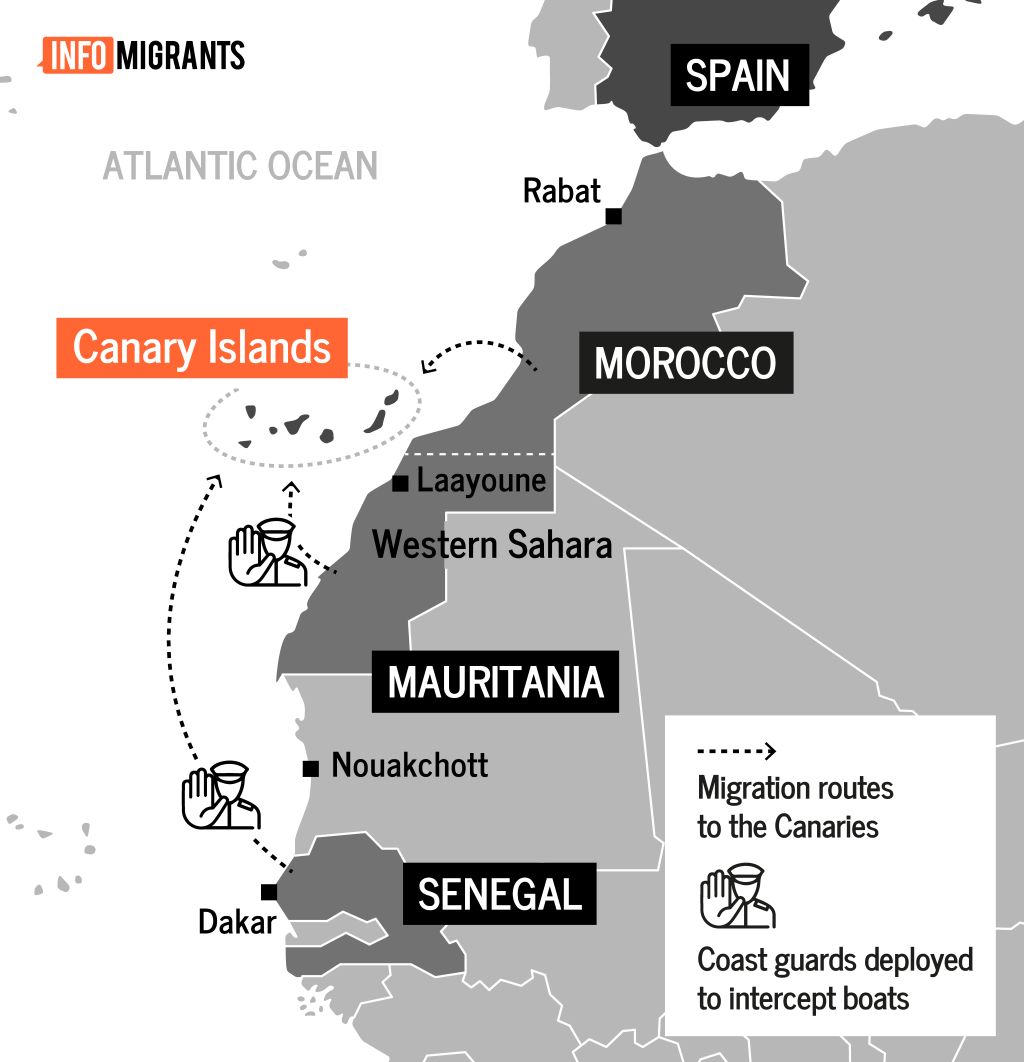
Each year, thousands of people with varied nationalities depart from the coasts of the country, heading for Spain’s Canary Islands, which are situated roughly 1,500 kilometers to the north in the Atlantic Sea.
This migrant route, however, is considered to be one of the most dangerous due to winds, strong currents and other weather patterns, which make crossings on overloaded and unseaworthy boats nearly impossible.
Each year, there are thousands of deaths recorded along Africa’s west coast; the number of unreported drownings is believed to be much higher than these official figures.
Also read: Report: 6,618 migrants died en route to Spain in 2023
Legal pathways to Spain
Of those who survive the route, more than 22,000 migrants have arrived in the Canary Islands thus far this year alone. That is more than twice the number compared to the previous year. The archipelago is struggling to keep up with the growing numbers of people reaching Spanish soil by irregular means.
Spanish Prime Minister Pedro Sanchez recently signed bilateral agreements with Senegal as well as with neighboring Gambia and Mauritania to combat irregular migration, especially to the Canaries, by promoting legal migration pathways based on labor needs in Spain.
Also read: Spain's circular migration policy explained
with AFP