
Libyan authorities reported the discovery of a mass grave containing two dozen unidentified bodies in an area formerly controlled by the Islamic State (IS) group.
The Libyan government announced on Monday (July 15) that it had recovered 17 of the 24 bodies found under destroyed buildings in the coastal city of Sirte, about 450 kilometers (300 miles) east of the capital, Tripoli. There were no details on when the mass grave could have possibly been made.
Authorities reportedly took DNA samples from 59 bodies for forensic testing. It was unclear whether those bodies include the two dozen found in Sirte.
After undergoing examination, the bodies were said to have been relocated to a cemetery in Sirte, reported the news agency Associated Press (AP).
Sirte, the city where the mass grave was discovered, was a former stronghold of IS until the militant group was expelled by US-backed forces in 2016. The extremist group gained power and influence following the turmoil in Libya after a 2011 uprising that ousted Muammar Gaddafi from four decades of rule.
Human Rights Watch reported that IS had carried out unlawful executions in Sirte using means such as decapitation and shooting. Those executed allegedly included captive fighters, political opponents, and people accused of spying, sorcery, and insulting God.
After the ouster of Gaddafi in 2011, Libya's porous borders turned it into a launching pad for people fleeing political and economic turmoil and attempting to enter Europe.
A trail of mass graves
As a result of being a stronghold for IS and a transit point for Europe, a trail of mass graves has been discovered in parts of Libya. In March, bodies of at least 65 people believed to have been migrants crossing through the Libyan desert were discovered in western Libya.
In a statement, the International Organization for Migration (IOM) said that it was "profoundly alarmed and shocked" over the discovery of the mass graves in the desert.
"The circumstance of their death and nationalities remains unknown, but it is believed that they died in the process of being smuggled through the desert," said the IOM.
Read more: Libya: At least 65 migrants found in mass grave
An open-air grave where more people die
Experts have long agreed that the Sahara crossing is one of the most dangerous migration routes in the world, but evidence to support this claim is scarce.
IOM has recorded the number of migrants who have died or gone missing along the treacherous route by sea through the Mediterranean and by land through the Sahara Desert.
The UN migration agency has recorded nearly 2,000 deaths in the Sahara Desert since 2014, but says that many more likely go unrecorded and that data on migrant deaths in the Sahara are incomplete. According to the IOM, several reports across different humanitarian agencies indicate that "more people die while crossing the Sahara Desert than in the Mediterranean Sea."
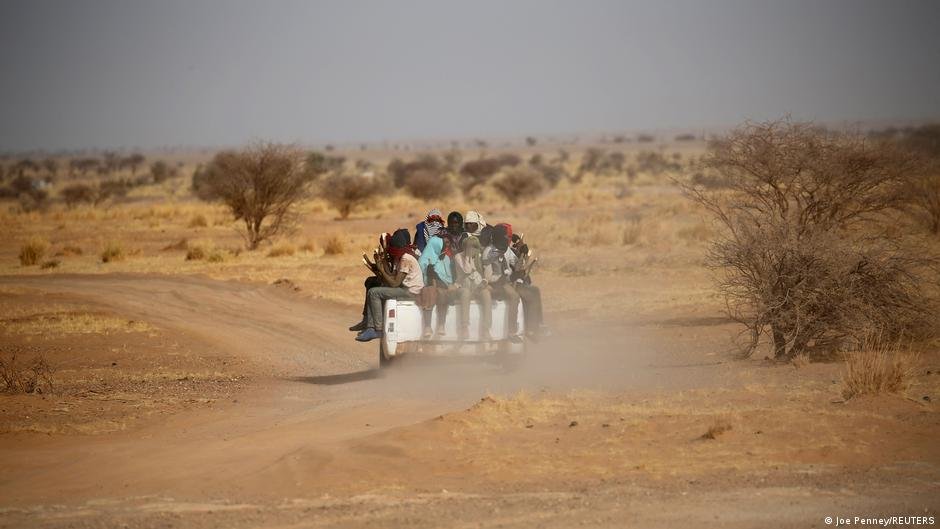
An IOM report, entitled "No one talks about what it's really like -- risks faced by migrants in the Sahara desert", revealed that people crossing the Sahara Desert face extreme peril, not only from the inherent dangers of the vast and arid desert terrain but also from human-made risks linked to regional insecurity and long journey. The causes of death in the Sahara from 2014-2019 included starvation and dehydration, sickness and being unable to access medical care, and vehicle accidents.
Women from Eritertia reportedly said they had acquired long-term contraception such as injectables before making the journey. They could not protect themselves from rape but they could at least prevent getting pregnant from it.
A 2019 IOM survey of more than 4,500 migrants in Libya showed that the majority (62 percent) said they would not dare cross the Sahara if they knew what the risks involved were.