
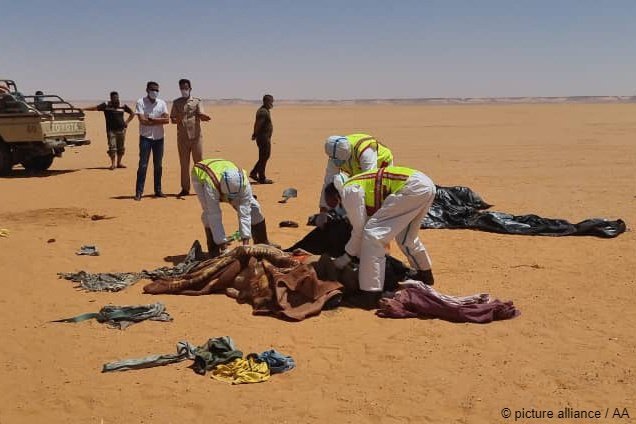
The UN is following up on reports of another mass grave in the desert along the Libyan-Tunisian border. This follows the discovery of the bodies of at least 65 migrants at another site this year in the region in March. According to the UN, the Sahara Desert is now more deadly for migrants than the Mediterranean crossing.
UN human rights chief Volker Türk denounced the ongoing abuse of and violations against migrants and refugees in Libya, saying he urged "the authorities to respond swiftly to our inquiries, and to investigate these crimes fully."
"The loved ones of those who died have every right to know the truth and the responsibility to investigate these crimes falls squarely with the Libyan authorities," Türk told the UN Human Rights Council in Geneva.
The senior UN official also stressed abuses against migrants and refugees in Libya had been documented for a long time and were being "perpetrated at scale, with impunity."
In particular, he highlighted crimes against people such as human trafficking, torture, forced labor, extortion, starvation, detention and mass expulsions, which the UN says are being committed by both state and non-state actors.
'Disturbing developments'
Türk gave no details of the suspected identity of the mass grave victims nor on how the site was found. A spokesperson for his office said, however, that the information had not originated from the authorities.
Türk meanwhile described the ongoing developments in Libya as "disturbing," highlighting that in March this year, a mass grave of at least 65 migrants’ bodies had already been discovered in southwest Libya.
At the time, the IOM said in a statement that the "circumstances of their death and nationalities remain unknown, but it is believed that they died in the process of being smuggled through the desert."
Little reaction from Libya and Tunisia
The Libyan representative at the Human Rights Council meeting chaired by Türk meanwhile reacted to the comments, rejecting culpability on her government’s part.
Libyan Justice Minister Halima Ibrahim Abdel Rahman said that Türk's comments did "not align with reality."
She further emphasized that "Libya gives special importance to the rights of refugees," and that her country was committed to upholding its human rights obligations.
Tunisia’s ambassador did not respond to the allegations of the mass grave during the meeting.
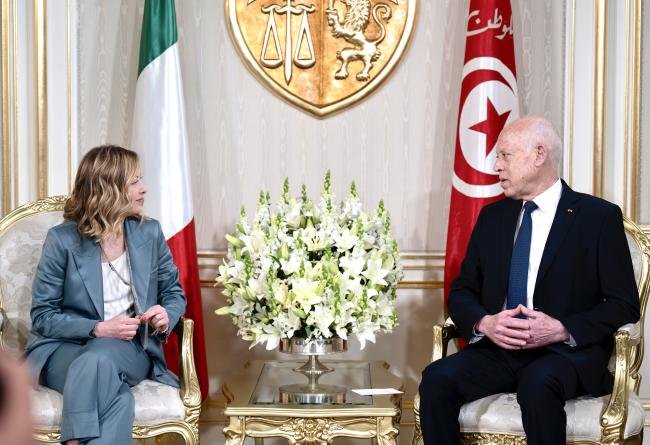
However, Tunisian President Kais Saied has in the past admitted that his government was involved in expelling migrants; in May, he said at a meeting of the National Security Council that about 400 sub-Saharan African migrants had been pushed across Tunisia’s eastern border with Libya.
Also read: At least 27 migrants found dead at Tunisian-Libyan border
Libya, Tunisia accused of ill-treatment of migrants
Libya and Tunisia both straddle the migrant route through the Sahara Desert, as irregular migrants and refugees depart from the shores of both countries in hopes of reaching Europe.
This is why both nations have become major transit points not only for African migrants but also for people trying to reach Europe from the Middle East and Asia.
Both countries have repeatedly been accused of not doing enough to protect people on the move despite receiving generous funds from the European Union and from various governments directly to help stem migration towards Europe.
Among those accusing the two nations of ill-treatment of refugees and migrants are various UN bodies, as well as Amnesty International and Human Rights Watch.
Meanwhile, The Gambia has filed a motion at the UN Security Council to discuss ways of providing assistance to help Libya to help improve its human-rights record.
Also read: Algerian desert: The 'point zero' where migrants are abandoned
Cash for migration management
Despite grave reports of human rights abuses, both Libya and Tunisia continue to serve as key partners in North Africa for stopping migrants from reaching the European Union by crossing the Mediterranean Sea.
In fact, the role of being the EU’s gatekeeper is only growing for both nations: in the past year, the European Union signed a series of additional pacts with both countries, providing cash to keep migration at bay.
The government of Italy under the leadership of Prime Minister Giorgia Meloni meanwhile has also reached additional deal with both countries to limit the number of migrants reaching Europe.
Also read: Libya: 20 migrants found dead in desert
'No one cares if you live or die'
Much of the attention in the current migration narrative has recently shifted to examining the conditions for people in the Sahara Desert. This comes after the UN published a new report last week, which found that twice as many people died in the desert than those who drown at sea.
Titled "On this journey, no-one cares if you live or die," the report painted a grim picture, showing that many fatalities occur in the desert due to "harsh environmental conditions, including exposure, dehydration, and starvation."
The document also stressed that the rate of violence committed against migrants and refugees in the desert was increasing, saying that "(c)riminal gangs and armed groups are the main perpetrators of these abuses, in addition to security forces, police, military, immigration officers and border guards."
The majority of violent crimes against migrants, according to the report, were found to take place in southwest Libya.
Also read: Videos of migrants being tortured in Libya published on social media
with Reuters