
A dressmaking workshop in Frankfurt, Germany, wants to help refugee women with integration. The award-winning company offers apprenticeships to migrant tailors to help them enter the work force.
Cutting patterns, ironing fabric and stitching together blouses, dresses, coats and other garments are all part of everyday life for dressmakers around the world. In many countries, these skills are passed on from one generation to the next, or acquired in informal settings. In Germany tailors are expected to have certain qualifications, which means undertaking a two to three-year apprenticeship program before being able to work.
This is Reyhane's dilemma. The Afghan-born refugee knows how to skillfully make a dress from scratch or mend a shirt. In fact, she is already at professional level as a tailor, but she doesn't have the paperwork to prove it in Germany. A company in Frankfurt has been established to help women like Reyhane gain access to the German labor market and, at the same time, financially empower them.
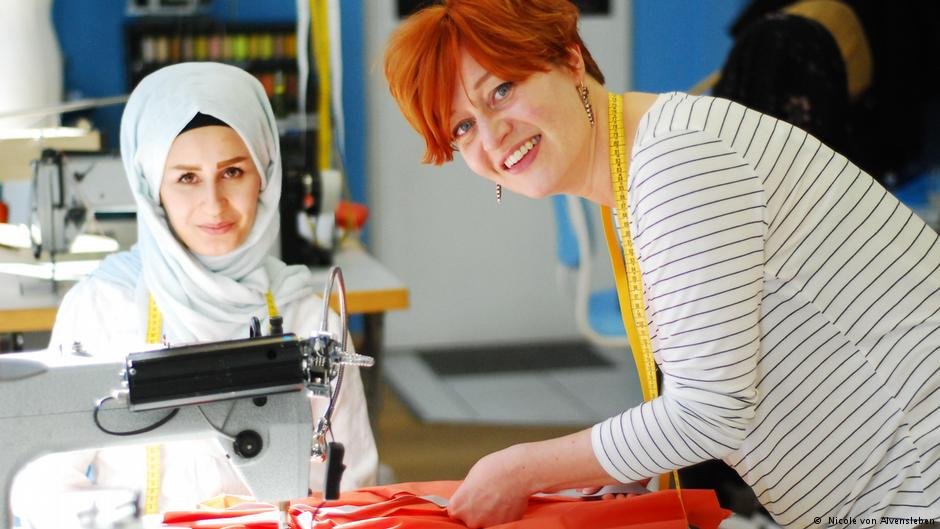
"Stitch by Stitch" offers migrant women paid apprenticeships to become qualified tailors. Reyhane is one of seven women who are enrolled in the program, all of whom come from either Afghanistan or Syria. The dressmaking workshop was founded by two German women who were looking for an entrepreneurial challenge two years ago.
Two women, one idea
Nicole von Alvensleben and Claudia Frick are both designers, who felt compelled to respond to the refugee crisis. They weren't initially sure if or how they could help after the arrival of more than one million refugees in 2015. However, von Alvensleben says that she felt very strongly that she wanted to find a way to offer assistance.
"I wanted to meet this social challenge with an entrepreneurial solution," she told DW.
Claudia Frick, however, said that she did not know how to go about of creating a suitable workplace for migrant women. But then she realized that she needed a production company for her fashion label "Coco Lores," that would only produce small amounts of garments.
"This is something that hardly exists in Germany anymore. I realized there was a niche," she explained.
Though they initially had their doubts whether they would be successful in integrating refugee women into their entrepreneurial plans, von Alvensleben and Frick decided to launch the new business, and thus "Stitch by Stich" was born.
On the fast lane to success
After coming up with idea for the project, it took the two entrepreneurs only nine months until their workshop was up and running, in August 2016. "At first, there was no financial assistance in place at all. We had to take out a small loan to launch the company," von Alvensleben told DW.
But financial backing soon followed after the KfW foundation (Reconstruction Credit Institute), which was originally set up as part of the Marshall Plan in 1948, lent its support. The city of Frankfurt also agreed to financially support "Stitch by Stitch." In the long run, however, von Alvensleben and Frick hope to become a fully self-sufficient business.

That prospect looks promising, as their company has had considerable local success. The two women have even won entrepreneurial awards and have been recognized as leaders in their field, all while providing migrant women with the opportunity to complete an apprenticeship and promoting integration. In addition to receiving a qualification, the refugees working for the company earn about 9 € per hour , which is enough to make long-term plans for their new lives in Germany.
"Our dressmakers are all very talented. However, they either have never undertaken official training or do not have the paperwork from their home countries to prove their qualifications," von Alvensleben said. "But in Germany, it is always essential to have paperwork as proof of training. Our tailors understand this, which is why so many showed interest in committing to the apprenticeship program."
The company started with two apprentice tailors but quickly grew to seven apprentices in total. An eighth apprentice is about to start her training soon. Due to the popularity of program, there are even applicants on a waiting list.
The
business works closely with Germany's Federal Employment
Agency, as well as local employment initiatives to help refugees find other work after completing the program.
Creativity as a universal language
The apprentices undergo classroom teaching not only to perfect their expertise as dressmakers but also to work on their communication skills. An important part of the program is supporting refugee women to cultivate their German skills.

"This is a really important aspect for us," von Alvensleben told DW, adding that even the tailors that hardly speak any German manage to communicate quite well with them.
"The craft of dressmaking is like a global language. The way you sow a blouse in Afghanistan or Syria is identical to the way you would do it in Germany. We all enjoy what we do, which is a great advantage. That's why it doesn't matter what country or culture a person comes from.
"Our work is so creative and enjoyable that it brings us all together. And because of this, we all get along beautifully."
Translation: Sertan Sanderson