
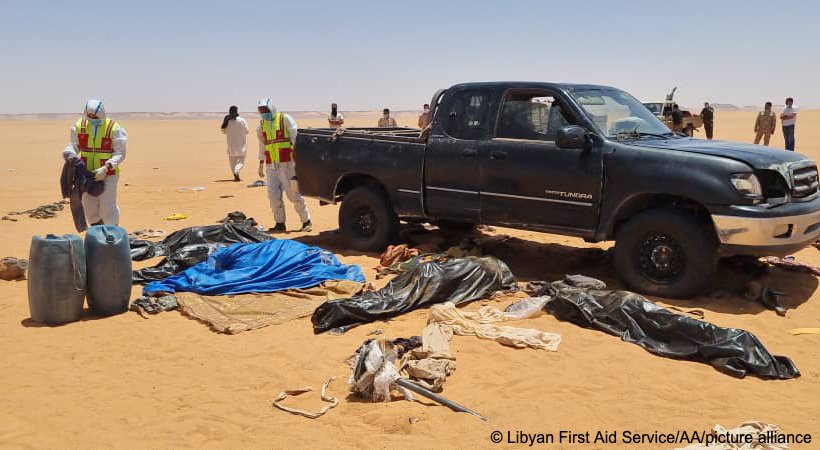
Fourteen migrants, twelve of them Syrians, have been found dead in the Algerian desert. Five others remain missing. The tragedy followed an announcement from the UN last week that more people are now believed to die in the Sahara Desert than those who drown at sea.
The victims are comprised of 12 Syrian nationals as well as two Algerians. It is believed that the missing five individuals are also Syrians, according to the Syrian Embassy in Algeria.
The youngest two victims were identified as a 10-year-old and a 16-year-old. According to Turkey’s Anadolu Agency, the oldest victim is believed to have been 55 years of age.
Meanwhile, the search for the remaining five continues, led by the Search and Rescue Association, an NGO that specializes in rescuing migrants lost in the Algerian desert.
There has been no official comment from Algerian authorities on the fatalities yet.
Allegations of pushbacks into the desert
The head of irregular migration at the Syrian embassy in Algeria, Bassem Farroukh, said the victims died after they "got lost in the desert."
Farroukh stated that Libyan authorities had expelled the migrants and "pushed them to flee towards Algeria" to the southern desert province of Illizi, located nearly 2,000 kilometers southeast of the capital, Algiers.
"We will see other Syrians leaving Libya in the same manner towards Algeria and I am afraid we must prepare ourselves for more disasters," he told the French AFP news agency.
However, there has been no confirmation from Libyan authorities on this particular course of events; Algeria’s southern provinces are also on the migrant route to Europe, with countless migrants passing the region each year.
Also read: Algerian desert: The 'point zero' where migrants are abandoned
UN: More migrants die on land than at sea
The events in Algeria come just days after a new UN report was published, claiming that twice as many people must die in the desert than those who are known to drown at sea in the attempt to reach Europe.
The report, titled "On this journey, no-one cares if you live or die" said that a quarter of those fatalities were due to "harsh environmental conditions, including exposure, dehydration, and starvation," while over 40 percent were attributed to vehicle accidents.
Also read: Videos of migrants being tortured in Libya published on social media
UNHCR special envoy Vincent Cochetel explained that some smugglers routinely fail to return to retrieve migrants who fall off vehicles, or even deliberately dump sick people off vehicles while crossing the desert:
"Everyone that has crossed the Sahara can tell you of people they know who died in the desert," Cochetel stressed.
"In total, 1,180 persons are known to have died while crossing the Sahara Desert for the period January 2020 to May 2024, but the number is believed to be much higher," the report says.
The document further highlights that "on land, due to the remoteness of the routes, challenging or lack of access to official and unofficial detention facilities, infrequent or absence of reports from authorities or media coverage, gathering information on deaths is extremely difficult and numbers are likely to severely under-represent the situation."
Also read: Libya: 20 migrants found dead in desert
Rape, abuse and organ harvesting
The growing rate of extreme violence, including rape and other forms of gender-based violence, was also highlighted in the report.
"Criminal gangs and armed groups are the main perpetrators of these abuses, in addition to security forces, police, military, immigration officers and border guards," the UN said, as Cochetel added.
In fact, the majority of instances of gender-based violence as well as other forms of physical violence recorded on African migrant routes took place on the Libyan side of the Libyan-Algerian border, the report highlights.
Cochetel pointed out meanwhile that the research team behind the report had also tallied hundreds of instances of organ removals for years.
Sometimes, he explained, migrants volunteer to having their organs removed for sale on the black market -- oftentimes a kidney -- as a way to earn money and thus pay for their journey.
"But most of the time, people are drugged and the organ is removed without their consent: They wake up, and a kidney is missing," Cochetel said.
Shift in migrant routes
UNHCR says that on certain parts of the migrant route across the African continent, the number of refugee and migrant deaths is skyrocketing.
In Tunisia, a country 16 times smaller in land mass than Algeria, there has been a tripling of the number of migrant fatalities since 2020.
Still, many people continue to embark on perilous journeys across land and sea to escape war and persecution. Syria is still one of the leading nations in terms of refugee numbers reaching Europe, as the civil war in the country is now in its 14th year.
With Tunisia having eclipsed neighboring Libya as the main point of departure for Europe, the number of refugees and migrants passing through Algeria en route to Tunisia (which borders both countries) meanwhile has also risen.
Earlier this year, 11 migrants were already reported to have died of thirst in the Algerian desert in a similar incident — this time near the border with Niger.
with AFP, AP, UNHCR, Anadolu
Also read: At least 27 migrants found dead at Tunisian-Libyan border