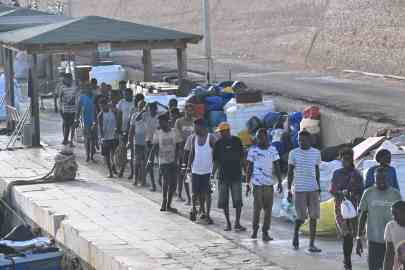
The Italian National Institute of Statistics (ISTAT) has released updated figures on foreign citizens in Italy in its publication "Italy - 100 Statistics to Understand the Country". Moreover, the National Council of Notaries together with the UN Refugee Agency (UNHCR) presented a practical guide for refugees and migrants coming to Italy.
At the beginning of 2023 there were approximately 5 million foreign citizens residing in Italy (111,000 more than the previous year), accounting for 8.7% of the total residents. More than 3.7 million are non-EU citizens.
60% of foreign citizens have a long-term residency permit. Most -- 83% of the total -- are located in Central and Northern Italy.
This information is found in "Italy - 100 Statistics to Understand the Country", an annual web document published by ISTAT, Italy's statistical office, last updated on June 20.
Increase in new migrant flows especially in the South and North-East
During 2022, almost 449,000 new residency permits were issued, with an 86% increase compared to 2021 due to the refugee crisis originating from Ukraine.
For this reason, in 2022 the main motivation of the newly arrived migrants were asylum requests and international protection (45.1%). These requests went from 31,000 to 200,000 (+556%), followed by family reunifications (28.1%), and work reasons (15%), a steep increase compared to 2021 (+32,2%).
Historically, foreigners on Italian soil concentrate especially in North and Central Italy. Until January 1, 2023, 83.4% of the number of foreigners in Italy resided there.
The major attraction of the Central-Northern regions is confirmed by the number of residency permits: 85% of permits were issued or renewed in the Center-North, especially in Lombardy, Lazio, Emilia-Romagna, and Veneto.
The education level of foreigners, in 2023, is still lower than the education level of Italians: approximately 48.9% between ages 15-64 obtained a middle school diploma compared to 35.6% of their Italian peers; 40.1% have a high school diploma, and 11.1% a University degree, compared to 44.3%of their Italian peers who hold a high school diploma and 20.1% who hold a University degree.
Information for newcomers: a guide in nine languages
Last week, the Italian National Council of Notaries, together with UNHCR, for World Refugee Day, presented a practical guide for refugees and migrants in Italy "From Human Rights to Integration". The objective is to assist all those entering Italy and contribute to their integration as part of the hosting community.
The text (which can be downloaded from the website www.notariato.it) starts with documenting the current situation and examines the different issues that someone assisting or sheltering a migrant or foreigner who decides to reside in Italy may face.
"As part of the memorandum, the Notary and UNHCR issued some informative forms, translated in nine languages (Amharic, Arabic, Tigrinya, Farsi, Bangla, French, English, Somali, Urdu), which is published on the website - collecting essential information for refugees", specifies the note.