
On Monday, Spanish coast guards recovered at least one dead body and rescued 170 migrants from a boat traveling off the coast of Gran Canaria, an island in the Spanish archipelago in the Atlantic Ocean.
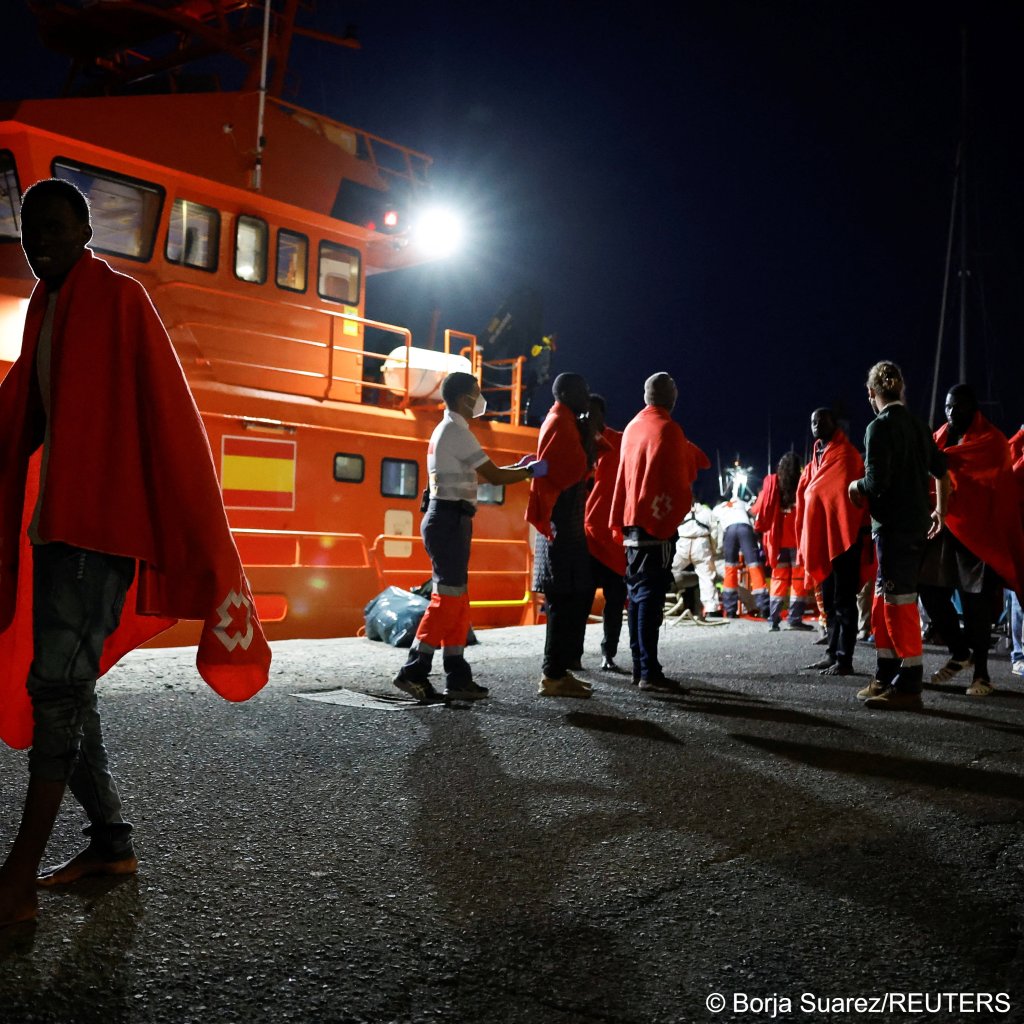
Video footage and pictures showed Red Cross workers bringing 140 men, 23 women and seven children into the port of Arguineguin, on the island of Gran Canaria on Monday (May 13). Some Red Cross workers followed with a white body bag on a stretcher, reported the news agency Reuters.
The migrants appeared tired, wrapped in red blankets, many of their faces downcast. Several children were carried on the port side by adults or Red Cross workers. Some of them seemed dazzled by the bright lights and the bustling port.
Reuters reported that the migrants were walked towards a Red Cross tent, where they underwent medical check-ups after crossing from the west coast of Africa.
Spotted from the air
On Monday evening, the local broadcaster Canarias 7 and the Spanish state news agency EFE, reported that the Spanish rescue services, Salvamento Marítimo, discovered a boat traveling about 280 kilometers south-east of Gran Canaria with at least "150 migrants" on board, including "one dead person." The agency stated it was difficult to estimate the exact numbers, but that there were several women and children in the group.
Also read: A Senegalese fisherman, haunted by migrant-boat disaster
The boat on which the migrants were traveling was spotted initially from the air by a surveillance plane operated by Spain’s Civil Guard (Vigilancia mrítima de la Guardia Civil). A rescue ship was mobilized immediately, reported EFE, and a nearby oil tanker, the Al Bateen, flying a Kuwaiti flag and on its way to Barcelona, was dispatched to wait near the migrant boat until the rescue services arrived.
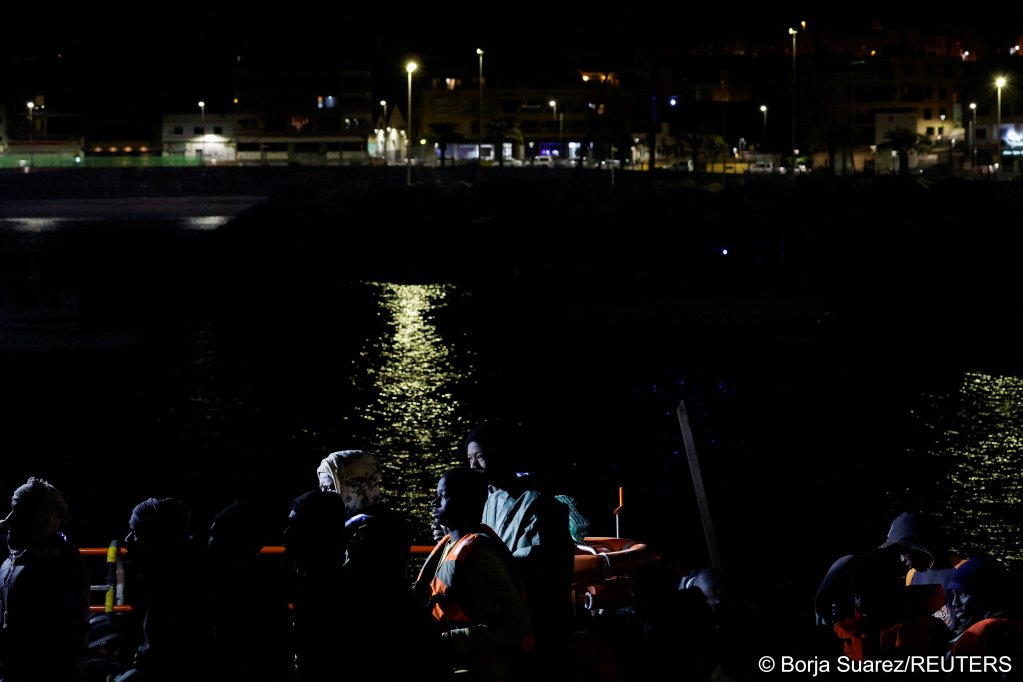
Once they arrived, they brought the migrants onto their ship and into the port of Arguineguín on Gran Canaria at around 10 pm.
Arrivals since the beginning of the year
Interior Ministry data shows that the number of migrants arriving in Spain by boat since the beginning of the year is almost three times as many as in the same period in 2023.
On Tuesday, (May 14) EFE reported that around 20,000 migrants had arrived in Spain since the beginning of the year, including at least 1,579 unaccompanied minors. The organization Save the Children has warned that arrivals are likely to increase as the year progresses, as calmer summer weather tends to make crossings more attractive.
Save the Children has underlined that political and economic instability, as well as food shortages and the climate crisis, are causing more and more people to migrate, in particular minors, who often feel a burden to try and support their families back home.
In 2023, more than 5,000 unaccompanied minors arrived in Spain, stated Save the Children, if this year continues as it has done, we could be looking at numbers greater than that by the end of 2024, said migration expert at the charity Bárbara González del Río.
Also read: Bodies of migrants found in Brazil may have been heading for the Canaries
Unaccompanied minors
Four out of five of these unaccompanied minors are choosing the Atlantic route towards the Canary Islands, say Save the Children. "There are two fundamental factors why the Canary Islands are the way they are now. On the one hand, what happens in countries of origin, and, on the other, the decisions that Spain and Europe make regarding migration and border management," explained González del Rio.
The distance between the west coast of Africa and the Canary Islands is around 200 kilometers at its nearest points, but some of the people who make the crossing can be at sea for days, or even weeks. Many of those who make it report the deaths of numerous of their companions along the way.
At the end of April, Helena Maleno Garzón, the director of the Spanish organization Caminando Fronteras (Walking Borders), posted that in the first four months of this year, more than 1,500 people had died on the Atlantic route towards the Canary Islands.
The actual figure could be even higher since the departure of boats is not monitored and many migrants leave telling as few people as possible in the hope of avoiding being stopped by the authorities.
Also read: Spain, three arrested for the deaths of five migrants
Guinea 'hemorrhaging' migrants
On May 10, Guinea’s Prime Minister announced that at least 26 migrants, who were hoping to migrate, died when their boat sank off the coast of Senegal.
Prime Minister Amadou Oury Bah, reported the French news agency Agence France Presse (AFP), said that his country was "hemorrhaging" migrants. "We now have nearly 3,000 of our young people waiting to be repatriated in Niger, 1,200 in Algeria, 400 in the Arab Republic of Egypt, thousands in camps in Italy, not to mention those in the United States, whose numbers I don’t know. It’s a hemorrhage for our country," Bah said.
Also read: Migrant arrivals to Spain up by 277 percent
According to the testimony of one of the survivors of the shipwreck, the boat had set off from Guinea at the end of April and had been attempting to turn back "for unknown reasons" when it sank. Oury Bah said that although migration from his country had been a "longstanding reality," his country was going through a particularly tough time economically.

The military took power in the country via a coup in September 2021. Oury Bah was appointed by the military in February, but in March, the military leaders announced they would no longer be honoring their commitment to hand back power to civilian leaders by the end of this year, reported AFP.
Oury Bah tried to motivate those who are still living in Guinea to stay. Last week, he told people that they were needed to help rebuild the country and provide a “major economic transformation” over the next two years. "In the next three or four years," said Oury Bah, "Guinea will not be the Guinea it is today. To those who have ambition: stay, work, take difficulty, take risks."
With AFP and Reuters