
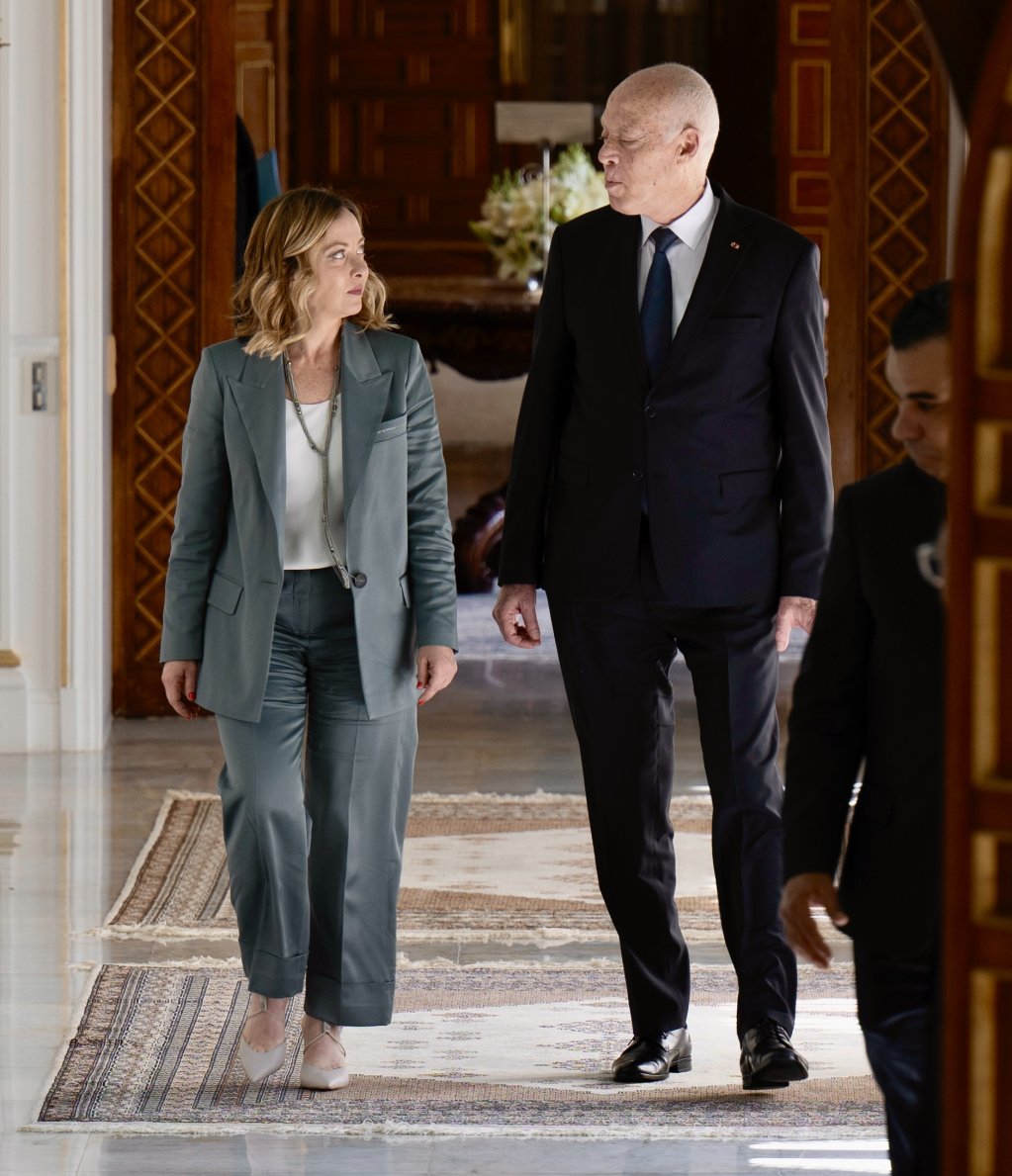
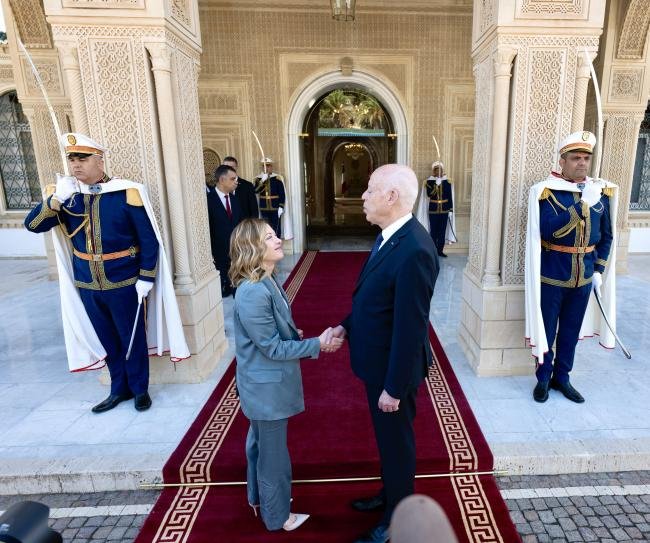
Italy's Prime Minister Giorgia Meloni completed her fourth visit to Tunisia in a year. In talks with Tunisian President Kais Saied, Meloni focused on the issue of migration. The two countries signed three new accords, with Italy pledging more funding.
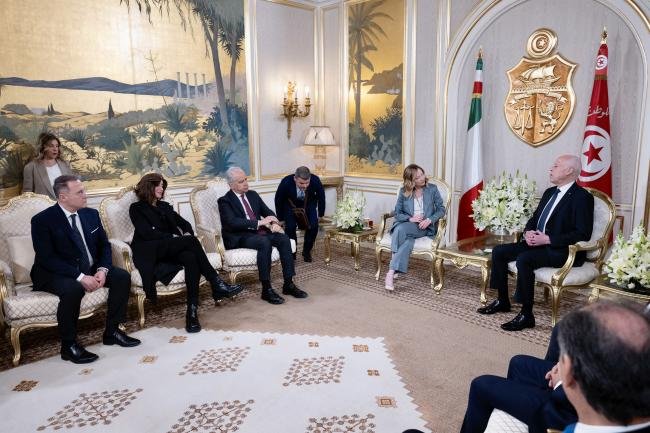
Italy's Prime Minister Giorgia Meloni met with Tunisian officials and the country’s president, Kais Saied, on Wednesday (April 17) to discuss what she termed a "new approach" to migration and "reciprocal" economic cooperation.
In a video addressing the press after the talks, Meloni called Italy's relationship with Tunisia "strategic" and of "maximum priority."
Italy's Interior Minister Matteo Piantedosi traveled alongside Meloni, as did Minister of Universities and Research Anna Maria Bernini and Deputy Minister of Foreign Affairs and International Cooperation Edmondo Cirielli.
"It is essential that we work together to continue to fight the slavers of the third millennium, the mafia organizations that exploit the legitimate aspirations of those who would like a better life," stated Meloni on her fourth visit to Tunisia in a little under a year.
Hopes to increase repatriations
Meloni added during the visit that she wanted to try and make sure that Tunisia did not become "the arrival point for migrants coming from the rest of Africa."
In the video statement, she said she would "involve international organizations to work on repatriations."
Also read: IOM distributes food to stranded migrants in Sfax
Tunisia's President Saied has been adamant for years that Tunisia will not accept returns of third country nationals or accept becoming a processing center for the EU, checking the legitimacy of asylum claims before people board boats towards Europe.
Meloni is reported to have "sidestepped" these issues somewhat, according to the news agency Associated Press (AP). Instead, she focused on praising the "shared priorities" that Tunisia and Italy held in "fighting human traffickers and repatriating African migrants back to their home countries."
Meloni also underlined the "good personal rapport between myself and President Saied … and the historic friendship between our two countries."
Three new accords signed as part of Mattei Plan
During the visit, Saied and Meloni signed a series of new accords, consistent with Italy's so-called Mattei Plan for the African continent.
The accords revolved around a 50 million euro aid package for energy projects, credits for small and medium-sized businesses and a university cooperation agreement.
Italy has also promised, reported the French news agency Agence France Presse (AFP), up to 12,000 residence permits to Tunisians trained in specific fields as well as plans to expand efforts to repatriate failed asylum seekers to their home countries.
Also read: Made in Italy: immigrant labor behind half of all food products
The Mattei Plan was first announced by Meloni at the end of 2023 and laid out in an Africa summit hosted in Italy at the end of January 2024. The plan, according to the Institute of International Affairs (IAI), a private independent think tank in Italy, is set to provide initial funding of 5.5 billion euros in grants, credits or guarantees for participating countries.
The plan consists of nine pilot projects in various countries including Tunisia, Morocco, Egypt, Ethiopia, Ivory Coast, Kenya, Algeria, Mozambique, and Democratic Republic of Congo.
Funding of Europe-Africa partnerships
The funding for the projects, states the IAI, is intended to build up partnerships with African countries, "where key goals and targets are codesigned … and rolled out in synergy with ongoing European initiatives … such as 'Team Europe Initiatives (TEI)' and 'Global Gateway.'"
Both TEI and Global Gateway are EU Commission projects to allow the EU to work on partnerships with third countries, focusing on "common objectives" usually revolving around development and policy goals, such as managing migration, health, and the economy.
Critics of the plan though, reported AFP, worry that the Mattei plan is all about obtaining green energy for Europe, while earmarking funding for the global south almost exclusively to the management of migration.
Arrivals in Italy
According to Italian Interior Ministry figures, more than 16,000 migrants have arrived in Italy by small boats since the beginning of the year. The figures were last updated early on April 18.
The three main countries of departure to make the journey across the Mediterranean towards Italy tend to be Libya, Tunisia and Algeria.
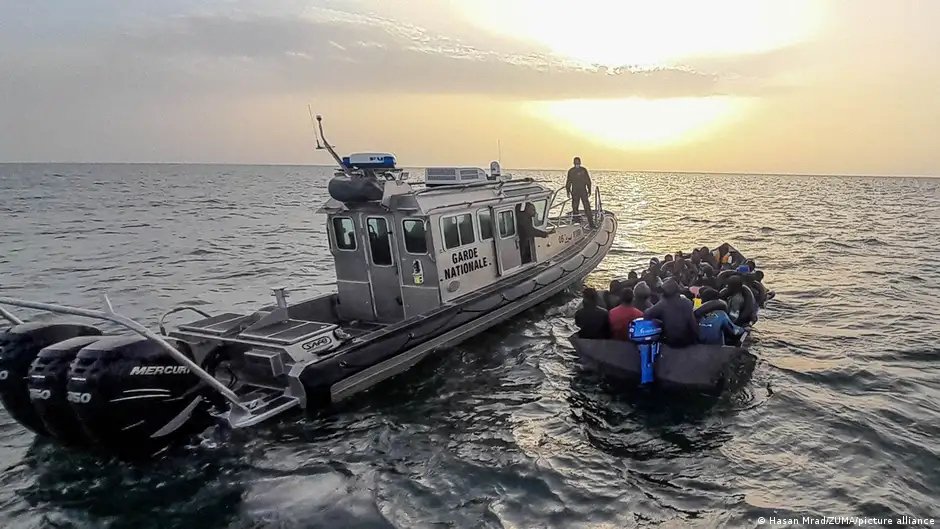
In hopes of curbing migration, Tunisian border controls have become more active in the past year. According to Tunisian figures, at least 21,000 attempts to cross the Mediterranean were intercepted since the beginning of the year. Some people may have been intercepted more than once.
While the Tunisian navy and border forces carry out frequent patrols in Mediterranean waters off the Tunisian coast, President Saied has reiterated that he doesn't want his country to act as Europe's "border guard."
He also stated earlier this week that he had no intention of opening similar detention centers to the one Italy is currently building in Albania, where intercepted asylum seekers would be processed before they reach European borders.
Funds yet to materialize
Last summer, the EU reached a separate agreement with Tunisia, in which they promised more than one billion euros in development aid and funding for Tunisia in return for increased border management.
The funding though was also contingent on Tunisia reaching an agreement with the International Monetary Fund (IMF) on a stalled bailout package. The package required Tunisia to make huge spending cuts -- conditions which it has not yet met.
The EU has reportedly begun paying out tranches of the funding. However, according to Romdhane Ben Amor from the Tunisian Forum for Economic and Social Rights (FTDES), much of the EU funding has "yet to be dispersed," reported AP.
The EU-Tunisia agreement has meanwhile also been criticized within the European Parliament, where the deterioration of the protection of human rights and freedoms in Tunisia since Saied dissolved parliament in 2021 was raised as a major concern.
Last year, Saied was also criticized widely by international organizations for using rhetoric, which linked African migrants to crime in his country and appeared to blame them for the economic and political woes Tunisia is experiencing.
His words created a climate of fear for many sub-Saharan African migrants in Tunisia, some of whom had been living and working there for years, resulting in violence, unrest and a series of roundups and arrests, in which several people were reported to have died and more injured.
Saied repeated similar comments ahead of the current visit by Italy's Premier, reported the news agency ANSA.
Saied accused of incendiary using language
Riccardo Noury, a spokesperson from Amnesty International Italy, said that Italy's agreements with Tunisia did not primarily have the best interest of migrants in mind and were chiefly designed to shore up the power that President Saied already held in his country.
Noury added that the cooperation with Italy appeared to tacitly allow him to continue with "racist and anti-immigrant rhetoric."
The center-left Italian newspaper Domani supported that view, saying that "despite the pretty words and the agreements signed, Italy's only objective is to stop migrant departures from North Africa."
The English-speaking news portal Middle East Monitor meanwhile reported on April 16 that the situation for migrants in Tunisia hoping to reach Europe was turning more deadly: A Tunisian health official in the region of the port town of Sfax had told the outlet that "the number of drowned migrants has exceeded the capacity of the region's hospital mortuary, which can take 35 corpses."
The official said that more than 100 bodies were awaiting burial at the moment, and that even the cemeteries were starting to "fill up."
In 2023, according to FTDES, more than 1,300 migrants died off the coast of Tunisia while attempting to reach Europe.
With AP, AFP and Reuters