
Spanish maritime rescuers found the bodies of two migrants on a fishing canoe off the Canary Islands. The Red Cross, citing survivors, says five more people died during the journey to Europe but that their bodies have been thrown into the ocean.
Two people died and five are feared dead after they tried to reach the Canary Islands on an unstable boat, the Spanish Maritime Rescue Service said on Tuesday (March 12).
A merchant vessel saw the distressed boat on Monday evening at around 8 pm (20:00 GMT) and alerted authorities on the island of Gran Canaria.
The bodies of two deceased people were found on the boat during the rescue operations, according to the maritime rescue workers. The migrants had been traveling in a pirogue – a type of long, wooden dugout canoe typically used for fishing.
Also read: Four migrants found dead off Spain’s Canary Islands
Later on Tuesday, the Red Cross in the Canary Islands said some survivors reported that five others died during the journey to Europe but their bodies were thrown into the sea. The humanitarian organization said the five bodies have not been found yet so they are being treated as missing people. Forty people were rescued from the pirogue, including the two deceased.
The Spanish rescue service has been unable to confirm the additional deaths but confirmed four people were hospitalized and that 34 others had been pulled to safety.
"Four people were urgently evacuated" by helicopter to a hospital on Gran Canaria, a maritime rescue service spokeswoman told the French news agency AFP.
Also read: Spain: Migration routes became busier in 2023
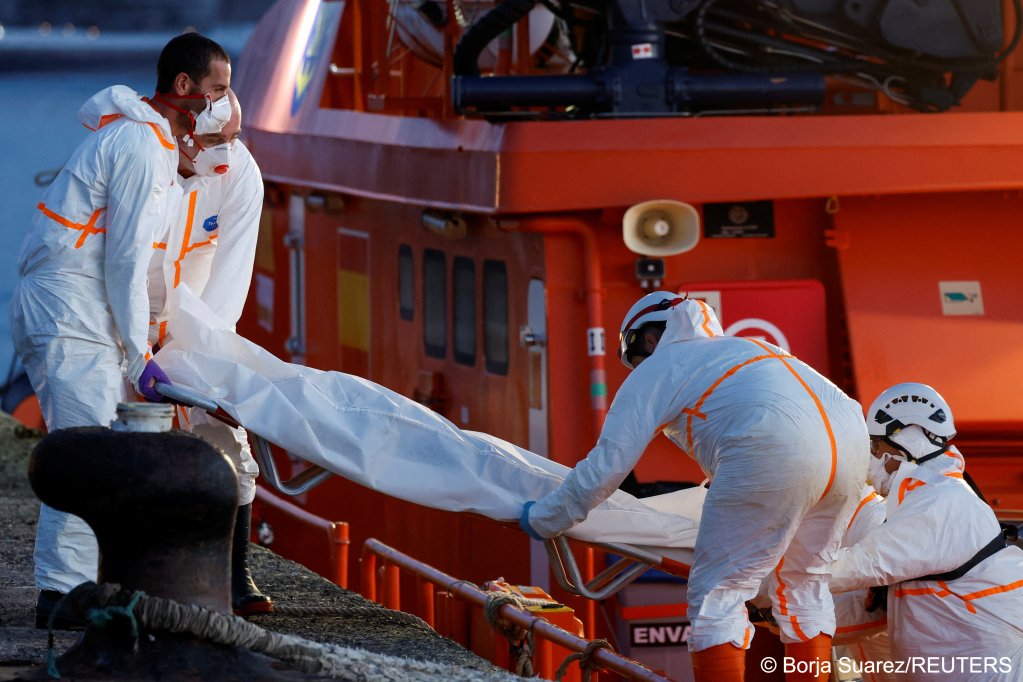
Rescued migrants disembarked in Gran Canaria
Rescue services sent a ship to tow the pirogue to the port of Arguineguin in Gran Canaria, some 76 nautical miles (140 kilometers) to the north and one of the Atlantic archipelago's seven islands.
Those on board the pirogue were African men and women, Reuters reported citing a spokesperson for the Spanish rescue services – but it did not elaborate where the pirogue started its journey.
Emergency services posted on the social media platform X that the four who were evacuated were in "serious condition," and that they had sent a large team to the port to treat the survivors. Red Cross members and police were also present to receive the migrants.
Also read: 'I saw myself already dead': Serge, Congolese exile, recounts his crossing for the Canary Islands
Atlantic route sees migration spike
By the end of February this year, 11,932 irregular migrants had arrived to the Canary Islands on 181 boats, in comparison to 1,865 arriving in 42 boats in the same period last year, according to figures from the Spanish interior ministry. In 2023, nearly 40,000 migrants arrived in the Canaries, up from some 15,600 in 2022, and exceeding the record set in 2006.
According to EU border surveillance agency Frontex, the Atlantic route to the Canary Islands is the busiest route for irregular migration from West Africa into the European Union. The route is particularly dangerous because of strong currents, making it even more life-threatening for people traveling in crowded, unseaworthy boats – often without proper life jackets and enough drinking water.
People embark on small boats in ports in Morocco, Western Sahara or Mauritania, but also increasingly from countries further south including Senegal and Gambia.
With AFP and Reuters
Also read: EU launches migration partnership with Mauritania