
A unique group of volunteers in Athens celebrate a year of bringing refugees and Greeks together amid the ongoing migrant crisis.
A group of young men and women are sitting in a classroom learning Greek as the gentle sound of children's laughter filters in from the playroom. There's an arts and crafts session planned for later as well as skateboarding lessons. The building is buzzing with activity.
The atmosphere is warm and welcoming. People are laughing and smiling and they have a spring in their step. It feels like a million miles away from the grim reception centers on the islands of Lesvos, Chios and Samos, where thousands of refugees are housed in ever-deteriorating living conditions.Here in the neighborhood of Exarcheia, the heart of Athens' anarchist and bohemian community, the message is clear. This is a place of sanctuary and solidarity for refugees.There's a bit more buzz than usual. That's because it's a special week for Khora, as it is officially one year old on September 30. Not only that, the center is joining in the demonstration organized by the 'Sick of Waiting' movement on the same day.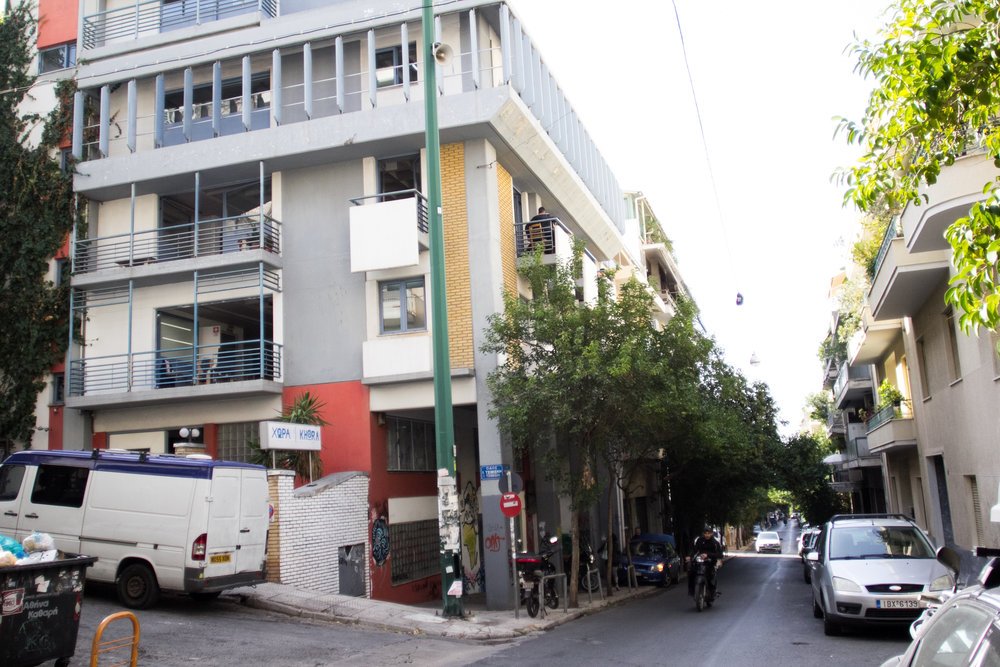
Emma Musty, one of the longest-serving volunteers at the center, takes a break to discuss Khora's celebratory landmark and what the future holds for the center."To be honest, it's difficult because although we are happy to still be open after a year, our continued existence means that unfortunately there is still a problem; that people are still being failed by asylum procedures," says Emma, a 35-year-old writer with a PhD from Aberystwyth University."The relocation programme should have relocated 160,000 people by now (September 30). That's why we're working with the group Sick of Waiting and supporting their demonstration," she adds.Six days a week, Khora throws open its doors to provide refugees and migrants with food and refreshments, and a host of services, including Greek and English language lessons, practical and legal information, creative play for children, carpentry and other crafts, dentistry and internet, among others.Most of Khora's volunteers have previously worked in refugee solidarity activism on the Greek islands during the peak of the crisis in 2015 and 2016. Humble beginnings "A few of us met on Lesvos while working on different projects," Emma reveals, speaking about the origins of Khora. "After the EU-Turkey deal, we ended up leaving the island but we knew that people were still having a difficult time in Athens and we'd met some of those people on the islands."
"It took us some time to find a suitable space. So for a few months we were cooking in Piraeus Port when there were still people living there."
From those humble beginnings, Khora moved to an 8-storey building which has been renovated by the volunteers with funding from a wide variety of sources, from a group of cyclists in London to other UK and Swiss charities.The name, according to the co-operative themselves, means 'a radical otherness that "gives place" for being'. Khora claims that the current EU border system creates the illusion of the 'other', dividing humans into categories of those who have freedom of movement and those who do not.
Khora helps between 500 and 1000 people who use the building on a daily basis. "Most are from refugee communities but also some local unemployed or homeless people come," Emma adds.With poor humanitarian conditions in government-run camps, centres such as Khora, as well as activist-run squats, provide a crucial service for refugees and migrants, filling a gap where the Greek state continues to fall short."We wanted to provide something like a "normal" life for people who use the center. A place where they can get involved and make decisions too, so they don't just feel like a number," says Emma, about the central idea behind Khora. Future challenges
Emma admits that most days are a big challenge, but is proud of what Khora continues to achieve. "The biggest challenge the people face now is the continuing political situation, the fact that people are trapped in Greece for months or years, the long-term effects of institutional mistreatment of people seeking refuge, the mental health problems which can result from this," Emma says.
Although the Greek government has put in place some support measures involving financial support and entry to the job market for refugees, the efforts so far have been "patchy", according to Emma.
With over 60,000 refugees in Greece and painfully slow asylum application processes, there is still a long way to go.
In 2015, EU countries committed to host 120,759 refugees by September 2017, but according to the organization #SickofWaiting, 74% are still in a limbo waiting for their destination. The processes of the families who have applied to be reunited are also stuck or slow.
It is in this context that Khora took part in the #SickOfWaiting demonstrations in Athens this past weekend (September 30 / October 1) to prompt the governments all around the world to assume their responsibilities.
Report by: Graham Wood