
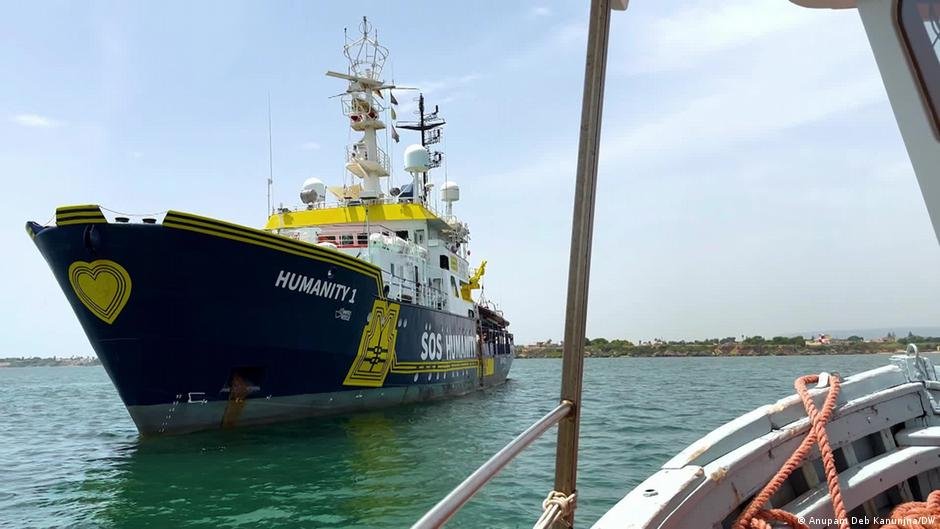
The SOS Humanity rescue ship carrying passengers that including women, unaccompanied minors, and babies is set to port in Bari, southern Italy. The journey will take about three days.
German search and rescue organization SOS Humanity rescued 90 refugees and migrants during three consecutive operations in the Mediterranean Sea which began on Sunday (October 15).
The ship is now on its way to the port of Bari, southern Italy, carrying passengers that include women, unaccompanied minors, and babies. It will take an estimated three days for the SOS Humanity to reach the port which is 1,000 kilometers away.
Read more: International law and the criminalization of sea rescue
"Being asked to dock in a distant port is absolutely unnecessary and illogical," Petra Krischok, press officer for SOS Humanity told InfoMigrants.
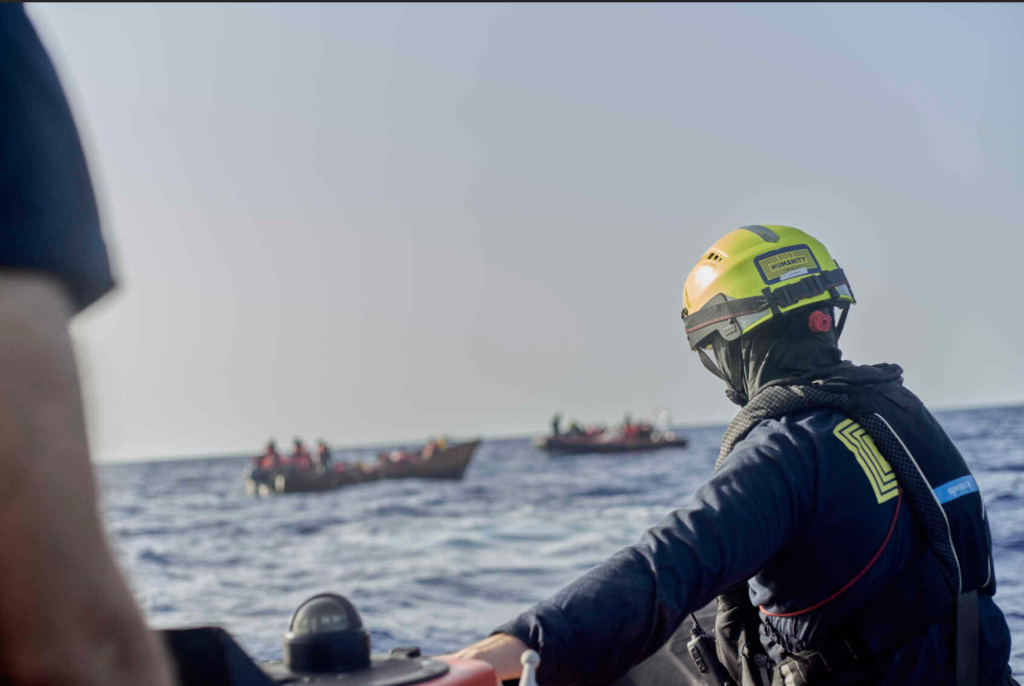
According to an SOS Humanity statement shared with InfoMigrants, one wooden boat was overcrowded, running low on fuel, and set adrift in the Maltese Search and Rescue Zone. None of the passengers were wearing a life jacket.
The rescue of another overcrowded fiberglass boat was made more risky by strong winds and waves that were over 2 meters high.
According to Krischok, the law makes it difficult for everyone. For those rescued, it compounds the trauma of being out at sea for a number of days. For rescue organizations, it drains resources because of the high cost of fuel, and it delays the rescue response.
The Italian law also prohibits successive rescue operations, requiring rescue boats to disembark before conducting another rescue operation.
Krischok told InfoMigrants that the three successive sea rescues were done in coordination with the Maltese and Italian authorities but emphasized, "We do not need permission to conduct a rescue operation. We are obliged to rescue people in distress at sea. The same would be expected of a trade ship or fishing boat."
"There were clear indications that these people were in distress and needed rescue," Krischok added.
Suing the Italian government
In April, SOS Humanity, together with other search and rescue organizations Mission Lifeline and Sea-Eye, filed a case against the Italian government’s systematic policy of assigning distant ports.
The organizations contend that the policy, imposed by Italian authorities since December 2022, is not in compliance with international maritime laws, restricts rescue operations, and endangers the well-being of those rescued at sea.
According to the international law of the sea, an assigned port should be within a reasonable distance to allow for quick disembarkation.
Since December last year, search and rescue NGOs have been assigned more than 50 ports that were “unnecessarily far away from the locations of the rescues conducted”, said SOS Humanity.
Last July, five organizations filed a complaint with the European Commission against the Italian law which obliges ships to immediately travel to an assigned port after rescuing migrants—and thus prohibiting successive rescue operations--saying it puts lives at risk.
Read more: Italy's new sea rescue law: NGOs file complaint with EU commission
Rescue operations do not induce migration
The Central Mediterranean Route (CMR) the vast sea area that is between the Libyan, Tunisian, Maltese, and Italian search and rescue areas – is one of the most dangerous sea passages in the world. The journey is often made on overcrowded inflatable or wooden boats that are no match for the waves and currents of the open sea.
The International Organization for Migration (IOM) estimates that there have been more than 17,000 deaths and disappearances along the CMR since 2014.
Read more: Video: Mediterranean migrant deaths at highest in years
Italy and Spain, countries with coastlines at the external border of Europe, have seen a sharp increase in new boat arrivals over the last couple of months.
Italy has implemented various measures to stem irregular migration through the Central Mediterranean by restricting rescue operations through the impounding of rescue ships and imposing fines on NGOs. Additionally, inter-country agreements have been penned to bolster sea patrols and return or deport those who have been rescued to Libya or Tunisia.
A 2023 study published in the international journal Nature showed that the presence and conduct of search and rescue operations do not drive irregular migration in the Central Mediterranean.
“State- and private-led search-and-rescue are hypothesized to foster irregular migration (and thereby migrant fatalities)...we do not find support for search-and-rescue as a driver of irregular migration,” reads the study.