
Over the past few years, EU governments have been clamping down heavily on migrant smuggling. But those taken into custody are often migrants who have found themselves in the wrong place at the wrong time, while the actual smugglers get off free.
Mahtab Sabetara knew something wasn't right. For the past six months, her father Homayoun Sabetara had been telling her he was in a refugee home in Greece.
But as the months passed, Mahtab started noticing strange details – he often didn't have access to a phone, for example. She knew that if he was in a refugee home, he'd have access to a phone.
She pushed him and eventually, he told her the truth: he wasn't in a refugee home after all – he was in jail.
Alone and ailing in Iran
Months earlier, in the summer of 2021, Homayoun had told Mahtab -- who was living in Berlin as a student – that he was leaving Iran to come to Germany.
With both children abroad, Homayoun had been living alone for the past two years in Tehran; his wife had died a decade prior. He was growing ill and had lost his job in software development.
But family reunification visas aren't available for these sorts of cases. The only realistic way Homayoun could make it to Germany was through irregular means, given his age and health.
Read more: How European countries seek to deter asylum seekers
Journey from Turkey to Greece
Like many migrants before him, Homayoun made his way to Turkey with plans to cross over into Greece. After around three weeks, he found someone who said they could smuggle him over the border.
Homayoun paid half the sum before the smuggling attempt, and promised to pay the rest when they'd made it to Greece, where he planned to meet his daughter.
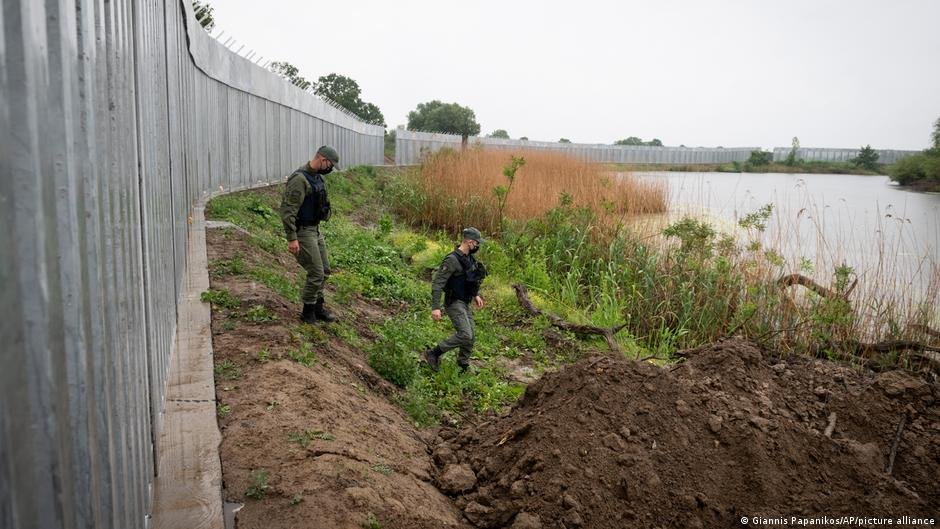
After three days in the Evros forest, where many migrants are known to hide before crossing the Greek border, a smuggler brought Homayoun and seven other people to a car, which he told Homayoun he'd need to drive the rest of the way to Thessaloniki.
Homayoun was chosen as the driver because he'd only paid half the price and was older than the others.
The smuggler provided Homayoun with a navigation device that he said would lead the group to a spot where they would be picked up by another smuggler. The journey over the border would take around two hours, the smuggler reportedly added.
After spending those desperate days in the Evros forest without food, water or a safe place to sleep, everyone on the journey was eager to finish the journey into Europe.
Homayoun was scared, Mahtab later said, but there wasn't much he could do.
Witnesses nowhere to be found
The car had nearly made it to Thessaloniki when it was stopped by police; everyone was ordered to get out.
The officers asked Homayoun if he had been driving the car, and he said yes. The others who had been traveling along confirmed that he'd been the driver, but all said he hadn't been the one who organized the journey.
The rest were left to go on their way but Homayoun was taken into custody. He has remained imprisoned since.
Although the others who made the journey with Homayoun could serve as key witnesses in a trial, nobody has been able to locate them since they departed that day.
'Until the trial I had hope'
Homayoun didn't immediately tell his daughter about his situation because he did not think it would last long. He knew he was innocent, and thought he'd be out within a few weeks.
Mahtab thought the same thing once she'd heard what had happened. When Homayoun's trial came, she was hopeful: "We had all the documents, his flight tickets – how can someone organize a journey when they aren't in Turkey? Everyone in the room said it was clear he hadn't organized the journey," Mahtab told InfoMigrants.
She thought this had all been a sort of misunderstanding and now, with the backing of NGOs and a lawyer she'd contacted to take on the case, she believed that things would iron themselves out.
"But none of it played any role," she commented.
Homayoun's court appointment took place a year after his original detention, in September 2022. The court process was conducted in Greek, and Mahtab and the lawyer had to organize translation services on their own.
In the end, the original charge for smuggling was reduced to 18 years, where it remains today.
The trial ended and Mahtab went back to Berlin. Homayoun went back to jail.
Read more: Inside France's battle against migrant smuggler: A closer look
A family's mental health in decline
A second trial will now likely take place next spring. Like the first one, however, which was delayed for nearly half a year, it will likely be pushed back, Mahtab said.
The stress of the situation has impacted Mahtab's studies as she had to give it up pursuing her next degree at one point.
Homayoun's mental health is also impacted, she told InfoMigrants. Although she has told him that she wants to come visit him, he does not want her to come because the conditions in the jail are so bad.
This is unlike him, she said – usually he would want to see her.
Forced into activism
Over the course of the past few years, Mahtab has found herself more or less forced into activism in an attempt to spread awareness on their father's case. The campaign is supported by some 50 NGOs from across Europe.
With their support, Mahtab has tried to access all resources available to her to receive assistance toward her father's case, being featured in several news reports across Germany.
Thanks to their initiative, Homayoun was presented with an award at a migration-themed gala in Berlin earlier this summer.
But he still remains imprisoned.

'Thousands of Homayouns across Europe'
Maurice Stierl, a migration researcher at the University of Osnabrück in Germany called Homayoun's case extraordinary – not because it's uncommon, but because the amount of visibility it has received due to Mahtab's campaigning efforts.
"There are so many Homayouns sitting in European prisons," Stierl told InfoMigrants. "The criminalization of people on the move has become increasingly systematic over the years."
Stierl, who also founded the Alarm Phone NGO hotline for migrant rescue at sea, highlighted that in order to justify the criminalization of people like Homayoun, authorities often misconstrue certain forms of unassuming behavior – like driving a car, steering a boat or holding a phone and calling for help – are as alleged indicators of smuggling.
"These attempts to criminalize people on the move have increased at the same time as it is blatantly obvious that the vast majority of these boats do not have any 'official smuggling person' on board," said Stierl.
A misguided deterrent
According to a Borderline Europe report published in July, over 2,150 people were detained in Greek prisons alone with accusations of smuggling in February of this year. The vast majority of these cases aren't publicized.
Stierl said the purpose of these punishments is twofold: first, it's a way to try and scare migrants out of embarking on journeys across borders by making an example of people on the move who end up in the wrong place at the wrong time.
Second, it's a way for governments to show that they're taking action against irregular migration by clamping down on smuggling, even if the number of migrants entering the borders actually is increasing.
"European governments feel, I think, that they have to show they're doing something, which is often very symbolic. But of course for the people on the move themselves, it is horrendous – being criminalized for 30, 40, 50 years basically for migrating," Stierl told InfoMigrants, highlighting the fact that such practices are on the rise in Greece and Italy in particular.
"It's an extraordinary punishment."
Homayoun's trial is scheduled take place in April 2024. You can follow the campaign here.