
In Spain, nine migrants have been taken into custody on piracy charges. They allegedly forced the ship that rescued them to change its course to the Canary Islands instead of Morocco.
The nine migrants belonged to a group of 78 seeking to cross from Africa to the Spanish archipelago on two boats earlier in the week.
When they ran into trouble, they were rescued by a Dutch tugboat heading to the southern Moroccan port of Tan Tan.
According to the Spanish police, they allegedly threatened the crew of the tugboat with knives when they realized it wasn’t traveling to the Canaries.
Under duress, the captain of the tugboat changed course, heading to Fuerteventura, one of the Canary Islands.
Local authorities were informed about the situation, which police called an act of "mutiny."
The nine migrants who commandeered the tugboat were arrested "on piracy charges", according to a police source, who spoke to the AFP news agency.
Their nationalities remain unclear.
Read more: Canary Islands: 'The most important thing for Madrid is that migrants remain in Morocco'
Canary Islands: A major migrant destination
Migrants from Africa have increasingly been trying to reach the Canaries in recent years, as the Spanish archipelago is part of the European Union.
While the majority of boats heading in that direction depart from Morocco or from the Moroccan-controlled Western Sahara territory, some set sail from further afield, including from Mauritania, Senegal and beyond.
Some boats travel more than 1,000 kilometers in the open sea in hopes of getting to the Canaries.
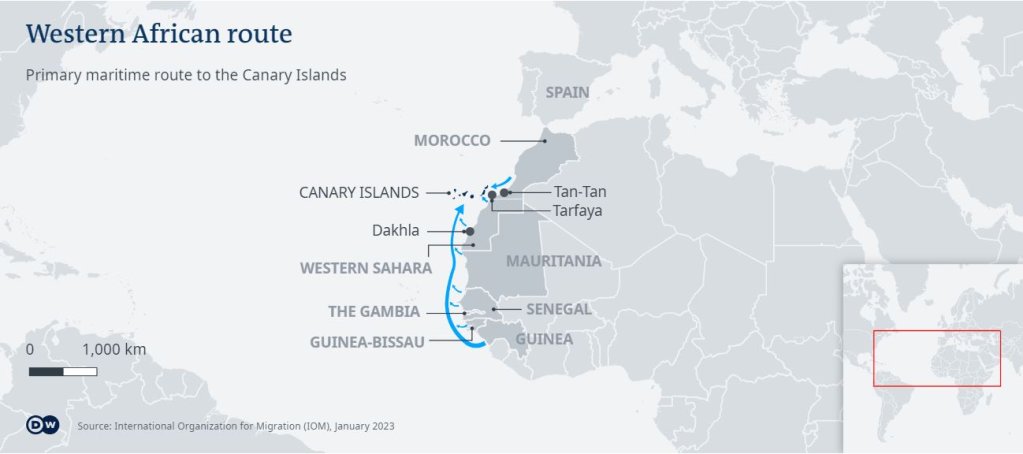
Death and tragedy at sea
The Atlantic route is considered one of the most dangerous migrant routes in the world with its strong currents and limited sea rescue operations.
Migrants departing from the African coast often have to journey on overloaded boats, which are not made to withstand travel at sea.
Since the beginning of this year, 140 migrants are confirmed to have drowned on this route, according to figures published by the International Organization for Migration (IOM). The Spanish migrant NGO Caminando Fronteras, however, believes that at least 778 people have died on the Atlantic route to the Canary Islands in the first six months of 2023 alone.
Meanwhile, almost 15,000 people have managed to arrive in one of the Canary Islands using irregular means, marking a rise of some 20% compared to the same period in 2022, according to Spanish interior ministry figures.
However, the chances of being granted asylum are slim for many, as the majority of the places they depart from are considered safe countries of origin.
Read more: Boat crammed with 280 migrants reaches Spain's Canary Islands
with AFP