
One of Germany's most affluent states is heading to the polls with CSU State Premier Markus Söder desperate to maintain his current coalition. But that means adopting his coalition partner's populist tone.
Bavarian State Premier Markus Söder has a certain way of entering the room at his campaign events: He doesn't come directly onto the stage, but from the back of the hall, working his way through the crowd to the front like a boxer entering a ring, shaking as many hands as he can on the way. He might be trailing an entourage of security guards, assistants, and sometimes a cameraman, but he's a man emerging from among his people.
Söder performed this entrance again at a campaign event in late September in Ebersberg, outside Munich, as he entered the home straight of his re-election campaign. Then he delivered what was not so much a speech as a 60-minute stand-up routine -- a collection of well-honed "bits," which he evidently no longer needs to read off any paper, and which he picks to suit the crowd.
On this particular night, the jokes come at the expense of climate activists, federal Social Democrat Health Minister Karl Lauterbach, and of course that perennial butt of all jokes among conservative German politicians – the Green Party and their supposed love of banning things that Bavarians like: Sausages, candy, shooting wolves that kill livestock.
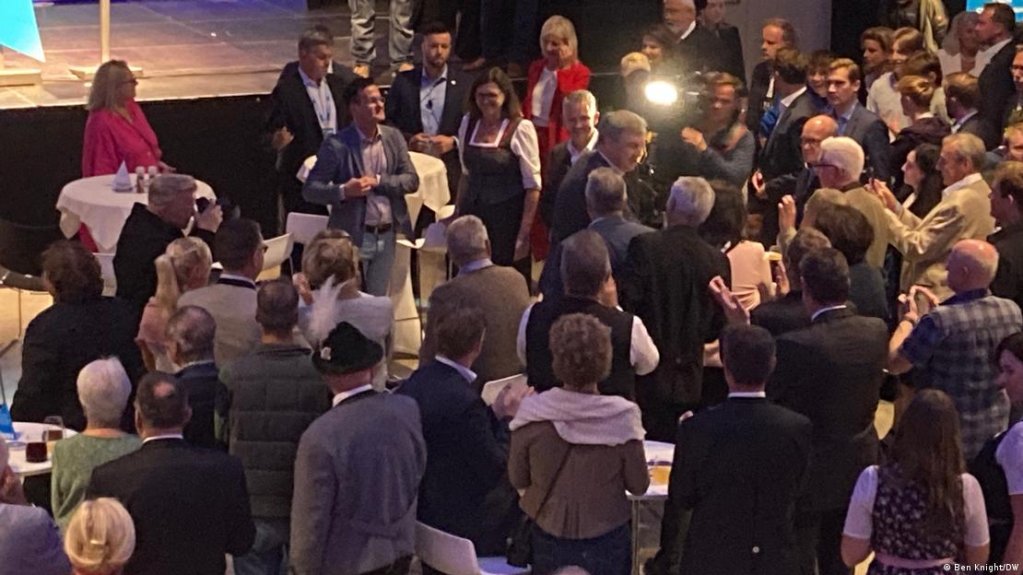
Söder has long presented himself as the consummate populist – and he has decided that food is the way to the voters' hearts. Among the freebies distributed to the Ebersberg crowd was a cookbook based on Söder's most successful social media hashtag: #Söderisst (Söder eats).
What might seem like just a document of his dinners also underscores his basic message: Söder loves Bavarian food because Söder is a Bavarian to his bones, and his Christian Social Union (CSU) basically is Bavaria. "A strong CSU means a strong Bavaria," he likes to say, and he can't resist adding a dig at the federal government: "And there's nothing that Berlin loves more than a weak Bavaria!"
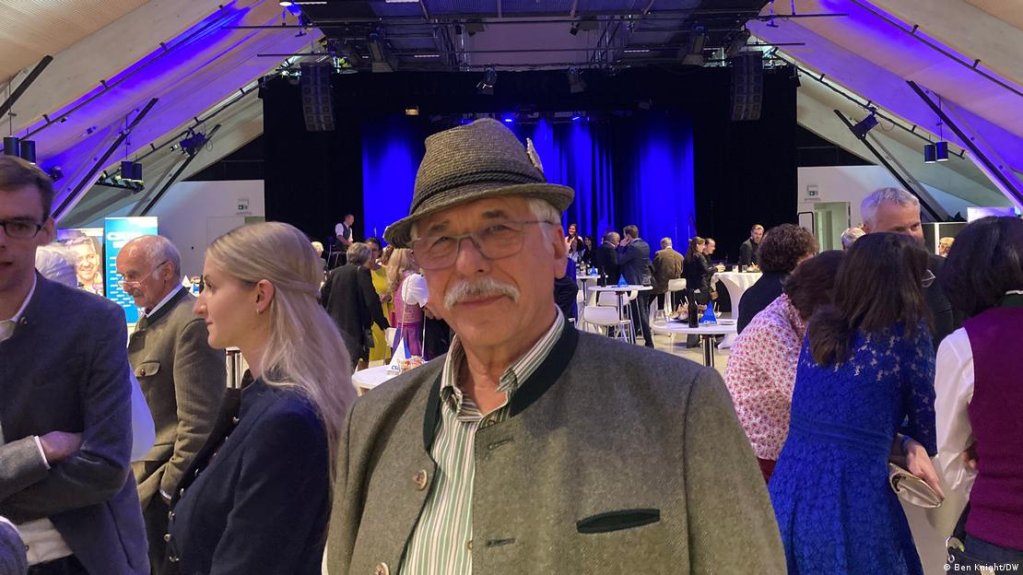
Lifelong CSU voter Josef Götz, dressed in traditional Bavarian costume, laughed this off as an echo of 200 years of inner-German rivalry: "Berlin needs us, but doesn't want us to have a say," he told DW. "That's why there'll never be a Bavarian chancellor!"
Free Voters: A new populist on the block
Recently, though, Söder has found himself outflanked in the populism game by his coalition partner: Deputy State Premier Hubert Aiwanger, state economy minister and head of the Free Voters (Freie Wähler), a relatively new party that prides itself on grassroots focus.
The CSU/FW coalition looks easy enough on paper: There is little separating the two parties in terms of ideology and policy -- they are both center-right, socially conservative, and economically liberal.
But the relationship has grown more uneasy since the last Bavarian state election in 2018 when Söder chose to form a coalition with the FW rather than the Greens. Since then, Aiwanger's confidence has grown. The scandals over his alleged far-right sympathies in his school days and his rhetoric about "taking back democracy" have only swelled his polling numbers.
Aiwanger insists that not all his public appearances are populist "beer tent speeches." "But part of beer tent culture is exaggerating, producing a few thigh-slapping gags that animate people to laughter, and a few -- yes -- cheeky claims about the political competitors," he told DW. "This beer tent exchange is a Bavarian tradition that a lot of outsiders don't understand. The result is that when a northern German gives a speech in a Bavarian beer tent they fail spectacularly after three minutes."
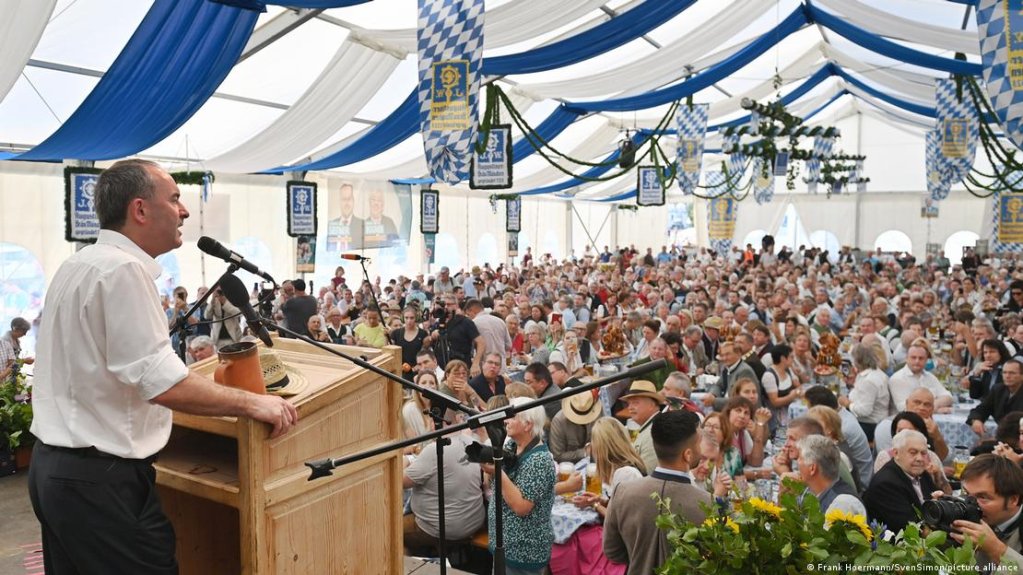
Aiwanger then went on to claim that when Chancellor Olaf Scholz tries to give speeches in Bavaria "no one shows up." To Aiwanger, culture war appears to come down to regional differences: "Northern Germany is just a bit more stand-offish and reserved than Bavaria. I was once in the state parliament Brandenburg and I thought I was at a Protestant church sermon."
He does not worry about what such rhetoric might be doing to the state of political debate: "Believe it or not, I don't see myself as a populist, because I see a populist as someone who speaks against his convictions and uses untruths just to kick up a storm."
Resisting 'the ratcatchers'
Some critics say that this is exactly what Aiwanger does -- not least with his now notorious speech condemning the government's planned heating law to phase out fossil fuels -- and it has worked for him: Latest polls put the FW at 16%, in second place behind only Söder's CSU, on 36.5%. That result would be a significant improvement on the 11.6% the FW achieved in 2018.
Traditionally, center-left parties are weak in Bavaria. This year, the Greens are polling on a similar level as the Free Voters and the AfD: at around 15%. But Scholz's Social Democrats are consistently polling at below 10%, and the neoliberal Free Democrats (FDP), the smallest member of the federal coalition government, looks set for yet another regional defeat and may fall below the 5% threshold for representation.
Söder, for whom anything below 35% would be a total disaster, is wary of losing even more CSU voters to the right. He has said that he intends to continue working with Aiwanger. That might make sense as a campaign tactic but could be damaging in the long term if it emboldens the Free Voters to ask for more than three of the 15 cabinet posts it currently holds.
Markus Söder does not want to be remembered as the CSU leader who squandered his party's national influence. But his authority remains unchallenged within the CSU, and his popularity is certainly intact in Ebersberg.
There, the appetite for right-wing extremism remains limited: It was notable that the loudest applause of the evening came when Söder condemned the far-right extremists of the Alternative for Germany (AfD).
Sabine Maier, a CSU voter in the crowd, dismissed the AfD as "rat-catchers," and said the CSU had no choice but to ally with the Free Voters. "A coalition with the Greens has been ruled out, and so has one with the AfD, thank God, so all that remains is to continue with the Free Voters."
Author: Ben Knight
First published: October 3, 2023
Copyright DW - All rights reserved
DW is not responsible for the content of external websites
Source: dw.com