
In northeastern Libya, volunteers continue to search for survivors of last week’s storm. The UN estimates that as many as ten percent of those killed were migrants.
Libya is still counting its dead after the devastating storm which hit the Mediterranean coast on September 10. Local and international emergency aid workers have put the death toll from the disaster at between 4,000 and 11,300 people – with difficulties recovering bodies and tens of thousands still missing, estimates vary widely.
As of Monday night (September 18), at least 3,338 bodies had been identified and buried, according to the health minister from Libya's eastern government, Othman Abduljaleel.
Derna in the east remains worst affected, after the collapse of two dams which sent a wall of water gushing through the city.
The UN migration agency, IOM, says around 30,000 people from Derna have been made homeless – many of them have reportedly been offered a temporary place to stay by residents of nearby Benghazi and Tobruk.
Some of the dead were from Libya’s huge migrant community – which numbers in the hundreds of thousands, according to IOM estimates.
The agency says about 400 of those known to have died were migrants, and the number is expected to rise with the discovery and identification of more bodies. Many migrants were living in particularly low-lying areas, the IOM told the BBC.
Of the victims already counted who are known to have been migrants, 250 were Egyptians, 150 from Sudan and six from Bangladesh, the IOM reported.
Also read: Libya: Concerns over the situation of migrants as death toll mounts
Fears of a second crisis
The floods have raised serious concerns about outbreaks of disease. UN officials have warned that a disease outbreak caused by contaminated water could create "a second devastating crisis."
On Saturday, at least 150 people, about a third of them children, had already suffered diarrhea after drinking dirty water in Derna, the head of the Libyan Center for Combating Diseases, Haider al-Saeih, said in televised comments. He said his ministry had begun a vaccination program, but did not give any more details.
Several UN agencies, including the World Health Organization (WHO), which has provided tons of medical aid, are working to prevent disease from spreading.
However, the WHO and the International Federation of the Red Cross and Red Crescent Societies (IFRC) also warned that treating dead bodies from the disaster as a health threat can be detrimental to the population.
We urge authorities in communities touched by tragedy to not rush forward with mass burials or mass cremations
While they said that bodies should not be left in contact with drinking water, Kazunobu Kojima, WHO medical officer for biosafety and biosecurity in the health emergencies program, stressed the importance of the opportunity to identity and mourn loved ones.
"We urge authorities in communities touched by tragedy to not rush forward with mass burials or mass cremations. Dignified management of bodies is important for families and communities, and in the cases of conflict, is often an important component of bringing about a swifter end to the fighting," he said.
Syrians try to trace family members
Among those affected by the loss of loved ones are the relatives of more than 100 Syrians, including entire families, who are believed to have died in the floods.
"In total, 112 Syrians were killed in the flood and more than 100 are still missing," said the head of the Syrian Observatory for Human Rights, Rami Abdel Rahman, in a report by Agence France Presse (AFP).
A Syrian construction worker, Khaled Ali, said he lost two nephews, Hadi and Mahmoud, as well as their wives and six of their children. The families had fled the Syrian conflict and taken refuge in Lebanon and then Libya, Khaled told AFP.
"We fled from one crisis to another," said the 37-year-old from Daraa province. "This is our fate."
Khaled said he had identified his nephews' bodies in pictures posted on Facebook.
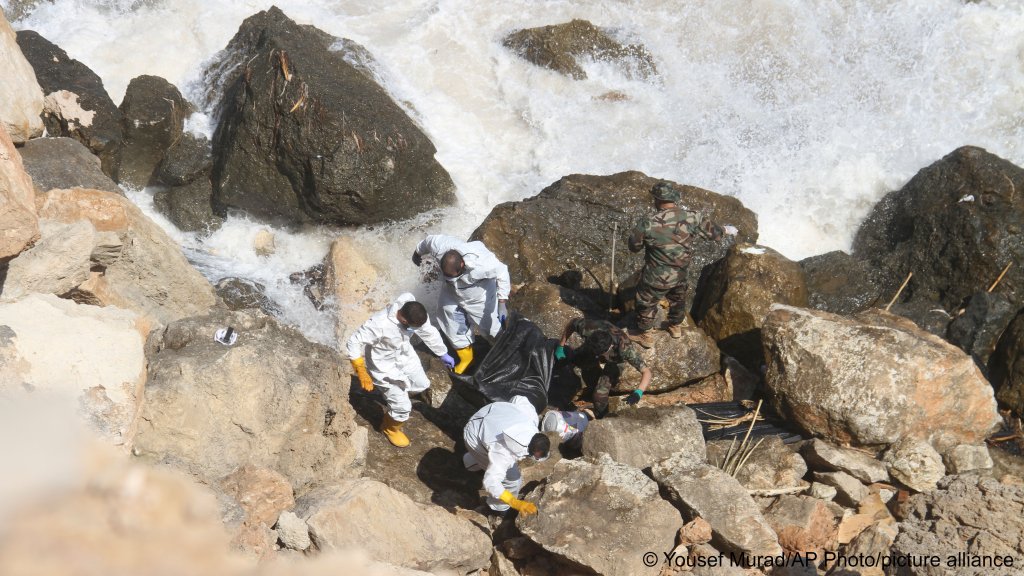
Other Syrians have been sharing photos of their relatives on the social media platform, hoping to find them.
A man from Damascus, Ibrahim Qalaaji, held a funeral for eight relatives including his brother Mohammed, who are either dead or missing in the disaster, he told AFP over the phone.
"A doctor (in Libya) told us my brother and his wife had died, but there is no trace of the rest of the family," he said.
Mohammed had been in Libya since 2000. His surviving brother Shadi was swept away from a rooftop and held on to a mosque's minaret as dead bodies floated past him.
Qalaaji said that Shadi had lost all his belongings, including identification papers, in the disaster, "He has no past, no present, no future."
Uncertainty turns to anger
The disaster has produced rare cooperation between Libya’s rival governments, with both sides deploying humanitarian teams to Derna and other affected areas.
But poor coordination, problems getting aid to the hardest-hit areas and the destruction of the port city’s infrastructure, including several bridges, have made their work difficult.
Some people are blaming the authorities over the destruction. On Monday, protestors outside the al-Shabana mosque in central Derna demanded that they speed up the investigation into the disaster.
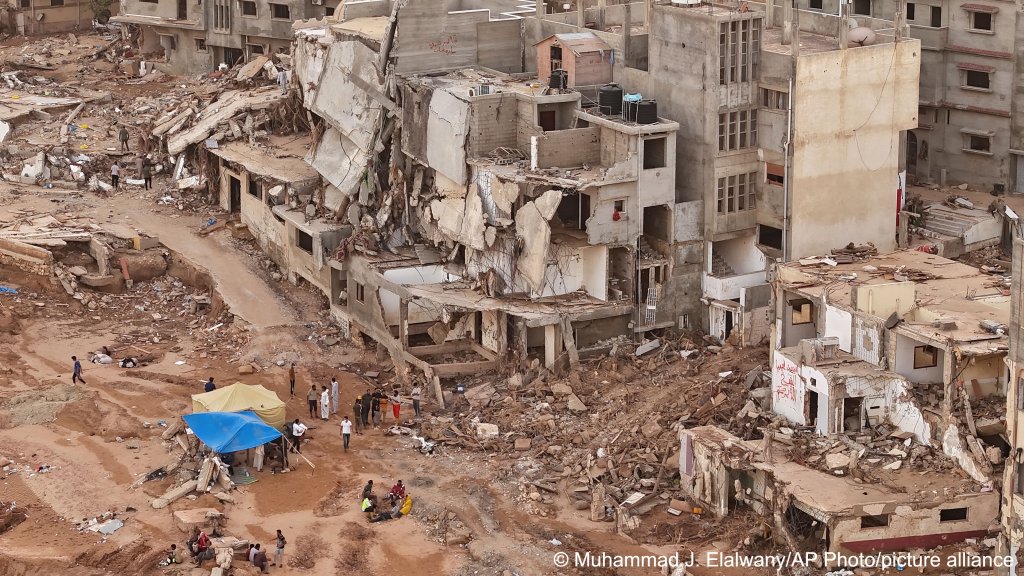
Protestors also called for the UN to set up an office in Derna, urgent reconstruction of the city and compensation for those affected by the flood.
Libya's general prosecutor, al-Sediq al-Sour, is reportedly investigating the collapse of the two dams, built in the 1970s, as well as the allocation of maintenance funds.
Meanwhile Derna's mayor, Abdel-Moneim al-Gaithi, who was suspended pending an investigation into the disaster, said Monday evening that his home had been set on fire by protesters.
Departures from Libya
Migrants have continued to set out from the Libyan coast in dinghies across the Mediterranean in recent days. Alarm Phone, a hotline for migrants in distress at sea, said late Monday night that a group of around 52 people who had left from Benghazi had asked to be rescued urgently as they feared for their lives.
Hundreds of people have died or gone missing while trying to cross the Mediterranean from Libya this year alone. On 10 August, the deaths of 34 people attempting the Central Mediterranean crossing were recorded by the IOM’s Missing Migrants project – their remains were washed ashore at Tajoura. On 21 August, another 41 people died north of Azzawizah.
Many migrants are also apprehended at sea by the Libyan coast guard, which is supported by the EU, and returned to Libya, where the IOM says they are routinely detained in state-run detention centers.
11,000 migrants have been intercepted and returned to Libya by the Libyan coast guard so far in 2023, according to data provided by IOM Libya. More than 275 of them in the week immediately following Storm Daniel.
With AFP, AP, DPA