
The German cabinet has presented its draft law change to the country's citizenship law -- the biggest in over a century. However, the amendments and articles have yet to be debated in parliament before the proposal becomes law, while opposition is mounting.
Germany's citizenship laws have long been regarded as archaic and outmoded, with certain elements harking back to the early 20th century.
Despite a steady increase in immigration over the past 50 years and more, German lawmakers have long refused to regard the country as a destination for immigrants, making it one of the most difficult EU member states for foreigners to fully integrate in.
This is now likely to change as the German cabinet has signed off on a proposal to reform the country's citizenship law in a major way, as Germany hopes to attract more skilled workers from abroad.
"We are in the middle of a global competition for the best minds," German Interior Minister Nancy Faeser said ahead of the presentation of the proposal on Wednesday.
"But we will only win the best minds if they can become fully part of our society in the foreseeable future," she added with a view of justifying the changes proposed in the draft legislation.
That proposal, however, still has to go through both houses of parliament, where amendments and adjustment might be requested before the law can be signed off later in the year.
Fast track to becoming German
To date, Germany's standard procedure for foreigners living and working in the country legally was to make naturalization as a German citizen available as an option after eight years.
Among the articles tabled in the draft proposal is a change to this standard period down to only five years of a foreigner having to reside and work in the country legally.
If applicants can prove a high level of integration in Germany, which includes possessing an advanced level of German language skills, they would even be able to obtain citizenship after only three years.
However, these changes would only apply to people who have full residency and work rights throughout this period and no criminal record.
Exclusions apply
Individuals who have committed serious crimes, including racially motivated assaults, will be barred. The draft proposal specifies that German citizenship will categorically be denied to people who have committed antisemitic, racist, xenophobic or other defamatory offenses which are "irreconcilable with commitment to the free democratic basic order."
Furthermore, foreign nationals who survive on government welfare will not qualify for citizenship until they demonstrably stop depending on benefits.
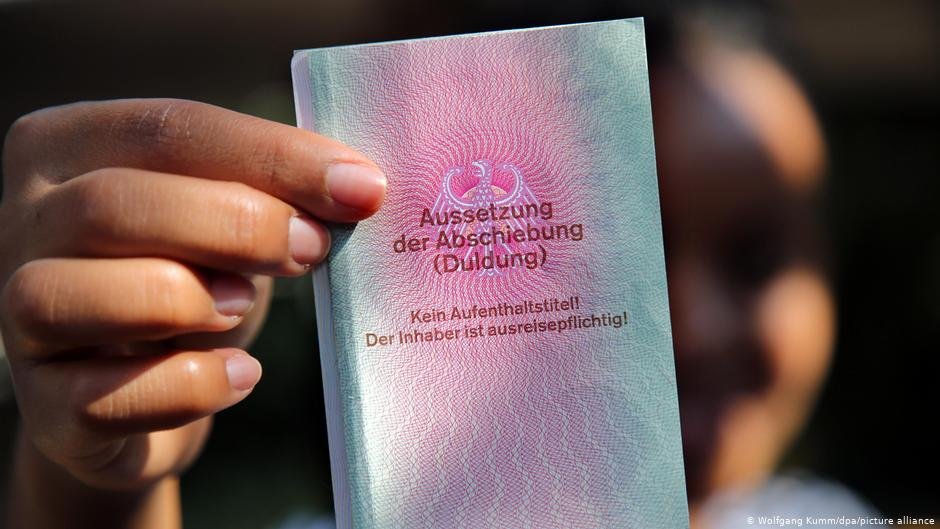
Asylum seekers who have managed to remain in Germany for a long time due to a ban on deportations to their home country ("Duldung") also will not qualify.
Applicants will have to prove that the center of their life is in Germany -- this is typically done by proving that Germany is your place of residence and/or by showing that your income is secured there.
This is also why, for example, homeless people cannot apply for German citizenship.
Finally, the proposal states clearly that access to German citizenship will be denied to individuals who are "married to more than one spouse at the same time, or show by their conduct that they disregard the equal rights of men and women as specified in [Germany's] Basic Law."
Special clause for 'guest workers'
The change in law, if passed, will also simplify certain requirements that have long been part of the naturalization process in Germany.
For example, foreigners who have been living in Germany for generations — in particular so-called "guest workers" who arrived in the 1960s and 70s — will no longer need to pass a written German exam but only an oral one.
This will make access to citizenship especially available to foreigners from the guest-worker generation who are illiterate, specifically those aged 67 and older.

However, Germany's overall approach to citizenship will remain on the basis of ius sanguinis, a legal principle that links the citizenship of a child to the nationality of one or of both their parents.
This is in contrast to the principle of ius soli, which specifies that nationality is given according to the place of birth. The latter is mainly applied in nearly all countries belonging to both North and South America.
Read more: Germany to change immigration laws to attract skilled labor
Multiple nationalities to be allowed
Many foreigners are, above all, excited about the prospect of Germany ending its long tradition of generally only allowing single citizenship.
Allowing multiple citizenships is seen as a cornerstone of the draft law, although several opposition parties disagree with its inclusion.
Greta Agustini, a lawyer who specializes in immigration to Germany, said the change would finally put Germany in line with "(o)ther European countries, such as Italy, Sweden, Ireland, France, etc, [which] allow dual citizenship, and they have less bureaucratic laws regarding this issue."
The idea of dual and multiple citizenships has long been regarded among German politicians as a lack of commitment to Germany and its liberal values to the exclusion of any other nationality.
However, Interior Minister Faeser highlighted the importance of allowing for dual citizenship, saying that with this change in law, people living in Germany will no longer be "forced to give up part of their identity."
To appease at least some of the opponents of the law, the wording of the draft proposal stresses that German citizenship will be lost if an individuals "joins the armed forces or a comparable armed association of a foreign state or by concrete participation in combat operations of a terrorist organization abroad."
Read more: Germany's dual citizenship reforms way overdue
Support and opposition to draft law
The proposal comes nearly two years after German Chancellor Olaf Scholz came into power as part of a three-way government coalition, which had pledged that citizenship reform would become its lasting legacy.
The deputy parliamentary leader of the Green Party, Konstantin von Notz, hailed the tabling of the planned reforms as a much-overdue change in German law, which would help attract skilled workers to the German labor market.
"At last, Germany is creating a modern and up-to-date citizenship law," von Notz told the Handelsblatt newspaper.
However, infighting between the three coalition partners — Scholz's Social Democrats, the Green Party, and the free-market Liberals — has resulted in support for the government tanking considerably in recent weeks and months, as many Germans say they would prefer the government address issues affecting them and not foreigners living in the country.

The right-of-center Christian Democrats, who form the biggest block of the opposition in the Bundestag, Germany's lower house of parliament, have meanwhile voiced their criticism against several aspects of the tabled proposal, and their lawmakers are likely to vote against it, at least in part.
The parliamentary director of the Christian Democrats, Thorsten Frei, accused the government of setting "the wrong priorities" by easing access to German citizenship.
He stressed that his party agreed with the idea of easing the immigration of skilled workers to Germany, but not by means of "open doors and the lowest requirements possible for acquiring German citizenship."
Frei said he feared that the changes to the law could endanger society, referring to the present rise in irregular migration in Europe as a "migration crisis."
Party leader Friedrich Merz meanwhile told Germany's public broadcaster ARD, when the first draft of the law was published in December 2022, that "German citizenship is something very precious; something one should treat very carefully."
Read more: German parliament reforms skilled work immigration law
Low naturalization rate at present
According to German government statistics, one in eight people currently residing in Germany is a citizen of a foreign country -- half of whom have been residing in the country for over ten years.
Despite this, naturalization numbers in Germany have hit record-lows, with only 2.45% of all foreigners living in Germany for over ten years in 2021 opting to adopt German citizenship.
The main reason for this reluctance is believed to be Germany's ban to date of multiple citizenships. Also, the process of vetting hopefuls can unfortunately take several years, which turns some potential applicants off from the whole process.
The government hopes the changes in law will also help speed up the process and help government workers clear the backlog of applications.
Read more: Is Germany attractive enough for qualified workers?
With dpa, AFP, EPD, Reuters