
New UNHCR guidance says most people fleeing from Burkina Faso shouldn't be forcibly deported back to their home country.
Migrants from parts of Burkina Faso embroiled in conflict should not be forcibly returned to their country, the UN’s agency for refugees UNHCR said on Friday (July 28).
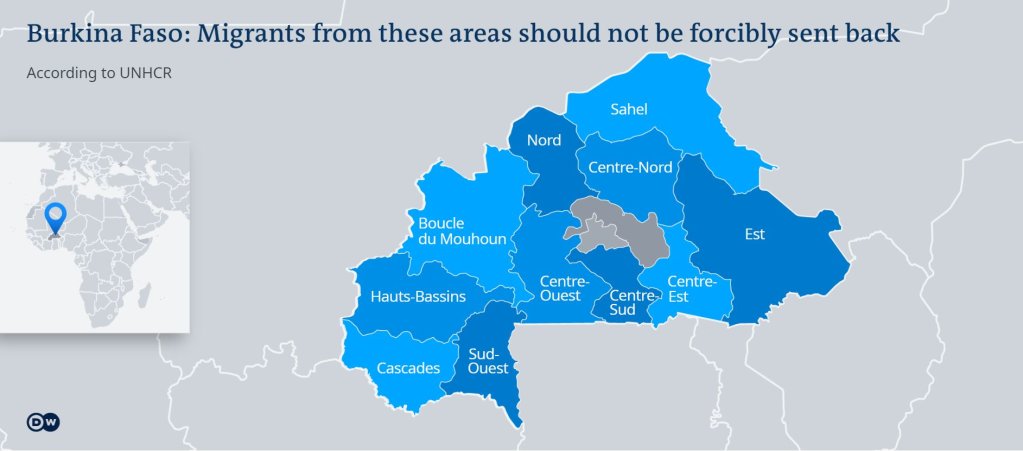
Previous guidance published in 2021 said migrants from the Centre-Ouest, Centre-Sud and Sud-Ouest regions could be returned to Burkina Faso. This new guidance overrides that. Now, anyone from those three regions or Boucle du Mouhoun, Cascades, Centre-Est, Centre-Nord, Est, Hauts-Bassins, Nord or Sahel should be able to receive asylum protection.
Extremist groups have caused conflict in the country for the past eight years, but violence has exploded recently – in 2022, the country experienced two coup attempts in less than nine months.
Over two million people have been internally displaced due to violence in Burkina Faso, a 7,000% increase from 2018, the UN said. The situation marks "one of the worst internal displacement crises on the African continent," Elizabeth Tan, UNHCR director of international protection, said while announcing the new guidance in Geneva on Friday.
Official Burkina Faso authorities only control an estimated 60% of territory in the country. The remaining areas are held by extremist groups, which are involved in 90% of violent attacks against civilians, according to the UN.
Last week’s coup in Niger – which borders Burkina Faso to the east and hosts around 300,000 of the country’s refugees – is unlikely to help to stabilize the Sahel region, which consists of Burkina Faso, Chad, Mali, Mauritania and Niger.
Guidance to Ghana
The guidance comes a few weeks after Ghana was accused of forcefully deporting over 500 people back to Burkina Faso in early July. Online videos appear to capture the deportation effort, although the Ghanaian government has denied it.
The UNHCR urged Ghana to halt the expulsions in response to the reports.
Thousands of schools closed
Burkina Faso is not safe for children in many areas, the UN said. Kids across the country are forcibly recruited by armed groups or to work as child laborers, child marriage is prevalent and up to 82% of girls are exposed to gender-based violence or mistreatment.
In November 2021, around 3,000 schools had been closed due to the violence across the country. By late March of this year, that number had more than doubled to 6,334.
On top of a lack of education, forced labor and other forms of violence, millions of people across the country are food insecure, with many living in areas without access to humanitarian assistance. Nearly 400,000 children are acutely malnourished, and nearly 100,000 are severely acutely malnourished.