
Reports have been spreading of migrant children being taken from their parents by state child protection authorities in Europe. But the dramatic scenes in social media videos rarely tell the whole story.
Parents have a right and a duty to care for their own children. But what happens when they fail, or when state authorities decide they need to intervene? In recent months, a wave of videos and media reports showing authorities in countries such as Sweden, Norway and Germany, forcibly taking children from immigrant families, has provoked outrage on social media.
Like a lot of social media content these videos are not always accurate. For example, on the Bangladeshi Facebook channel Frontier Daily, one video shows uniformed, armed German police taking a screaming child from an apartment, with adults crying and protesting. Martin Heising, a German lawyer involved in the case, told InfoMigrants there was no truth to claims that the boy had been removed after it was discovered that his parents had told him homosexuality was forbidden.
International tensions
Another case, which has made headlines in India and Germany, involves a two-year-old Indian girl Ariha Shah, who was removed from her parents’ care in Berlin in 2021. Just seven months old at the time, Ariha Shah was said to have suffered an injury as a result of an accident that happened while her grandmother was visiting.
The injury prompted authorities to place her in the custody of the Youth Welfare Office, or 'Jugendamt'. Though an investigation into alleged sexual assault against the parents was dropped without charges, Ariha Shah remains in state care.
The subject of removals of migrant children in European countries was even made into a Bollywood movie this year. 'Mrs Chatterjee vs Norway' was inspired by the real story of an Indian family whose two children were taken by Norwegian child protection services in 2011 because their mother was said to have been feeding them with her hands and because the family was sharing a bed.
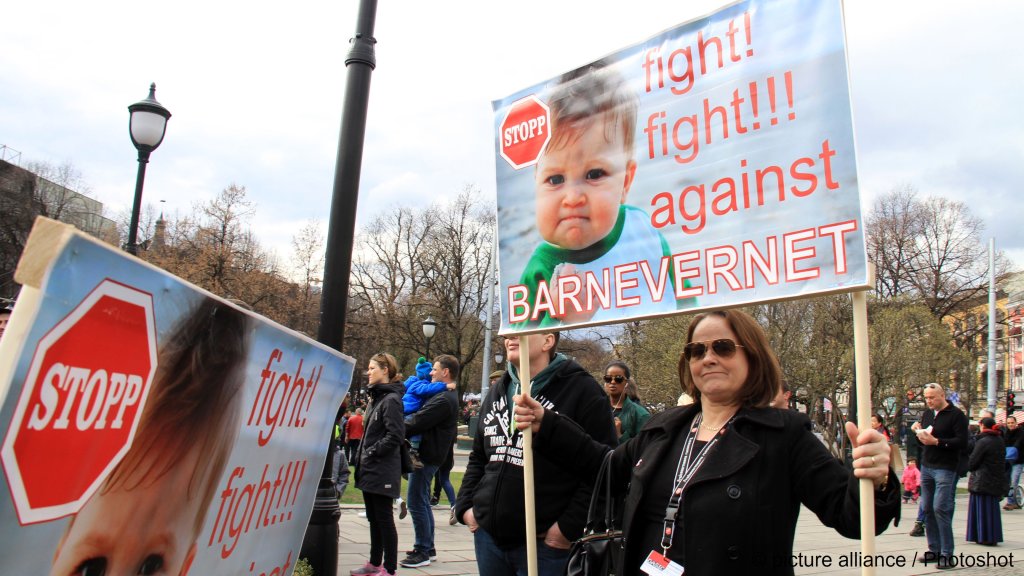
The film does not reflect the reality of the situation, according to the Norwegian ambassador to India. Yet cases like these have highlighted what some say is 'cultural racism' by European authorities who are not allowing immigrant parents to raise their children according to their own religion or culture. Some parents have even called these removals 'state kidnapping'.
Mistakes are made
In Germany, child protection services has the right to take a child out of any family if they consider that the child is in danger. Parents can’t prevent them from entering the home to remove the children, but they do have a right to go to court and claim that the authorities’ decision to take the child was wrong, says Heising.
Very often, mistakes are made, according to Heising. By the time this is decided by the court, however, the family has already suffered damage, regardless of culture or migration status.
"I don’t think that the problem we face here in Germany is a problem which is related only to foreigners."
However, going to court over the removal of a child can be more difficult for migrant families, as there are judges who have little understanding of their cultural background, Heising says. In the case of refugee families from Syria, many are already traumatized and some have been tortured by state authorities in the past. For them in particular, the intervention of police can be extremely stressful.
Cultural problems
What concerns Heising most is a lack of concern for the religion and culture of the children who are placed into state care.
"One of the problems I see (here) when it comes to Muslims, for example, is if children are taken away from the family, very often they go to non-Muslim (foster) families and there is this culture clash."
It’s not only Muslims who are affected. The parents of Ariha Sha, who are Jains, have complained that their daughter is being forced to eat meat and losing her culture, religion and identity.
"Requests that her Jain heritage is preserved as far as possible are rejected by [the Jugendamt] saying that this is our, her parents’ heritage, and not hers," they wrote in a petition to German Foreign Minister Annalena Baerbock.
Heising warns that reports about cases of child removals should not be taken at face value. "Astonished" at how quickly people have responded to rumors and social media videos without knowing the background, he expressed doubts about the footage of German police taking away a young boy, shared recently on Facebook.
"What we saw in this video is not usual. Police do not usually go into a house and take a child out like this."
Whether this was an extreme case, or parts were edited out to increase the video's dramatic effect, it suggests there is a bigger picture to consider.