
Three boats, presumed to have been on course to Italy, sank off the coast of Tunisia, killing at least three people, while at least 12 migrants remain missing. Tunisia has recently emerged as the North African country with the highest number of people departing for Italy.
Three people died and at least 12 African migrants were reported as missing after three boats sank off Tunisia, news agency Reuters reported yesterday (22 June).
A reported 152 people meanwhile were rescued off the southern city of Sfax, a major port town in east-central Tunisia located on the northern shore of the Gulf of Gabes, according to information from Reuters.
The boat was reported to have been on course for Italy.
In the first four months of 2023, an estimated 40,000 people arrived in Italy through the central Mediterranean route, according to Italian government data. In response, Italy declared a state of emergency in April, allowing the government to release additional funds to manage the flow of arrivals into the country.
More people leaving from Tunisia for Europe
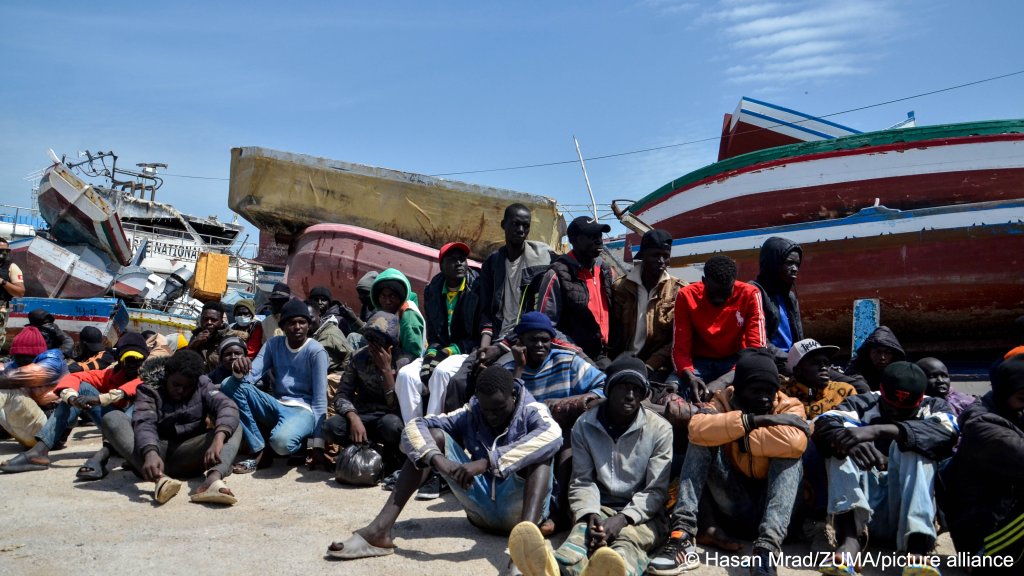
Many of the more than 600 migrants who have died or gone missing in the central Mediterranean since the beginning of this year had set sail from the Tunisian coast, according to data from the United Nations High Commissioner for Refugees (UNHCR).
Since the end of 2022, Tunisia has emerged as the leading North African country for people headng to Italy on irregular routes. Tunisia has even outpaced Libya as a main point-of-departure for crossing the central Mediterranean into Europe.
"Since 2020, the number of people trying to get from Tunisia to Italy has risen constantly," Sarah Doyel, project manager at the Mixed Migration Center in Tunisia, told the migration think-tank Mediendienst Integration.
Migration experts say that the economic crisis in Tunisia as well as racist attacks against immigrants already in the country are contributing to the rising number of people attempting to cross over to Europe.
Following the 2011 revolution in the North African country, Tunisia has been grappling with an increasingly sluggish economy. According to the World Bank, the country's economy stagnated between 2011 and 2019, with an average gross domestic product (GDP) growth of only 1.7%.
Deals with the European Union
Earlier this month, the EU proposed a migration deal with Tunisia to avert the country's economic collapse.
European Commission President Ursula von der Leyen suggested a cash injection of €900 million ($971 million) in an economic aid package for Tunisia as well as another €150 million in immediate budget assistance as well as a further €105 million for border management and anti-smuggling activities.
Rights organizations, however, have criticized the deal as a veiled attempt at more restrictive border policies.
"The EU has already been spending millions of euros supporting — as they call it — 'migration management,' which is essentially migration control and border control in Tunisia," said Lauren Seibert, a researcher at Human Rights Watch (HRW).
Tunisia also hosts immigrants
The Vienna-based International Center for Migration Policy Development (ICMPD), comprised of more than 18 member states, estimates that around 90% of the 50,000 immigrants who live in Tunisia hail from other African countries.
But a 2021 ICMPD survey showed that only a third of the immigrants from African countries wanted to stay in Tunisia.
Last February, Tunisian President Kais Saied’s made statements suggesting that the arrival of sub-Saharan migrants was part of a plot to "change the composition of the demographic landscape in Tunisia" and to weaken the country's Arab Islamic identity. Saied was then heavily criticized for echoing unfounded ideas from the so-called "great replacement theory," which is being promoted by far-right groups in Europe and Western countries.
The "great replacement theory" states that welcoming immigration policies — particularly those impacting non-white immigrants — are part of a covert plot designed to undermine or "replace" the existing political power and culture of white people living in Western countries. It has widely been debunked.
Human Rights Watch (HRW) has documented a surge in violent assaults, arbitrary evictions by landlord and job terminations experienced by Black African migrants following Saied's speech.
Tunisia denied allegations of racism and announced a set of migrant protection measures, which HRW slammed as insufficient.
"After fanning the flames of anti-immigrant violence, President Saied now offers only a spoonful of water to contain them," said Salsabil Chellali, HRW's Tunisia Director.
The deadliest migration route
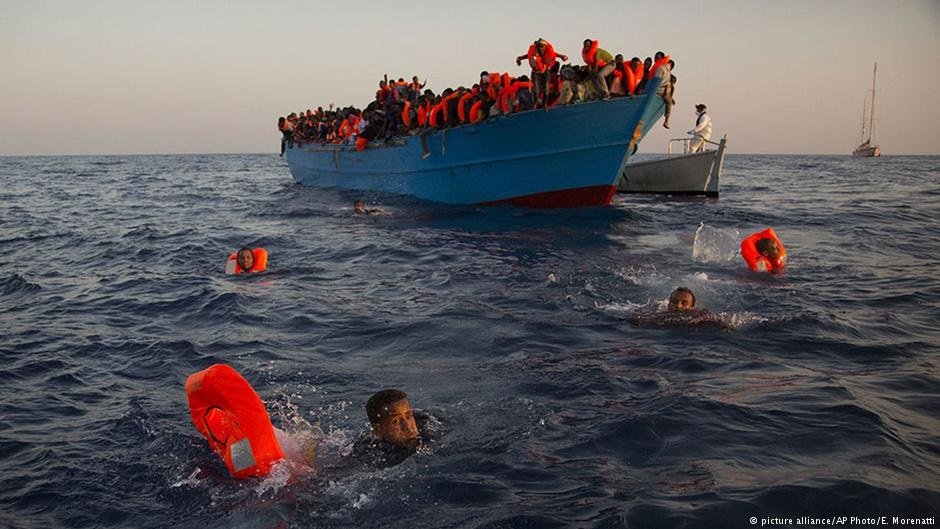
The Central Mediterranean is the deadliest known migration route in the world. According to the International Organization for Migration's (IOM) Missing Migrants Project, more than 17,000 deaths and disappearances have been recorded along this sea route in the past 20 years.
The days-long journey across the Mediterranean Sea is often made in overloaded inflatable or rickety boats that are not sturdy enough to withstand the tides and currents of the open sea.
Complicating search-and-rescue efforts are gaps in capacity and responsibility, as well as restrictions on NGOs who attempt to coordinate their own rescue efforts.
Read more: Another Mediterranean migrant rescue ship detained in Italy
Specific to Tunisia, the ICMPD told Mediendienst Integration that smuggler networks are smaller and less organized groups there, who use "improvised means" -- such as old wooden boats or cheap metal boats -- to set sail for Europe across the Mediterranean.
The IOM reports that there is also strong evidence of "invisible" shipwrecks in the Mediterranean. These invisible boats refer to boats that disappear with no survivors at all and thus, they go entirely unrecorded.