
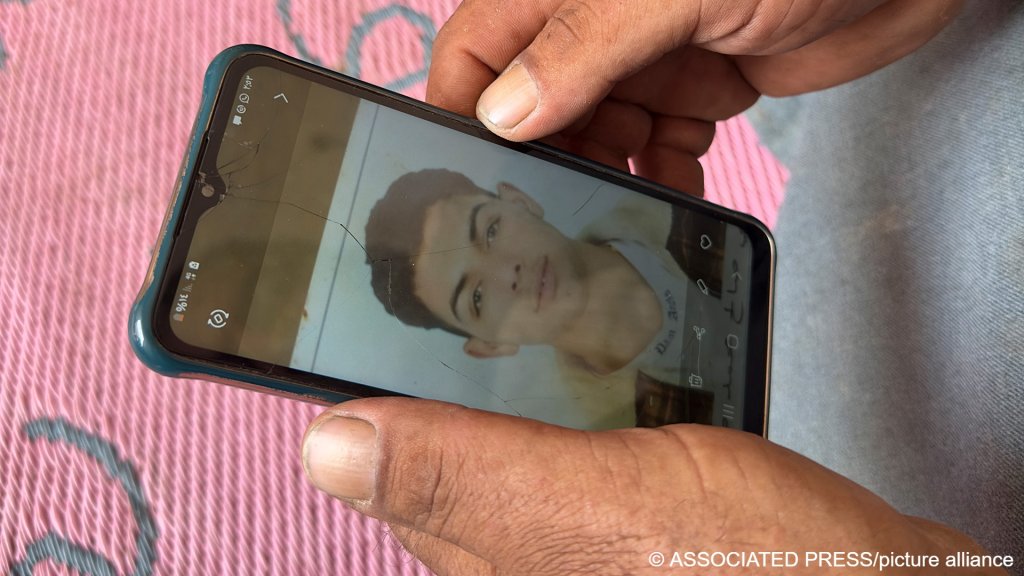
The relatives of those missing since the shipwreck in Greece on June 14 face an agonizing wait for information about their loved ones. In the Egyptian village of Ibrash, the parents of one young man have spoken of their grief.
For the past week, Yahia Saleh's family has been hoping for news of their son, desperate to know if he is among the survivors, the dead, or still missing after the tragic shipwreck off Pylos in Greece.
"I want my son, I want him alive or dead," Saleh’s mother Sabah Abd Rabu Hussein said in tears, speaking with the Associated Press (AP) news agency on Sunday.
She last heard from her 18-year-old son two weeks ago, when he said he was planning to get on a boat from Libya to Europe.
"I had begged him not to go," she said, "but he became fed up with our difficult [living] conditions."
Saleh left home in the Nile Delta less than a month ago without telling his family his plans. They now know that he boarded the fishing trawler that sailed from the town of Tobruk in eastern Libya on June 9, heading for Italy. Five days later the boat sank off Greece in one of the deepest parts of the Mediterranean Sea.
Of the hundreds of people on board, only 104 survived. As of Monday, the Greek authorities had retrieved 81 bodies, leaving several hundred people, including Saleh, unaccounted for.
'The village is wounded'
Yahia Saleh was the second of four children born to a family of farmers in Ibrash, in the province of Sharqia.
Many young men and teenagers like him from the region have made the journey to Libya, hoping to cross the Mediterranean to Europe. Five villagers who spoke to AP on condition of anonymity said some of those who left managed to reach Italy, but many others were detained and returned.
After last week’s shipwreck Greek authorities arrested nine Egyptian men and charged them with people smuggling and participating in a criminal enterprise.
Among the dozens of Egyptians on the trawler there were as many as 35 from Saleh's village, most of them minors or single men in their early 20s. According to relatives, only six are known to have survived the shipwreck.
"The village is wounded," one villager, Sameh el-Gamal, told AP. "It's a catastrophe. Each family has a funeral."
On Saturday, the Egyptian embassy in Athens shared a list of 43 Egyptians, including minors, who it said had survived. The list included migrants from Cairo and other Nile Delta provinces.
Saleh's parents tried for six months to talk him out of his plans to make the trip. But he had become more determined as his family's living conditions worsened. He helped his father cultivate their small farm, and sometimes worked as a day laborer, earning about €55 a month, his mother said.
Like other villagers who had traveled to Europe via Libya over the past few years Saleh wanted to be able to send money back home, his father, Mohammed Saleh, said.
Extortion tragedy in Libya
When he left in mid-May, Saleh’s mother thought he was going to spend the evening with his friends.
"He kissed my forehead as if he knew that it would be the last time he would see me," she recalled.
They found out the next day that he had traveled to Libya with his cousin and four other men. He had borrowed around €45 from a villager to pay for the trip. The group traveled to Alexandria and then to the coastal town of Salloum on the border with Libya.
Saleh’s father and other family members frantically contacted other Egyptians living in Libya who connected them with smugglers working between Egypt and Libya, according to AP.
"I begged them to get my son back," he told the news agency. But the smugglers reportedly refused his offer to pay them up to 50,000 Egyptian pounds (around €1,450) to return his son.
"They told me, 'He has been warehoused, waiting to sail' and asked me to pay the bill," he said.
Eventually, the young man’s father gave in and paid the equivalent of more than €4,000, most of which he borrowed, fearing that if he didn't, the smugglers may torture or kill him.
Are looking for a family member from the Pylos tragedy?
If you are in Greece, please contact
Hellenic Red Cross
E-mail: tracingstaff@redcross.gr
Tel.: +30 210 523 0043 (Monday to Friday : 08.00 -14.00)
The International Committee of the Red Cross in Athens
E-mail: ath_tracing@icrc.org
Tel.: +30 210 825 9069 (Monday to Friday : 09.00 -17.30)
If you are in Egypt, please contact
The International Committee of the Red Cross in Cairo
Tracing Department
E-mail: cai_tracing_services@icrc.org ; cai_tracing@icrc.org
Tel.: +20 22 528 1548 ; +20 22 528 1540 ; +20 22 528 1541 ; +20 22 528 1542 ; +20 22 528 1566
Adapted from AP