
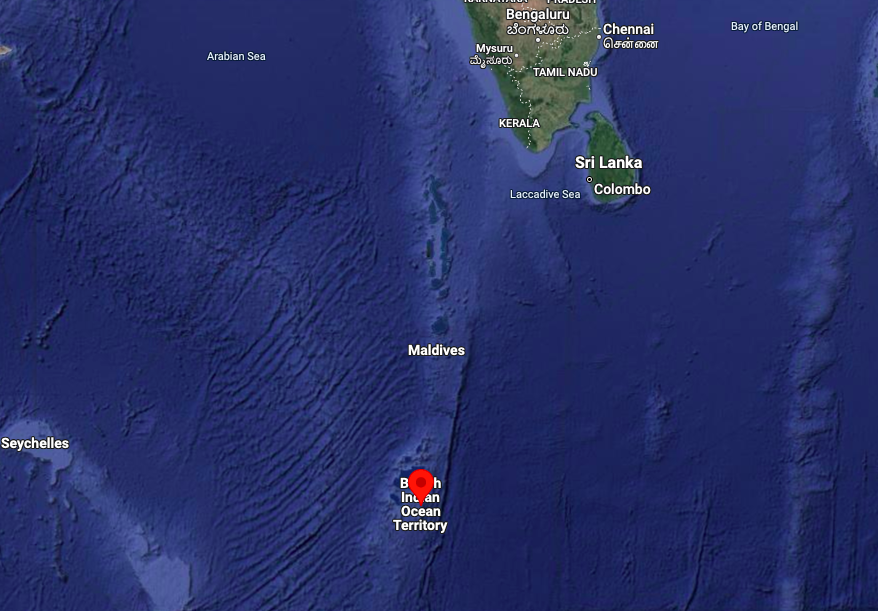
For 20 months, a group of migrants have been stranded on the tiny British territory Diego Garcia in the Indian Ocean after they were rescued from an unseaworthy fishing boat. Those that remain face increasingly difficult conditions and serious health issues.
Currently, at least 60 Tamils remain on the island, awaiting decisions on their asylum claims or appealing earlier rulings which are processed in the UK.
InfoMigrants has reported previously about the group of migrants who remain stranded on the island of Diego Garcia part of the British Indian Ocean Territory (BIOT). The last time was in March 2023 when two of the group were granted third country asylum by Britain, while staying in a military hospital.
But their story starts longer ago than that. The first boat carrying some of the Tamil asylum seekers, including alleged torture victims, arrived on the island in October 2021 when British forces rescued 89 men, women and children that had set sail from India in a vessel that was foundering near the island. Some have said the group have links with the former Tamil Tiger rebels in Sri Lanka, who were defeated in the civil war that ended in 2009. They claim they have since faced persecution because of those alleged links and some allege they were victims of torture or sexual assault in Sri Lanka.
The initial boat was significantly larger than the subsequent vessels, which reportedly were wooden fishing boats. In April and June of last year, two further boats carrying a combined total of 84 asylum seekers, also reached the territory.
Permitted to leave
A further two boats arrived in August and October 2022. Despite running into difficulties, both unseaworthy fishing boats were later permitted to leave the territory without basic safety equipment, putting passengers, including several young children, at "grave risk," according to lawyers representing the asylum seekers.
One of those boats, carrying 46 people, spent three weeks at sea before reaching the French territory of Réunion, while another carrying 35 people, including an 18-month-old child, was escorted back to Diego Garcia after its engine failed.
When more boats arrived on Diego Garcia last year, lawyers for the migrants estimated that as many as 150 migrants were being housed in the camp on the island. Over the past 20 months the conditions on the island have continued to deteriorate, with the migrants facing increasingly serious physical and mental health issues, some have since returned to Sri Lanka and a number of migrants are now receiving medical treatment in Rwanda.
No safety provisions for women
"I was initially happy, thinking: 'I survived, I am getting food, and I am away from torture,'" one of the migrants, named Lakshani told the BBC last month.
However, she said that the tropical island refuge soon "turned out to be a hell".
The conditions do not appear to provide for vulnerable migrants or to protect women. Lakshani says she faced sexual violence within the camp in October last year by a man who was housed in the same tent as her.
"I started to scream, but no-one came to help," she told reporters.
When she tried to make an official complaint, she says she was told it was difficult to gather evidence as she had washed her clothes. She says she was then forced to continue staying in the same tent as her alleged attacker for almost a week until authorities finally responded to her request to have him moved.
Neither the UK government nor the BIOT administration responded to the BBC's requests for comment about this allegation.
Suicide attempts
The BBC reported that Lakshani and others told the UK broadcaster that they themselves or others they knew had attempted suicide or self-harmed in response to the dire conditions they were living in.
Lawyers told the BBC that they are aware of at least 12 suicide attempts and allegations of at least two sexual assaults within the camp.
"We are mentally and physically exhausted… We are living a lifeless life. I feel like I am living like a dead man," said Vithusan, a migrant being housed in the camp, told the BBC.
Another man, Aadhavan, told reporters that after his initial claim for protection was rejected, he "lost all hope" and decided to take his own life.
"I didn't want to live here like a caged animal forever," he added.
After telling another migrant in the camp of his suicide attempt, who alerted the camp authorities, he was provided with medical treatment.
The deteriorating mental health of the migrants is not only linked to the conditions they are made to live in but also to the lack of clarity regarding their status. Lakshani told the BBC that her own attempt to take her life had been triggered when an officer at the camp told her she would be sent back to Sri Lanka, where she was allegedly subject to sexual violence and torture at the hands of soldiers in 2021.
G4S - the private security company brought in to guard the migrant camp - has stated that its officers have treated migrants on the island with "dignity and respect at all times".
A UK government spokesperson told the BBC that the "welfare and safety" of migrants on BIOT was "paramount" and that "all allegations of mistreatment are taken seriously and fully investigated", noting that the BIOT administration was providing "extensive medical support."
Also read: Two Sri Lankans granted third-country asylum by UK
Hunger strikes and limited communication
Lawyers say that there have also been hunger strikes on the island, some have involved children.
In response to a hunger strike earlier this year, lawyers told the BBC the BIOT commissioner confiscated migrants' phones, stopped access to the communal telephone and withdrew medical treatment "unless the individuals were willing to sign a form disclaiming certain liabilities of the BIOT administration".
The BIOT administration has dismissed this allegation in court documents, saying that in response to one hunger strike, sharp objects were removed from the camp and other measures taken to prevent self-harm.
Speaking to the BBC, lawyers representing the migrants said although basic education became available about a year ago, classes have at times had to be held outside because of a rat infestation.
In the meantime, some migrants have returned home, after giving up their claim or having it rejected. While others set sail for the Indian Ocean island of Reunion, a French territory, hoping to claim asylum there.
Despite being party to conventions protecting refugees, court papers say these international legal provisions do not apply to BIOT, as it is an area "constitutionally distinct and separate from the UK."
Also read: UK plans to deport Tamil refugees on British territory in Rwanda-style plan
Judicial Review
Tessa Gregory, a lawyer at Leigh Day, told the BBC that her firm has launched a judicial review on behalf of a number of asylum seekers on Diego Garcia, challenging the "lawfulness" of the UK process - which she describes as "fundamentally unfair."
Speaking to the BBC she explained that decisions to return several migrants to Sri Lanka were made based on rushed initial interviews, and that the later extensive interviews were hampered by translation errors. She added that others have been left "in limbo" as the UK government has not yet identified a suitable safe third country.
The UK government has since claimed that the BIOT administration was "considering migrants' protection claims under BIOT law and in line with international legal obligations."
Following reports of the "deteriorating health situation" on Diego Garcia, the UK office of the United Nations refugee agency (UNHCR) told the BBC it had requested access from UK authorities, although this had not yet been granted.
Lost hope
Emilie McDonnell, UK advocacy and communications co-ordinator at Human Rights Watch, stated that the government "should consider any and all options to ensure the welfare of these asylum seekers who are on British-controlled territory and therefore should be protected by the British government."
However, according to lawyers, the UK has said it will not take in any of the Diego Garcia asylum seekers whose claims are approved. This policy is in keeping with the UK's hard line 'stop the boats' approach towards asylum seekers.
Three of the Tamil migrants who were previously being held on Diego Garcia are currently in Rwanda receiving medical treatment following self-harm and suicide attempts. However, their transfer is not part of the UK-Rwanda deal to send asylum seekers to the country.
Four asylum seekers on Diego Garcia have since had their claims to be sent to a "safe third country" approved. However, reportedly conditions continue to worsen and the limbo the migrants feel they have been left in drags on; this prompted one asylum seeker to tell the BBC that everyone seemed to have "lost their hope."